

Email Phishing vs Spear Phishing: Key Differences Explained
Most people think they'd spot a scam email immediately. The reality is different. Phishing attacks have evolved well beyond the days of poorly written messages from fake princes, and the crypto space is a prime target. If you hold digital assets, especially if you're moving toward self-custody, understanding the difference between email phishing vs spear phishing is no longer optional. It's a core part of protecting your wealth.
Standard phishing casts a wide net, hitting thousands of inboxes with the same generic bait. Spear phishing is surgical, researched, personalized, and aimed directly at you. For cryptocurrency holders, a single successful spear phishing attack can mean handing over seed phrases or login credentials to an attacker who already knows which exchange you use and what wallet you own. That's the kind of threat we take seriously at FinTech Dynasty.
This article breaks down how each attack works, what separates them in terms of targeting and sophistication, and what you can do to defend yourself. Whether you're just getting started with crypto security or tightening up an existing setup, recognizing these threats is step one. Knowing how to respond to them is what keeps your assets safe.
Why this distinction matters for crypto holders
Cryptocurrency operates differently from traditional finance. There is no bank to call, no fraud department to reverse a transaction, and no insurance policy to recover stolen funds. When an attacker gains access to your wallet or convinces you to reveal your seed phrase, the loss is final. That's exactly why understanding the full picture of email phishing vs spear phishing matters more in the crypto space than in almost any other context. Both attack types land in your inbox, but they carry very different levels of risk depending on how well the attacker has targeted you specifically.
You are a known target, not a random one
Most people assume they're invisible online, that attackers pick victims at random. That assumption is wrong, especially for crypto holders. Data breaches from exchanges, leaked forum posts, and public blockchain activity can reveal more about you than you realize. If you've ever signed up for a crypto platform, participated in a token sale, or posted in a public Discord server, your name, email, and possibly your wallet address may already be in someone's database.
Attackers don't need to guess that you hold crypto. In many cases, they already know.
This is why the gap between general phishing and spear phishing is so significant for anyone in the crypto space. A general phishing email might claim to be from a bank you don't use, and you'll delete it immediately. A spear phishing email might reference the exact hardware wallet you bought three months ago, use your real name, and come from an address that looks nearly identical to the manufacturer's support team. That second scenario is far harder to catch.
The irreversible nature of crypto losses
Traditional fraud victims often have some path to recovery. Credit card companies issue chargebacks. Banks can freeze accounts and reverse wire transfers under certain conditions. Crypto transactions are immutable by design, meaning once funds leave your wallet to an attacker's address, they cannot be recalled. No authority can force a blockchain to reverse a confirmed transaction.
This makes social engineering attacks, including phishing of any kind, far more dangerous in the crypto context than in everyday banking. An attacker doesn't need to break your encryption or crack your hardware wallet. They just need you to hand over your seed phrase or approve a malicious transaction after believing a convincing lie. That's it. That's the entire attack.
What attackers actually want from you
Understanding what an attacker is after helps you recognize the real threat. In the crypto space, the most valuable things you hold aren't passwords or usernames. They are your seed phrase, your private keys, and your recovery information. These give complete, permanent control over your wallet with no authentication required on the attacker's end.
Phishing attacks, both broad and targeted, are built around getting you to provide or expose that information. A fake support email might ask you to "verify your wallet" by entering your seed phrase into a fraudulent site. A spear phishing campaign might impersonate a colleague, a project team, or even a wallet manufacturer's support agent to extract the same information through conversation over several messages. The method differs, but the goal is always the same: get your seed phrase, drain your wallet, disappear.
Knowing the difference between these two attack styles means you approach every unexpected email with the right level of skepticism, whether it's a bulk scam or a calculated, personal attempt to compromise your holdings.
What email phishing is
Email phishing is a mass-scale deception tactic where attackers send fraudulent emails to thousands or millions of recipients at once, hoping a small percentage will take the bait. The emails impersonate a trusted brand, institution, or service and push you toward a fake action, such as clicking a malicious link, logging into a spoofed site, or downloading a file that installs malware. The attacker has no idea who you are specifically. They're running a numbers game, and volume is the entire strategy.
How the attack is designed
The core mechanic behind a phishing email is urgency combined with imitation. Attackers replicate the visual design of legitimate companies, from logos and color schemes to signature lines and legal disclaimers, to make the email look credible at first glance. The message typically presents a scenario that pressures you to act immediately: your account has been suspended, a payment failed, or unauthorized activity was detected on your profile.
The goal is to make you react before you think, because a panicked response is far easier to manipulate than a considered one.
Because these campaigns target everyone without any research or selection, the messages stay generic and broad by necessity. They don't include your real name, your account details, or anything tailored to your situation. That lack of personalization is actually your first and most reliable signal that something is wrong.
What phishing emails typically look like
When evaluating email phishing vs spear phishing, one of the clearest distinctions is how a message reads on first contact. A standard phishing email usually opens with something vague like "Dear Customer" or "Hello User" rather than your actual name. The sender address often contains subtle misspellings or unfamiliar domains, such as "support@paypa1.com" instead of "support@paypal.com," and the discrepancy is easy to miss if you're reading quickly.
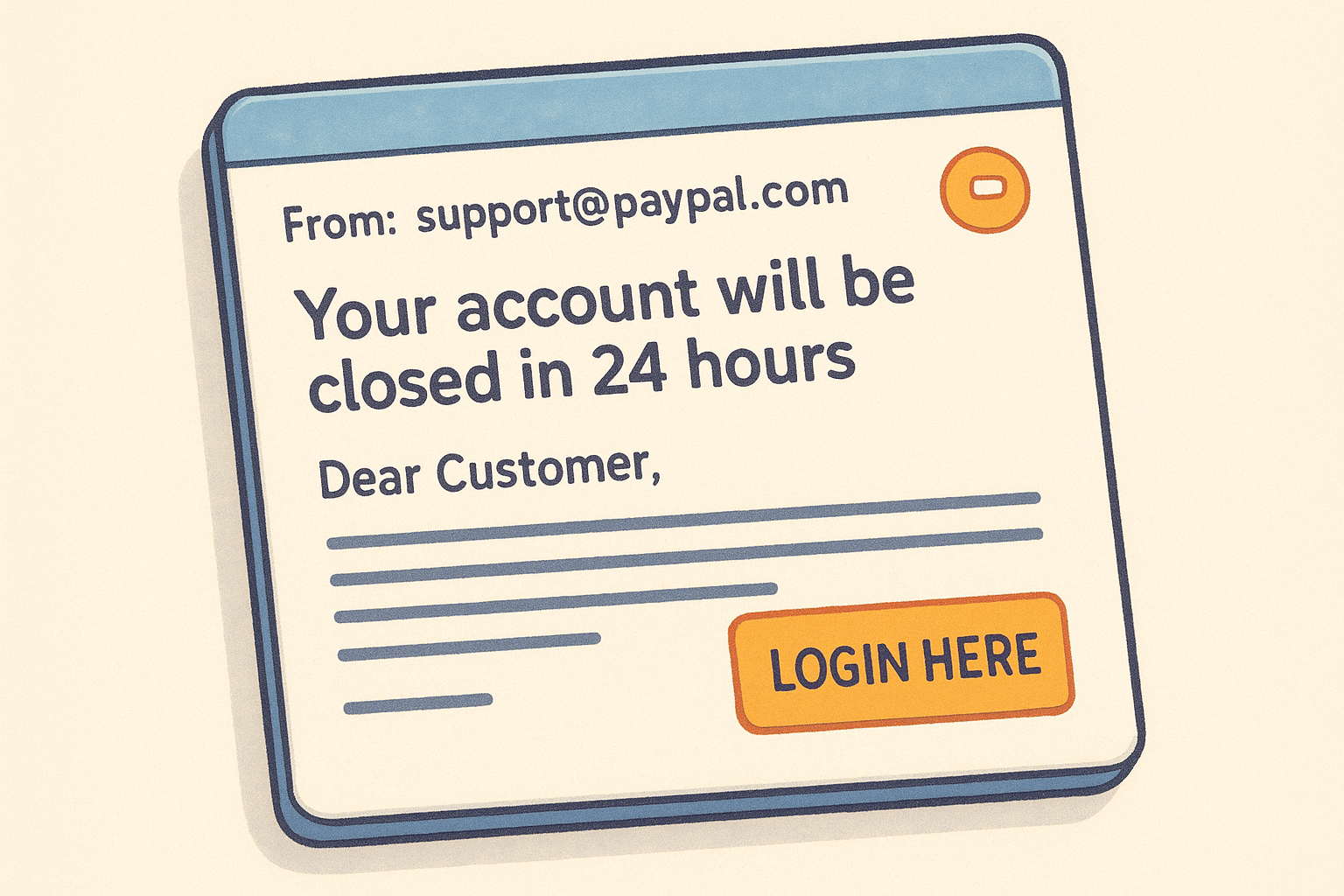
Common elements you'll find in a standard phishing email include:
- A subject line built around fear or urgency, such as "Your account will be closed in 24 hours"
- A link that looks legitimate in the visible text but redirects to a fraudulent site
- A request for login credentials, payment details, or personal information
- Grammar or phrasing that feels slightly off, though more polished attacks are increasingly common
Recognizing these patterns takes some practice, but once you know what to look for, generic phishing emails become much easier to catch before they cause any damage.
What spear phishing is
Spear phishing is a targeted, research-driven attack aimed at a specific individual or organization. Unlike mass phishing campaigns that ignore who you are, spear phishing starts with you as the subject. An attacker studies your digital footprint before writing a single word, gathering details from social media profiles, data breach databases, public forums, and even your purchase history, then uses that information to craft a message designed to look completely credible.
How attackers build a spear phishing campaign
Before sending anything, an attacker assembles a detailed profile on you. They might find your name and email through a leaked exchange database from a platform you signed up for years ago. They might also check your public social media accounts to identify which services you use, what projects interest you, or whether you've posted anything about a recent crypto purchase. LinkedIn, Twitter, and Discord are common research sources, and all of that information feeds into a message that feels personal because it genuinely reflects details from your actual life.
The more data available about you online, the more convincing a spear phishing attack can become.
Once they have enough context, attackers write a message that references real, verifiable details: your name, a specific wallet brand, a platform you've interacted with, or even a transaction you made publicly. The message might impersonate a customer support agent from a hardware wallet company or a team member from a project you follow. Every element is chosen to lower your guard and push you toward a single harmful action, whether that's clicking a link, entering credentials, or revealing your seed phrase.
What a spear phishing email looks like
When comparing email phishing vs spear phishing, the spear variant reads nothing like a bulk scam. It opens with your actual name, references something specific to your situation, and uses language that matches the tone of whoever it impersonates. The sender address is crafted carefully, often using a domain that differs from the real one by a single character or relies on a subdomain structure that looks legitimate at a quick glance.
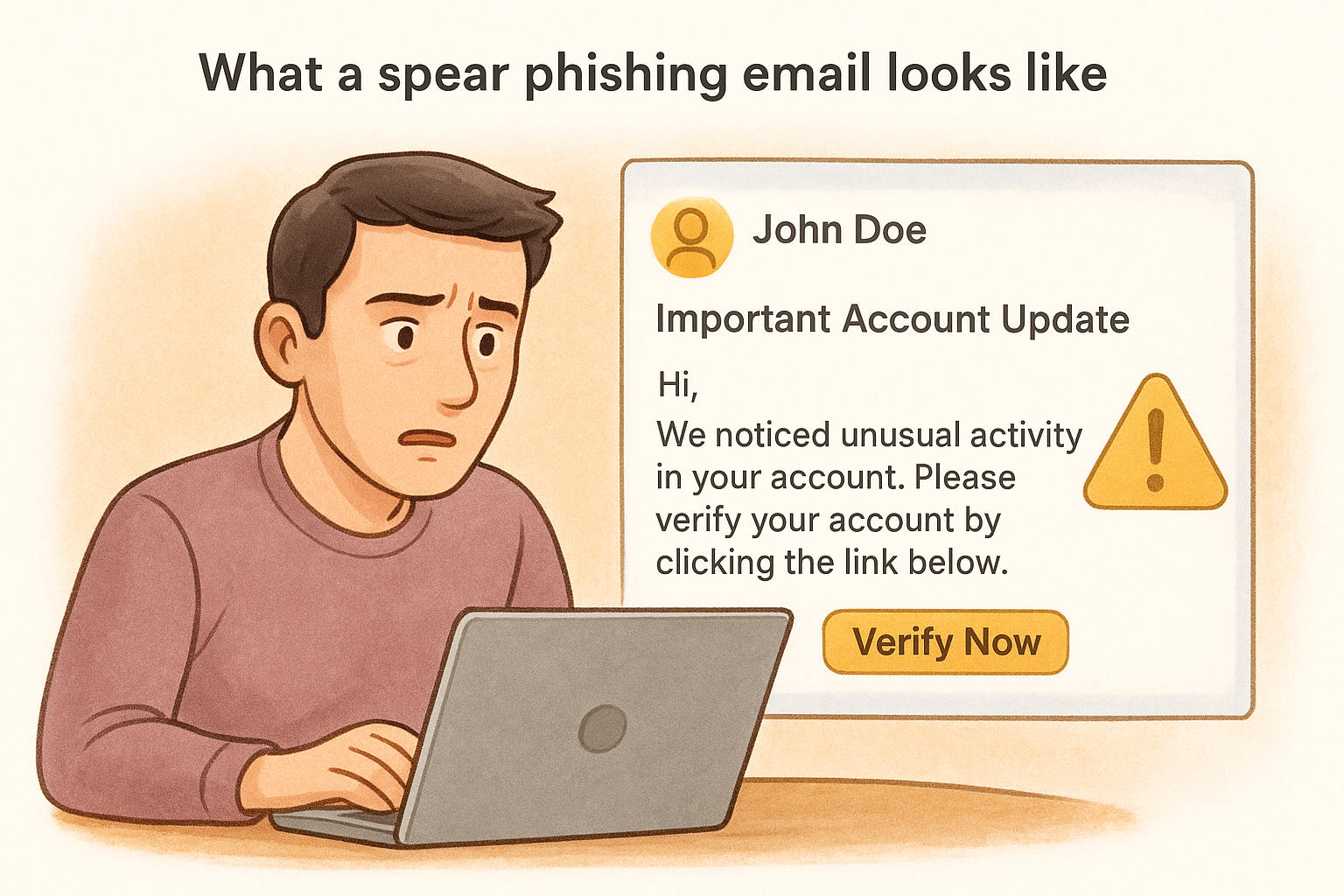
Unlike generic phishing, spear phishing emails often arrive without obvious red flags. The grammar is polished, the formatting matches the real company's branding, and the request feels reasonable given the context provided. That's what makes them genuinely dangerous, and why recognizing the setup matters as much as spotting the ask itself.
Key differences at a glance
When you put email phishing vs spear phishing side by side, the contrast becomes clear quickly. One attack type relies on volume and automation, while the other depends on patience and targeted research. Understanding where those differences actually live helps you build the right mental filter for every message that lands in your inbox.
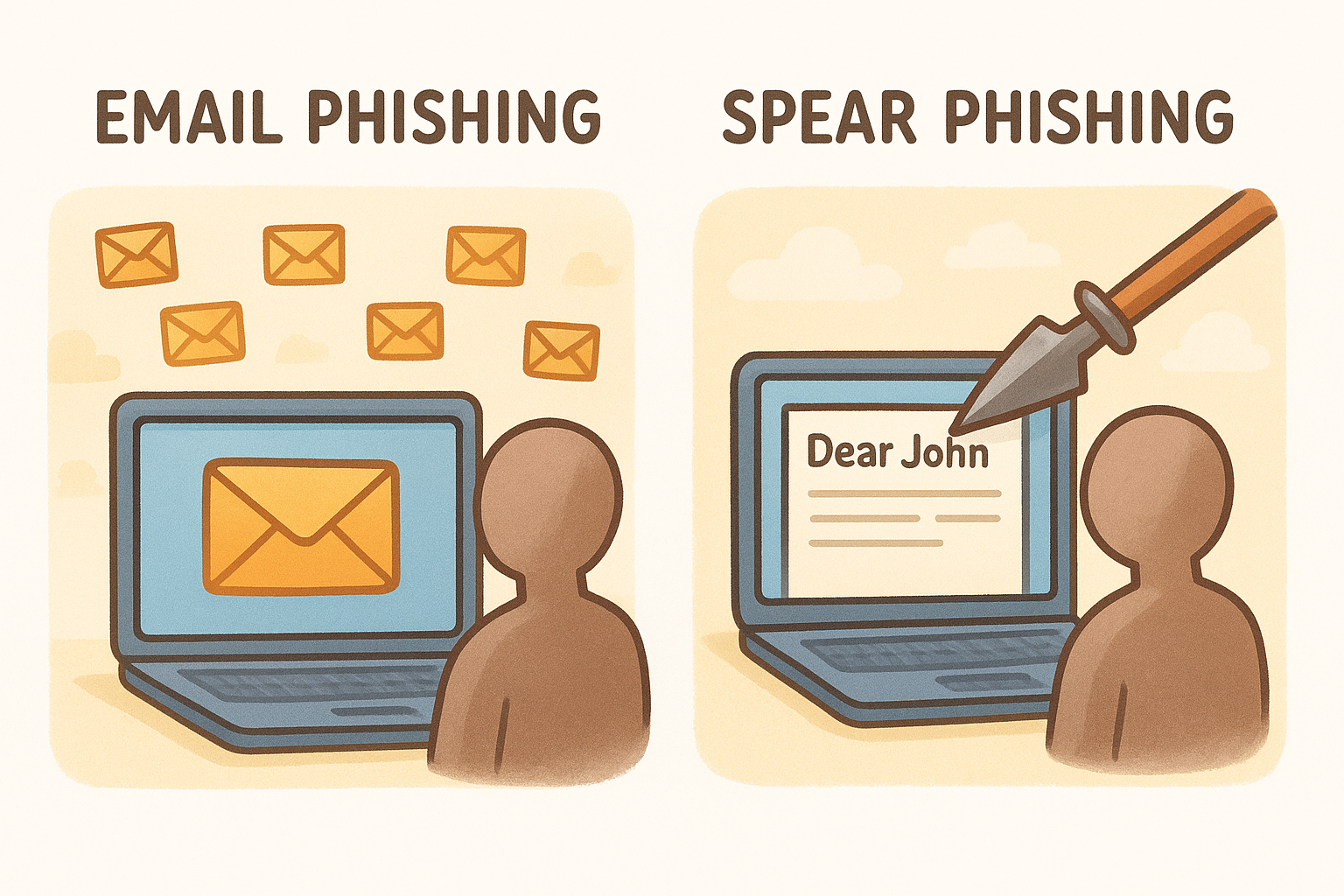
| Factor | Email Phishing | Spear Phishing |
|---|---|---|
| Targeting | Mass, undirected | Specific individual |
| Research required | None | Extensive pre-attack profiling |
| Personalization | Generic (Dear Customer) | Name, platform, and role-specific |
| Sophistication | Low to moderate | High |
| Volume per campaign | Thousands to millions | One to a small group |
| Primary goal | Broad credential harvest | High-value extraction (seed phrases, keys) |
Targeting and research
Standard phishing attacks require no knowledge of you whatsoever. The attacker purchases or scrapes a large email list, loads a generic template, and sends. You're receiving that email for the same reason thousands of other people are: your address simply exists in a database. There is no selection process and no attempt to match the message to your actual situation or your specific holdings.
Spear phishing inverts that model entirely. The attacker identifies you as a specific target before composing a single line. They pull together data from breach databases, social media profiles, public forum posts, and public blockchain activity to build a profile that shapes every word in the message. The time investment is deliberate because the potential reward from one successful attack far exceeds what any bulk campaign can return.
The research phase of a spear phishing attack is where your real exposure begins, and most people never know it's happening.
Scale vs. precision
A standard phishing campaign might reach millions of recipients within hours, relying on sheer volume to guarantee a handful of successful clicks. The attacker accepts a very low success rate because the cost of adding another recipient is essentially zero. Success is measured in aggregate, not in individual outcomes, which is why generic messaging is acceptable to the attacker even if it's obvious to you.
Spear phishing campaigns work in the opposite direction. An attacker might send a single carefully constructed email to one target, or a small handful of messages to a specific group within an organization. Every detail in that message is engineered to bypass your skepticism, which means nothing in it is accidental or generic, and that precision is exactly what makes it so much harder to catch before it's too late.
Common tactics and red flags in inboxes
Knowing how email phishing vs spear phishing campaigns actually operate in your inbox gives you a practical advantage that general awareness alone cannot. Both attack types use psychological pressure and visual deception, but they deploy those tools differently. Recognizing the specific mechanics behind each approach lets you evaluate any suspicious message more accurately, rather than relying on a gut feeling that attackers are specifically trained to override.
How standard phishing emails work against you
Standard phishing emails rely on urgency and brand imitation to push you into acting without thinking. The message usually mimics a widely used service, such as a payment platform, a crypto exchange, or a cloud storage provider, and presents a scenario that feels like it requires your immediate response. A typical tactic is the account suspension warning, where you're told your access will be terminated unless you click a link and verify your credentials within a fixed window.
The link itself is often the most dangerous element. It might display a legitimate-looking URL in the visible text but actually redirect you to a fraudulent domain with a nearly identical address. Attackers also use link shorteners or embed redirects through compromised websites to obscure the final destination. Red flags to watch for include:
- Sender addresses that use slight misspellings or substitute numbers for letters
- Generic greetings like "Dear User" or "Hello Customer"
- Mismatched URLs where the displayed text and actual link destination differ
- Requests to confirm personal details, payment information, or login credentials
- Subject lines that combine a specific time limit with a serious consequence
How spear phishing targets your specific situation
Spear phishing uses personalized detail to simulate legitimacy in ways that standard phishing never attempts. You might receive an email that opens with your actual name, references the hardware wallet brand you own, and offers a firmware update from an address that closely resembles the manufacturer's real support domain. None of that detail is coincidental. It reflects research the attacker completed before sending anything.
If an unsolicited email knows specific details about you that a random sender has no reason to know, treat that as a warning, not reassurance.
The real red flag in a spear phishing attempt is the request that follows all that personalized setup, which is almost always an ask for your seed phrase, private key, or login credentials. Legitimate companies, including hardware wallet manufacturers, will never request your seed phrase under any circumstances.
How to protect yourself and your accounts
Defending against both attack types requires consistent habits built around verification, not a one-time setup. Whether you're navigating the differences between email phishing vs spear phishing or simply trying to keep your accounts secure, the protective measures overlap in important ways: verify before you act, limit what attackers can learn about you, and never share your seed phrase regardless of how legitimate a request appears.
Verify every request before you act
The single most effective habit you can build is treating every unsolicited email as suspect until confirmed through an independent channel. If an email claims to be from a hardware wallet manufacturer and asks you to update your firmware or verify your account, go directly to the company's official website by typing the URL yourself. Never use contact information provided inside a suspicious email, including phone numbers and reply addresses, since attackers control those channels entirely.
- Check the sender's actual email address, not just the display name
- Hover over links to see the real destination URL before clicking
- Contact companies directly through their verified support pages if something feels off
- Never enter your seed phrase into any website or form, for any reason
A legitimate company will never ask for your seed phrase. If a message does, the attack is already in progress.
Reduce your attack surface online
Spear phishing depends entirely on data gathered from your public digital footprint, so limiting what's visible online directly reduces how convincing a targeted attack against you can be. Audit what you've posted publicly on social media, crypto forums, and Discord servers. Avoid mentioning which hardware wallet you own, which exchange you use, or any details about your holdings in public spaces, since that information feeds directly into a spear phishing attacker's research phase.
Using an authenticator app for two-factor authentication adds a critical layer of protection between an attacker and your accounts even if your login credentials are exposed in a breach. SMS-based codes are vulnerable to SIM-swapping attacks, so switch to an app-based method. Microsoft's guidance on multifactor authentication covers the practical differences if you want to go deeper on this.
Storing your seed phrase completely offline, written on paper or stamped in metal and kept in a secure physical location, ensures no phishing email can ever reach it directly.
Quick recap and next steps
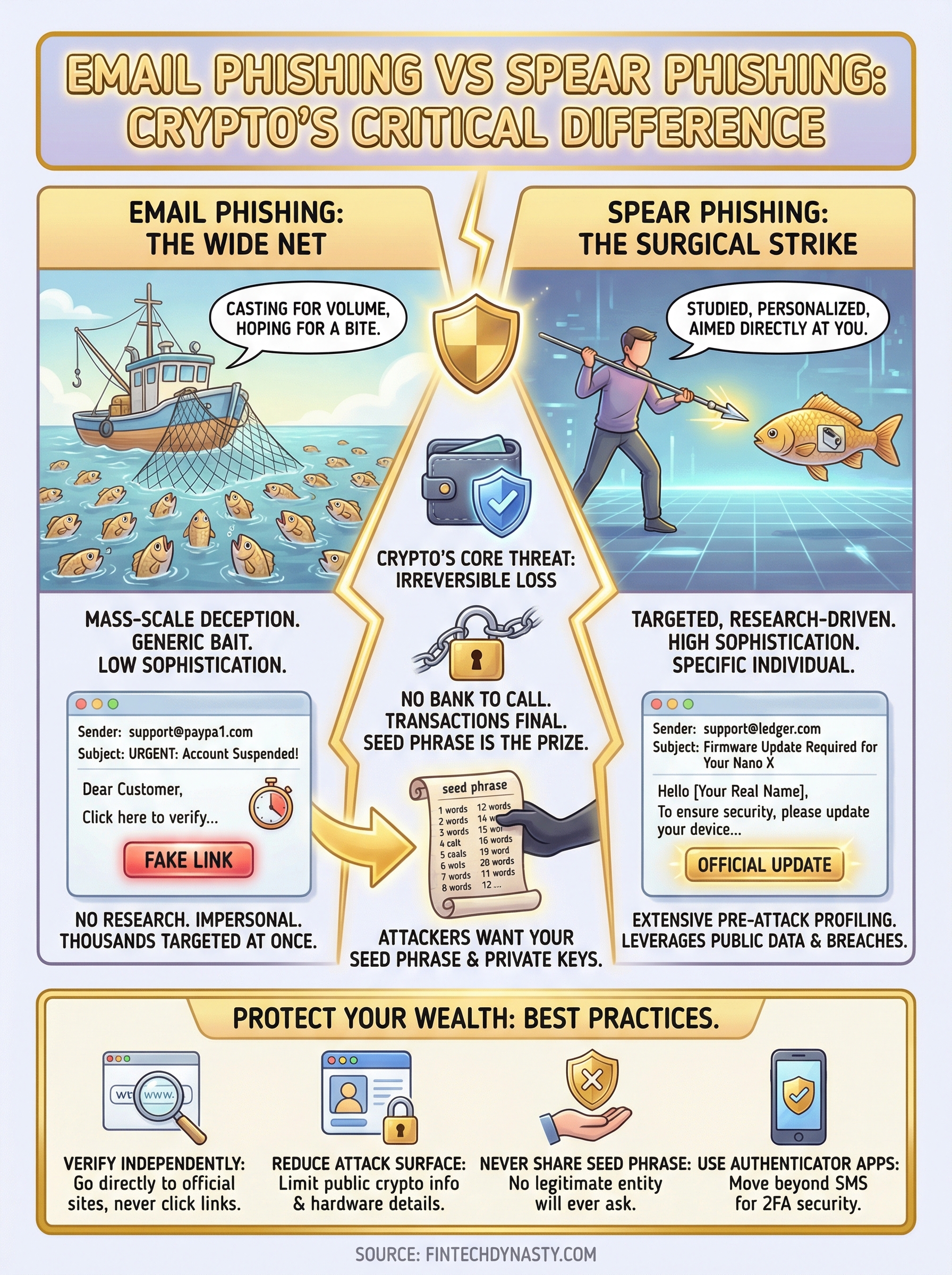
The core difference between email phishing vs spear phishing comes down to targeting. Standard phishing hits millions of inboxes with generic bait and hopes a small percentage clicks. Spear phishing starts with you specifically, uses researched personal details to manufacture trust, and aims at high-value targets like crypto holders who control their own wallets and seed phrases. Both attacks arrive through email, but spear phishing is far harder to catch because nothing about it looks accidental.
Your best defenses are consistent verification habits, a reduced public footprint, and a firm rule that no one legitimate will ever ask for your seed phrase. Apply those three principles to every message you receive, and you cut off the attacker's primary path to your assets. If you want to build a stronger foundation around crypto security and self-custody from the ground up, the FinTech Dynasty crypto education course is a practical place to start.