

What Is A Multisig Wallet? Security, Benefits, And Use Cases
A single private key is all that stands between your crypto and someone who wants to steal it. That's exactly why more holders are asking what is a multisig wallet, and whether it's the right next step for protecting their assets. The short answer: a multisig (multi-signature) wallet requires two or more private keys to authorize a transaction, removing the single point of failure that makes standard wallets vulnerable.
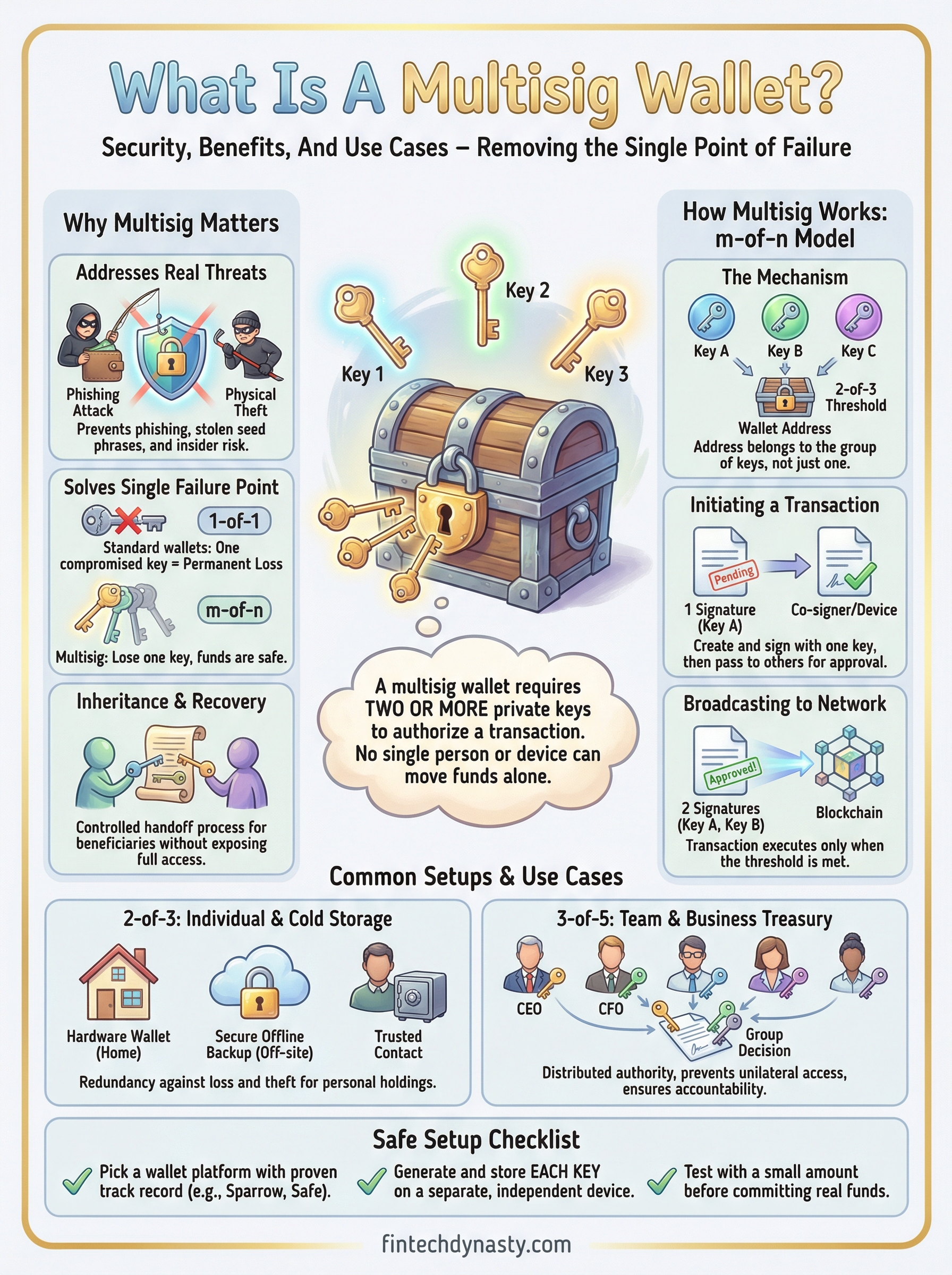
Think of it like a safe deposit box that needs multiple keys turned at once. No single person, and no single compromised device, can move your funds alone. For long-term holders and anyone managing significant value, that distinction matters. Multisig wallets address real threats: phishing attacks, stolen seed phrases, and even insider risk within teams or organizations.
At FinTech Dynasty, we focus on the practical side of crypto security, no price speculation, no hype. This guide breaks down how multisig wallets actually work, who they're built for, and where they fit alongside hardware wallets and other self-custody strategies you may already be using.
Why multisig wallets matter for self-custody
When you hold crypto on a standard wallet, one compromised private key is all it takes to lose everything. A hacker who gets your seed phrase, a thief who grabs your hardware wallet, or even a house fire that destroys your backup all lead to the same outcome: permanent loss. Self-custody gives you control, but single-key wallets replace custodial risk with a different and equally serious problem: a single catastrophic failure point that no backup strategy fully eliminates.
Understanding what is a multisig wallet changes how you think about that risk entirely. Instead of relying on one key to stay secret and intact forever, multisig spreads authorization across multiple keys, and all it takes is a threshold number of those keys to approve any transaction. Lose one key, and your funds are not gone. A thief who steals one key still cannot move your crypto. That structural shift is what makes multisig genuinely important for serious self-custody.
The real threats that single-key wallets cannot handle
Phishing attacks are the most common way crypto holders lose funds. You click a malicious link, enter your seed phrase on a fake site, and within minutes your wallet is drained. With a single-key setup, one moment of distraction is enough. Even experienced users fall for well-crafted phishing attempts because the attacks have become increasingly sophisticated and difficult to spot in real time.
Physical theft is the second major threat. If someone steals your hardware wallet and gets access to your PIN or seed phrase backup, they have full control of your funds. Many holders store their seed phrase in one location for convenience, which means a single burglary or natural disaster can result in total loss. A multisig setup distributes keys geographically and across separate devices, so no single theft can drain your wallet.
A single point of failure is not a risk you can fully hedge with backups alone. Distributing authorization across multiple keys is the only structural solution.
Why self-custody without multisig is still fragile
Self-custody is the right goal. Keeping your assets off exchanges removes counterparty risk, protects you from platform insolvencies, and gives you genuine ownership. But standard self-custody with one hardware wallet still leaves you exposed in ways that are easy to underestimate. If that device fails and your seed phrase backup is also compromised or lost, you have no fallback mechanism and no recovery path.
Multisig solves the inheritance and recovery problem too. Estate planning for crypto is notoriously difficult because handing over a single seed phrase means handing over complete control instantly. With a multisig setup, you can structure access so trusted people each hold one key but cannot act alone. That design gives you security during your lifetime and a clear, controlled handoff process for beneficiaries without exposing your full wallet access to any one person.
The organizational case for multisig
Businesses and teams that hold crypto face a different version of the same problem: trusting any single individual with full access creates both an insider threat and a single point of failure. A multisig wallet means no one person, whether a founder, CFO, or employee, can move funds unilaterally. Every significant transaction requires agreement from multiple authorized parties, which enforces accountability at the structural level.
Small teams, DAOs, and investment clubs all benefit from this approach because it removes the need for a custodian while still preventing unilateral action. Even for individual holders managing significant wealth, distributing keys across a hardware wallet, a secure geographic backup, and a separate signing device gives you organizational-grade protection on a personal scale.
How multisig wallets work step by step
Understanding what is a multisig wallet becomes clearer once you see the actual mechanics. Every multisig wallet operates on a threshold model, written as m-of-n, where "n" is the total number of keys created for that wallet and "m" is the minimum number of keys required to sign and broadcast a transaction. A 2-of-3 wallet, for example, has three keys in total but only needs any two of them to authorize a move.
The m-of-n signing model explained
When you set up a multisig wallet, the process generates multiple independent private keys rather than one. Each key is completely separate, stored on a different device or in a different location. The wallet address itself is derived from the combination of all the public keys involved, which means the address does not belong to any single key but to the group as a whole. Changing any one key without regenerating the wallet would break the signing structure entirely.
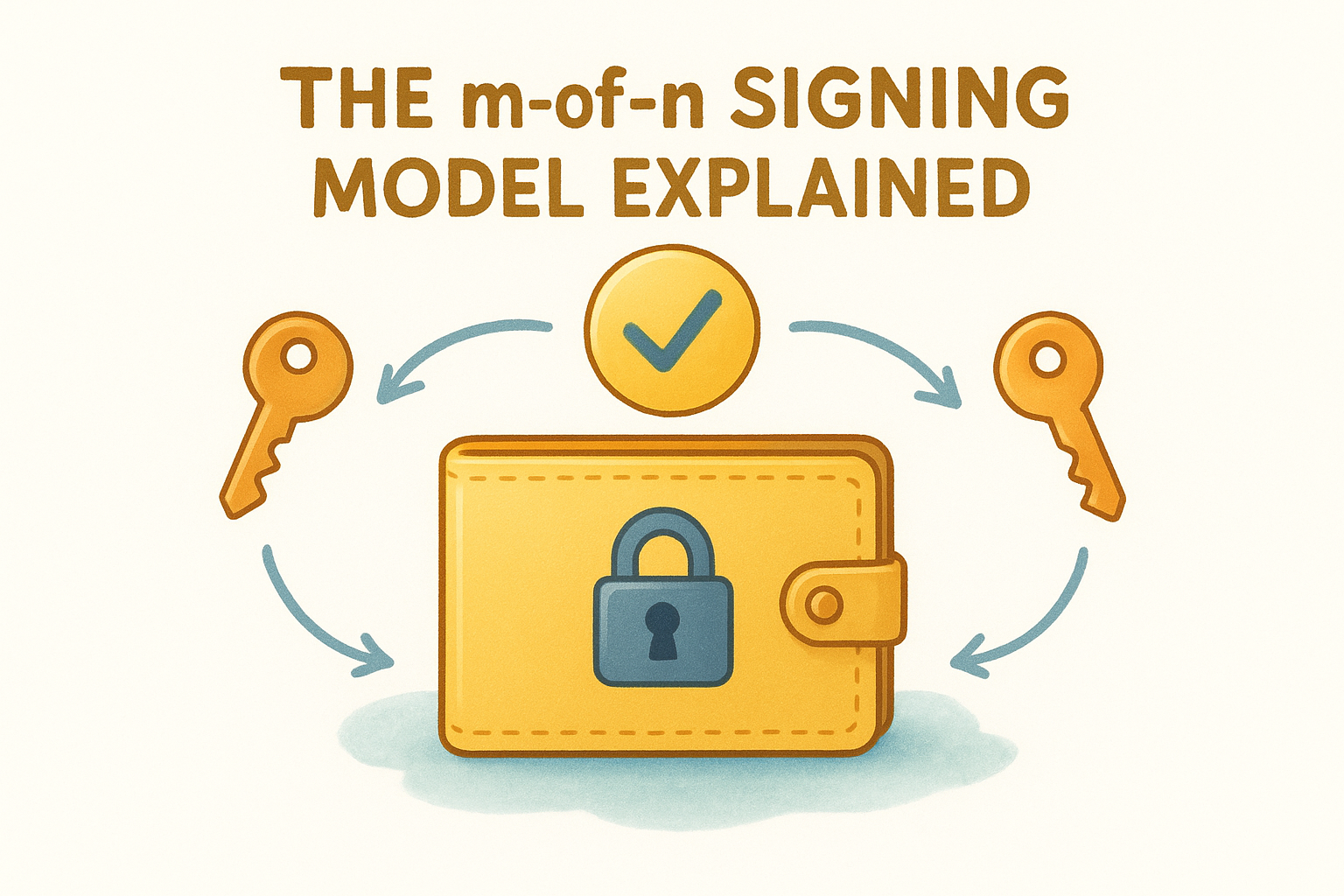
No single key owns a multisig wallet. The address belongs to the combination of keys, which is what makes the structure resistant to single-point compromise.
The threshold you choose determines how much fault tolerance your setup has. A 2-of-3 setup lets you lose or damage one key without losing access to your funds, because two remaining keys still meet the signing threshold. A 3-of-5 setup gives you even more redundancy, tolerating two lost keys while still requiring a majority to sign. Higher thresholds increase security but also increase the complexity of completing each transaction.
What happens when you initiate a transaction
When you want to send crypto from a multisig wallet, the process works in stages. First, you create and sign the transaction with one key, which produces a partially signed transaction file. That file carries the transaction details and one valid signature but cannot be broadcast to the network yet because it does not meet the threshold.
You then pass that file to the next key holder, whether that is another device you control or a trusted co-signer. Each additional signer reviews the transaction details and adds their signature to the same file. Once the file collects the required number of signatures, any of the signers can broadcast it to the blockchain and the transaction executes. Your funds never move until the threshold is met, which is the core protection multisig provides.
Common multisig setups and when to use each
Not every multisig configuration fits every situation. The threshold ratio you choose directly affects how much redundancy you have, how convenient signing becomes, and how exposed you are if a key is lost or compromised. Understanding what is a multisig wallet means recognizing that the m-of-n structure is a decision you customize to match your specific risk profile and operational needs, not a setting you accept by default.
2-of-3: The starting point for most individual holders
The 2-of-3 setup is the most widely used multisig configuration for individual crypto holders. You generate three keys, store each one in a different location or on a different device, and only two are needed to sign any transaction. This structure gives you a clear safety net: losing or damaging one key does not lock you out of your funds, because the remaining two still meet the signing threshold.
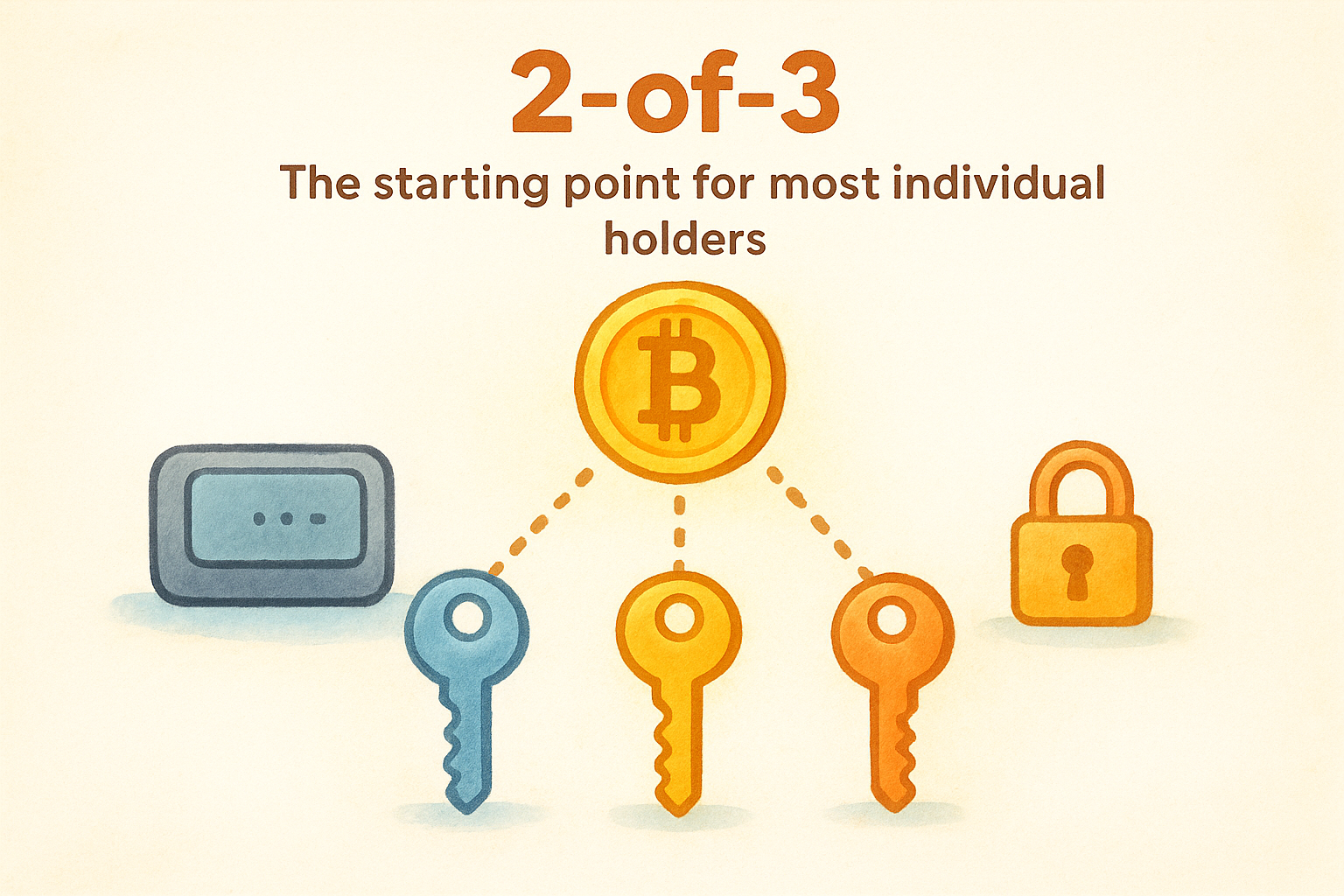
A 2-of-3 setup gives you both redundancy and security without adding so much complexity that everyday transactions become a burden.
A practical distribution for this setup is one key on a hardware wallet you keep at home, a second stored as a secure offline backup in a separate physical location, and a third held by a trusted person or locked in a safety deposit box. That spread protects against both theft and accidental loss at the same time.
3-of-5: Built for teams and significant holdings
When you are managing crypto on behalf of a business, DAO, or investment group, a 3-of-5 setup adds the accountability and fault tolerance that shared custody demands. Five keys are distributed across authorized signers or locations, and any three must agree before a transaction goes through. This means two keys can be unavailable or lost without freezing access to the wallet.
For individual holders managing substantial wealth, a 3-of-5 also makes sense as a long-term storage structure. You gain two full layers of redundancy, meaning two separate failures would have to occur before you lose access.
2-of-2 and why most holders should avoid it
A 2-of-2 setup requires both keys to sign every transaction, which sounds maximally secure but creates a serious structural problem. Losing either key locks you out permanently, and there is no redundancy built into the configuration to recover from that.
Most holders are better served by a 2-of-3 that preserves the same dual-approval requirement while still giving you a fallback if one key is destroyed, stolen, or simply misplaced.
Real-world use cases and examples
Understanding what is a multisig wallet becomes more concrete when you see it applied to actual situations. The technical structure only matters as much as the problem it solves, and the problems multisig addresses show up in contexts ranging from individual cold storage to corporate finance and peer-to-peer agreements. Each use case below illustrates a real scenario where single-key wallets fall short and multisig provides a structural answer.
Personal long-term cold storage
If you hold a significant amount of crypto with no intention of moving it frequently, a standard hardware wallet leaves your entire balance vulnerable to a single event. A 2-of-3 multisig setup built around personal devices gives you a storage structure where no single failure eliminates your access. You could keep one key on a hardware wallet at home, a second as an encrypted backup stored off-site, and a third with a trusted family member who only uses it in a clearly defined emergency.
Multisig for cold storage is not about making transactions easier. It is about making loss and theft structurally harder.
Business and team treasury management
When a company holds crypto as part of its treasury, unilateral access by any single employee creates both a security risk and a governance problem. A 3-of-5 multisig wallet distributes signing authority across leadership roles so that no one person can approve a large transfer alone. Each transaction requires a genuine group decision, which creates an authorization record at the structural level and removes the threat that a single compromised account could drain company funds.
Investment clubs and DAOs benefit from the same design. Members each hold one independent key, and the signing threshold ensures collective agreement before any funds move. That removes the need for a designated custodian while still giving the group functional control over its shared assets.
Escrow and conditional transactions
Multisig also replaces the need for a trusted third party in peer-to-peer transactions. A 2-of-3 escrow arrangement puts one key with the buyer, one with the seller, and one with a neutral arbitrator. If both parties agree, they sign together and the funds release without the arbitrator getting involved at all. If a dispute arises, the arbitrator signs alongside one of the parties to resolve it, and the majority threshold determines where the funds go.
How to choose and set up a multisig wallet safely
Knowing what is a multisig wallet is the first step; choosing the right platform and setting it up without making critical mistakes is what actually protects your funds. The setup process introduces risks that differ from standard wallets because errors in key generation or storage can lock you out permanently if your threshold structure does not account for key loss from the start.
Pick a wallet platform with a proven track record
Your first decision is which software handles the multisig coordination. Bitcoin-native options like Electrum and Sparrow Wallet are widely used and have been reviewed extensively by the security community. For Ethereum-based assets, Gnosis Safe (now called Safe) is the dominant choice for both individuals and teams managing significant value. Stick with software that has open-source code, a long public history, and no dependency on a central company server to function.
The platform you choose should support fully offline signing. Any multisig setup that requires a live internet connection to authorize every transaction introduces unnecessary exposure.
When evaluating options, confirm that the platform supports standard derivation paths and exportable wallet descriptors. Those details matter because they determine whether you can recover your wallet using a different software client if your original choice is ever discontinued.
Generate and store each key on a separate device
Once you pick your platform, generate each key on a dedicated, independent device. Never create two keys on the same machine, even temporarily. For a 2-of-3 setup, that means three separate hardware wallets or air-gapped signing devices, each initialized independently and never connected to the same network at the same time.
Store each key in a physically distinct location: one at home, one off-site in a secure spot, and one with a trusted person or in a safety deposit box. Write down the wallet descriptor or xpub information separately from the seed phrases themselves, because you need that descriptor to reconstruct the wallet structure during any recovery attempt.
Test with a small amount before committing real funds
Before you move any significant holdings into your new wallet, run a complete signing test using a small amount you can afford to lose if something goes wrong. Complete the full m-of-n signing process across all your devices and confirm the funds arrive correctly.
Use this checklist before moving real funds:
- Send a test transaction and complete every signing step
- Recover the wallet using only the threshold number of keys, not all of them
- Confirm the wallet descriptor file is stored separately from all seed phrase backups
- Verify that each key works independently on its own device
Final thoughts
Once you understand what is a multisig wallet, the case for using one becomes difficult to ignore. Single-key wallets shift risk from exchanges to you personally, and that risk stays fully intact until you build a structure that can survive one key being lost, stolen, or destroyed. Multisig does not eliminate every threat, but it removes the single point of failure that makes standard self-custody fragile at its core.
Your next step is making sure the foundation underneath that structure is solid. Choosing the right setup, using trusted hardware, and testing before committing real funds all require a clear understanding of how private keys, seed phrases, and signing devices actually work together. If any part of that feels uncertain, start there before you add multisig on top. The FinTech Dynasty crypto education course walks you through each layer of self-custody in plain terms, so you can build your setup with confidence.