

How Multisig Wallets Work: Security, Key Types And Use Cases
A standard crypto wallet relies on a single private key to authorize transactions. If that key gets compromised, through phishing, malware, or a simple backup mistake, everything stored in that wallet is gone. No reversal, no support ticket, no recovery. This single point of failure is one of the biggest risks in self-custody, and it's exactly the problem that multisig technology was designed to solve. Understanding how multisig wallets work gives you a practical tool to eliminate that vulnerability before it ever becomes a crisis.
A multisig (multi-signature) wallet requires two or more private keys to approve a transaction instead of just one. Think of it like a safe deposit box that needs multiple keyholders to open. No single person, or single device, can move funds alone. This mechanism adds a layer of redundancy that protects against theft, human error, and even coercion scenarios where someone physically forces access to one key.
At FinTech Dynasty, we focus on the technical side of protecting digital assets, no price speculation, no hype. Multisig fits directly into that mission because it represents one of the strongest self-custody strategies available to long-term holders. This article breaks down the mechanics behind multisig wallets, covers the different key configurations you can use, explains the security advantages over single-key setups, and walks through real use cases where multisig makes the most sense for individuals and teams alike.
Why multisig exists and when you need it
Single-key wallets are the default setup for most crypto holders, and for casual use they work. But default does not mean secure. When you store significant value, whether it is $5,000 or $500,000, the risk profile of a single private key becomes a genuine liability. Multisig was not invented to complicate things. It was built because real-world experience showed that one point of failure in an irreversible asset system creates consequences nobody can undo.
The core vulnerability in single-key wallets
Every standard wallet, hot or cold, derives its entire security model from one secret: the private key. Whoever controls that key controls the funds, permanently and completely. If you lose the key, the funds are locked forever. If someone else gets it, through a phishing link, a compromised backup, a stolen hardware device, or a physical coercion attack, the wallet is emptied and you have no recourse. There is no fraud department, no chargeback, and no freeze mechanism in a decentralized network.
A single private key is not just a password. It is the final authority over your funds, with no appeals process and no second chances.
The seed phrase you write down when you set up a hardware wallet is a direct representation of that private key. If that piece of paper gets damaged, photographed, or discarded by accident, your funds go with it. People store seed phrases in fireproof safes and safety deposit boxes precisely because they understand this risk. But even those measures have failure scenarios: house fires, flooded bank branches, and misplaced backups. Single-key setups force you to protect one secret perfectly, and that is a security problem with no clean solution.
Situations where multisig becomes essential
Multisig shifts the security model entirely. Instead of protecting one secret perfectly, you distribute trust across multiple keys so that no single failure, whether loss, theft, or compromise, can drain your wallet. This is when multisig stops being a theoretical upgrade and becomes the practical choice.
You should seriously consider multisig when any of the following apply:
- You hold a significant amount of crypto and a single device failure or loss would be financially devastating.
- You share ownership of funds with a business partner, spouse, or team and need joint authorization over spending.
- You want geographic redundancy, meaning keys stored in separate physical locations so one event like a fire or theft cannot reach all of them.
- You are working through inheritance planning and need a trusted person to access funds after your death without giving them unilateral access while you are alive.
- You run a treasury or organization where rules require multiple approvals before any transaction executes.
For long-term holders specifically, the inheritance and redundancy scenarios carry the most weight. Standard single-sig setups leave your heirs with a difficult problem: locate one key, in the correct format, without making a mistake that destroys access permanently. A properly designed multisig setup lets you distribute partial access across trusted parties while keeping the full authorization intact during your lifetime.
Understanding how multisig wallets work at a structural level starts with recognizing that multisig is not a feature you bolt onto an existing setup. It is a fundamentally different model for controlling digital assets, one that replaces a single fragile secret with a distributed, fault-tolerant system of keys.
How multisig wallets work step by step
Understanding how multisig wallets work requires a clear picture of what happens between the moment you initiate a transaction and the moment the network executes it. The core mechanic is a threshold system where you define how many keys exist and how many of those keys must sign before any transaction becomes valid.
Setting up the key threshold
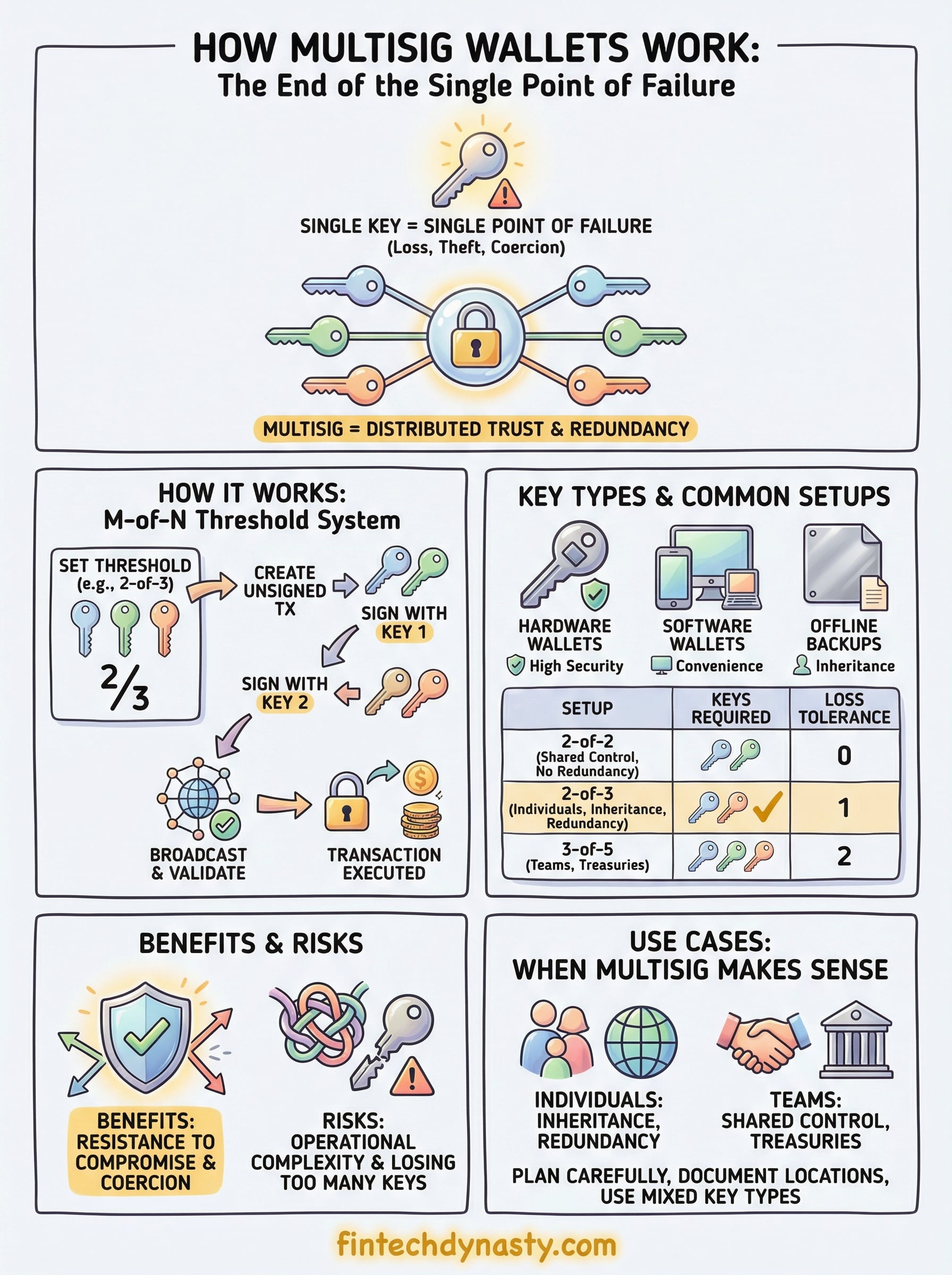
When you create a multisig wallet, you choose two numbers: the total number of keys and the minimum number of signatures required. These are written as an M-of-N configuration, where N is the total number of keys and M is the minimum needed to sign. A 2-of-3 setup, for example, creates three keys but only requires two of them to approve a transaction. This means one key can be lost, stolen, or destroyed without locking you out of your funds permanently.
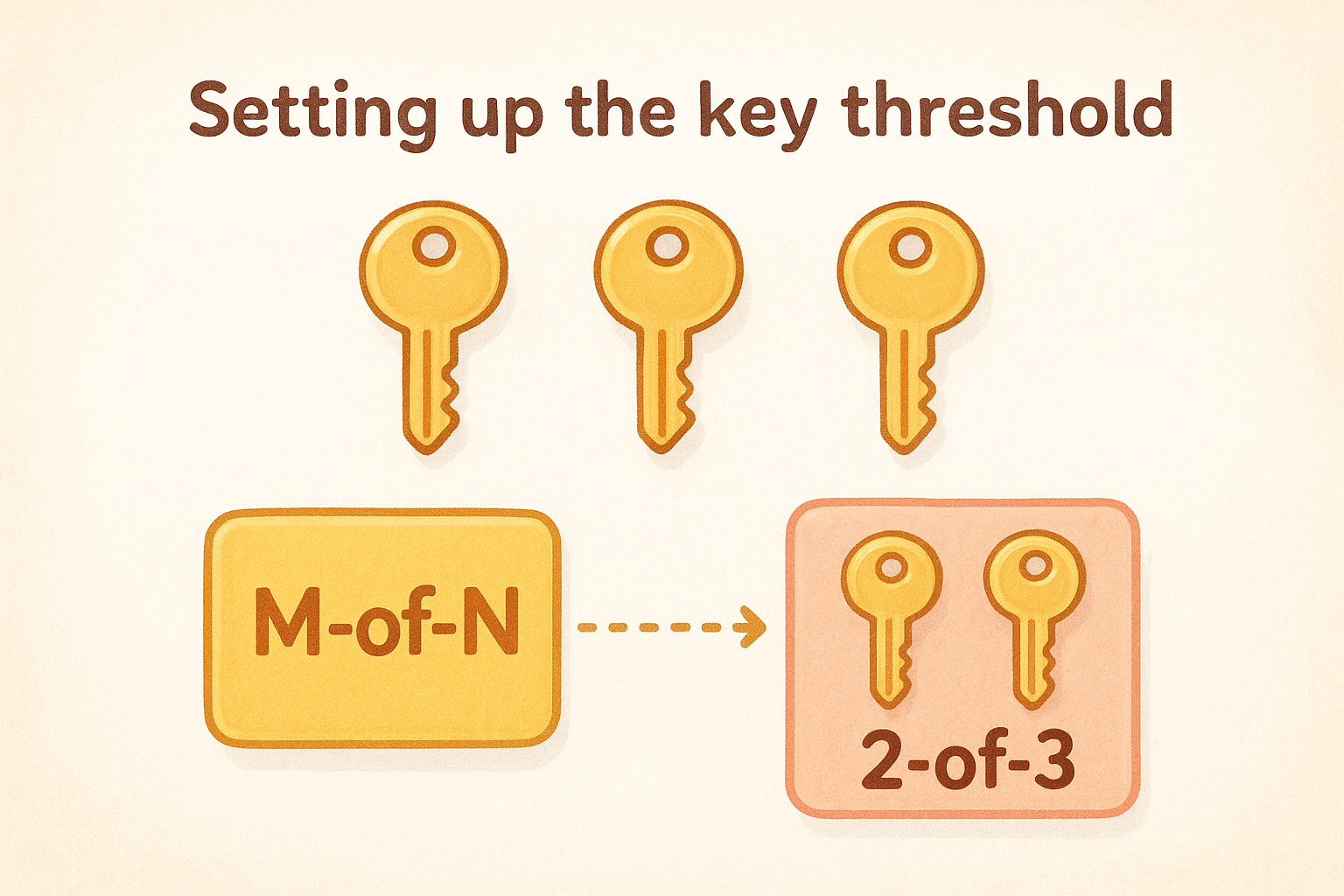
The most common configurations break down like this:
- 2-of-2: Both keys must sign. High security, but no redundancy if one key is lost.
- 2-of-3: Two of three keys required. The most widely used setup for individuals.
- 3-of-5: Three of five keys required. Common for organizations managing shared treasuries.
The threshold you choose is a direct tradeoff between security and accessibility, so match it carefully to your actual risk tolerance and storage situation.
Signing and broadcasting a transaction
When you want to send funds, the wallet generates an unsigned transaction and passes it to the first signing key. That key cryptographically signs the transaction data without ever exposing the private key itself. The signed transaction then moves to a second key for another signature. Once the required number of signatures is collected, the transaction is complete and ready to broadcast to the network.
The network then validates all the signatures against the public keys registered to that multisig wallet address. If the signatures meet the M-of-N threshold, the transaction executes. If even one signature is missing or invalid, the network rejects the entire transaction with no partial approvals and no workarounds. Every step in this process is enforced by the protocol itself, not by any company or custodian, which is why multisig is considered one of the most reliable security models in self-custody.
Key types and common multisig setups
The keys in a multisig wallet are not all the same kind of device or software, and understanding the differences between them shapes how you design a setup that actually fits your situation. Each key is a standard cryptographic private key, but where and how you store it determines the security value it adds to the overall configuration. Mixing key types deliberately across different devices and locations is what makes a multisig arrangement genuinely resilient rather than just more complicated.
The three categories of keys you can use
Most multisig setups draw from three categories of key storage: hardware wallets, software wallets, and offline backups. Hardware wallets like Ledger or Trezor are the most common primary key choice because they keep the private key isolated from internet-connected systems entirely. Software wallets running on a phone or desktop add convenience but carry higher exposure to malware, which is why most serious setups treat them as a secondary or emergency key rather than a primary one.
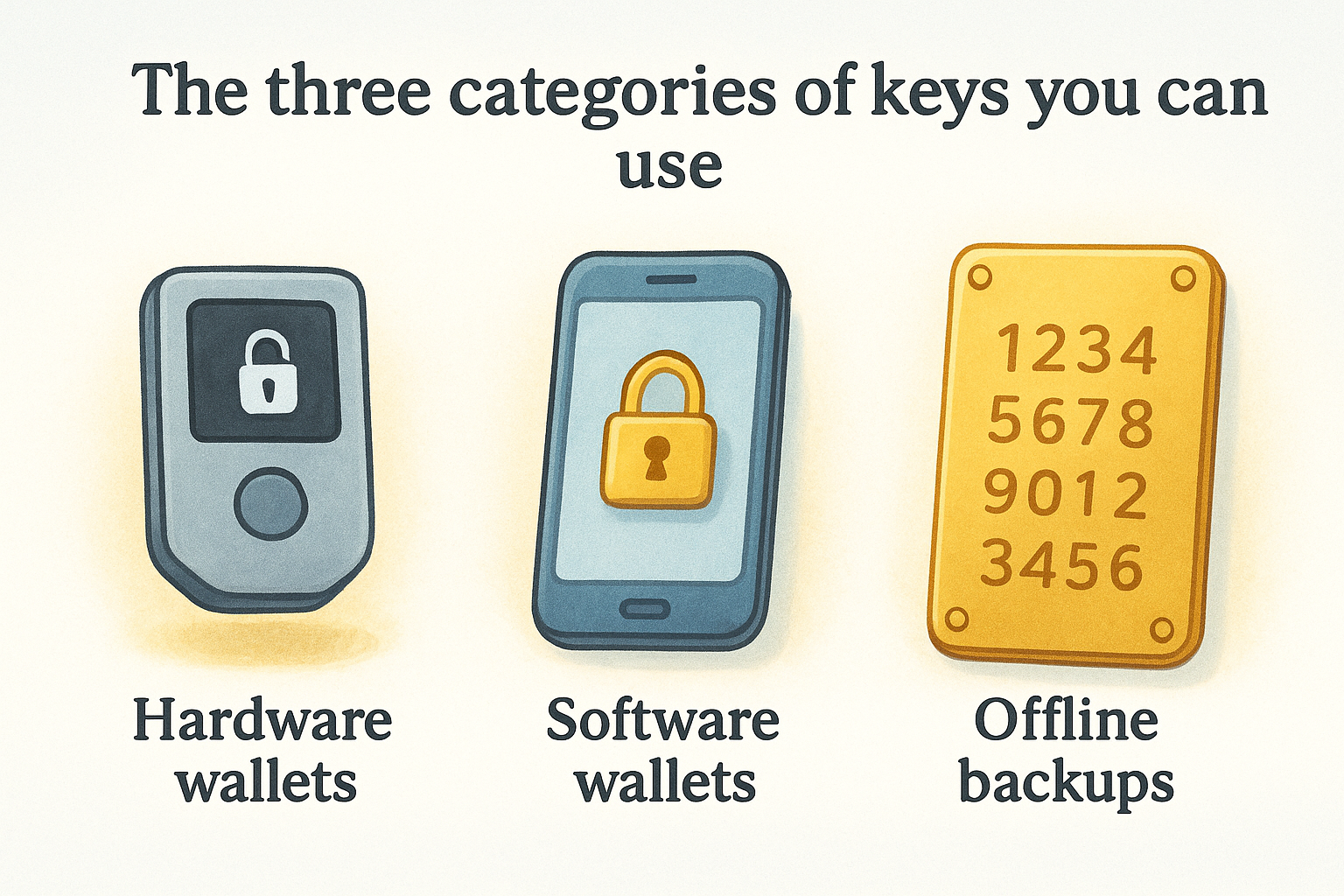
Offline backups, whether paper or engraved metal, serve a specific purpose in multisig design. Metal backup plates are particularly useful for inheritance scenarios, where a trusted person needs access after your death but should not have unilateral control while you are alive. Using all three categories across physically separate locations eliminates the scenario where one fire, flood, or theft event reaches every key at once.
Mixing key types across different devices and physical locations is the most direct way to prevent a single event from compromising your entire multisig setup.
Choosing the right M-of-N configuration
Understanding how multisig wallets work at the configuration level means matching specific setups to specific risk profiles. A 2-of-2 setup provides maximum shared control but zero tolerance for losing either key, which makes it a poor choice when redundancy matters. A 2-of-3 setup is the most practical option for individuals because it functions with any two of three keys, so one lost or damaged key does not lock your funds permanently.
Here is how the most common configurations compare:
| Setup | Keys Required | Total Keys | Keys You Can Lose | Best For |
|---|---|---|---|---|
| 2-of-2 | 2 | 2 | 0 | Shared control between two parties |
| 2-of-3 | 2 | 3 | 1 | Individual long-term holders |
| 3-of-5 | 3 | 5 | 2 | Teams and organizational treasuries |
Security benefits, risks, and failure modes
Multisig does not just add complexity to your wallet setup. It restructures the entire threat model by removing the single point of failure that makes standard wallets so fragile. Once you understand how multisig wallets work at the security layer, you can evaluate both what it protects you from and where new risks appear if you design the setup carelessly.
What multisig actually protects you from
The most immediate benefit is resistance to key compromise. If an attacker steals one of your three keys in a 2-of-3 setup, they cannot move any funds because they still need a second signature. This neutralizes a wide range of attacks including phishing, device theft, and malware targeting individual signing devices. Remote attackers who compromise a software wallet holding one key gain nothing unless they can also reach a second key stored on a separate hardware device in a different physical location.
A stolen key in a properly designed multisig setup is a security alert, not a catastrophe.
Another direct benefit is protection against coercion. If someone forces you to hand over one key, you can comply without surrendering full access to your funds. This is a real scenario that single-sig setups have no practical answer for.
Risks and failure modes to plan for
Understanding the risks matters just as much as understanding the benefits. Operational complexity is the biggest practical risk in multisig. If you lose two of your three keys in a 2-of-3 setup, your funds are permanently inaccessible. The same fault tolerance that protects you from losing one key becomes a liability when multiple keys are damaged, destroyed, or misplaced at the same time.
Here are the failure modes you need to account for before committing funds to a multisig wallet:
- Losing more keys than your threshold allows: In a 2-of-3 setup, losing two keys locks your funds forever.
- Poorly documented key locations: If your heirs or recovery contacts cannot find the keys, the redundancy means nothing.
- Software incompatibility: Multisig wallets tied to a specific application can become inaccessible if that software is discontinued or significantly changed.
- Incorrect initial setup: Creating a wallet with configuration errors can result in funds sent to an address nobody can fully authorize.
You can reduce most of these failure modes through careful documentation and redundant backups of your wallet configuration data, not just the keys themselves. Store your setup details, including the public keys used and the software version, in a secure location separate from the keys. This gives you or your recovery contacts a clear path back to the funds even after significant time has passed.
Real-world use cases and wallet options
Understanding how multisig wallets work in theory is useful, but seeing where people actually apply them makes the value concrete. Multisig is not reserved for large institutions or technical experts. Individual holders, families, and small teams all have legitimate use cases that map directly to the configurations covered in this article.
Where individuals and teams use multisig
Long-term holders use multisig most often for inheritance planning and geographic redundancy. A 2-of-3 setup where one key stays at home, one is stored in a bank safety deposit box, and one is held by a trusted family member gives you full control during your lifetime while giving your heirs a clear path to access funds after your death. No single location holds enough to move the money, so a house fire or break-in does not end with a total loss.
This structure lets you give a trusted person partial access without giving them unilateral control, which is the exact problem single-sig setups cannot solve cleanly.
Business and team use cases follow a different logic. Small businesses holding operational crypto funds often use a 2-of-3 or 3-of-5 setup to require co-authorization from multiple team members before any transaction executes. This prevents any single employee from moving funds unilaterally and creates a built-in audit trail at the authorization layer. Decentralized organizations managing shared treasuries apply the same model at larger scale, sometimes with five or more keyholders distributed across different countries.
Wallet software that supports multisig
Several established options support multisig, and your choice depends on the blockchain you are using and how much technical setup you are willing to manage. For Bitcoin, Sparrow Wallet and Electrum both support native multisig with hardware wallet integration. For Ethereum and EVM-compatible chains, Safe (formerly Gnosis Safe) is the most widely used smart contract-based multisig platform and is commonly used by both individuals and organizations managing on-chain funds.
Hardware wallets from Ledger and Trezor both work as signing devices within multisig configurations, though you set up the multisig structure through compatible software rather than on the device itself. Combining hardware devices with separate software coordinators keeps your private keys air-gapped while still giving you a clean interface to manage and broadcast transactions. Matching the right software to your hardware and network is one of the most practical decisions you make when building out a multisig setup.
Key takeaways
Understanding how multisig wallets work gives you a practical path away from the single point of failure that puts most crypto holdings at risk. A properly configured multisig setup distributes trust across multiple keys so that losing, damaging, or having one key stolen does not end with a total loss. The M-of-N threshold system lets you match your configuration to your actual risk profile, whether you are a long-term holder planning for inheritance or a team managing shared funds.
The tradeoffs are real. Operational complexity and poor documentation remain the most common reasons multisig setups fail people who built them correctly. Plan your key storage locations carefully, back up your wallet configuration data, and make sure at least one trusted person understands the setup.
If you want to build a stronger foundation before implementing multisig, the FinTech Dynasty crypto education course covers wallets, private keys, and self-custody in a structured, beginner-friendly format.