

What Is Domain Spoofing? Examples, Risks, And Prevention
Someone sends you an email that looks like it's from your hardware wallet provider. The domain checks out, or so you think. You click the link, enter your credentials, and just like that, your crypto is gone. This is what is domain spoofing in practice: an attacker forging a domain name to impersonate a trusted source, tricking you into handing over sensitive information.
Domain spoofing is one of the most common tactics behind phishing attacks targeting cryptocurrency holders. Fake websites mimicking exchanges, wallet manufacturers, and DeFi platforms steal billions in digital assets every year. For anyone serious about self-custody and protecting their funds, understanding this threat isn't optional, it's foundational.
At FinTech Dynasty, we focus on the security side of crypto ownership, no price hype, no speculation, just practical knowledge to keep your assets safe. This article breaks down exactly how domain spoofing works, walks through real-world examples, and gives you concrete prevention strategies to avoid falling for these attacks.
Domain spoofing explained in plain English
At its core, domain spoofing is the act of faking a web address or email sender to make communication appear to come from a trusted source. When you understand what is domain spoofing, you realize it's less about breaking technical systems and more about exploiting human trust. Attackers know that most people glance at a domain and move on. That split-second of inattention is all they need.
A spoofed domain doesn't need to be perfect. It just needs to look convincing long enough for you to act on it.
How a domain gets spoofed
Attackers use several low-tech tricks to make a fake domain look real. The most common method is typosquatting, where an attacker registers a domain that is one or two characters off from a legitimate one. For example, "myetherwallet.com" becomes "myetherwallet.co" or "myetherwal1et.com." Another technique uses homograph attacks, where characters from other alphabets visually replace standard Latin letters. The Cyrillic "а" looks identical to the Latin "a" on most screens, and you would never catch the difference with a quick glance.
Email spoofing follows a different path. Attackers forge the "From" field in an email header, making a message appear to originate from a domain you trust. Because older email protocols don't verify sender identity by default, this kind of manipulation is technically straightforward. Your inbox displays "support@ledger.com," but the actual sending server has nothing to do with Ledger.
Why the gap between domain and server matters
The domain you see on screen and the server actually delivering the communication are two separate things, and attackers exploit this gap constantly. A phishing email might display "security@coinbase.com" in your email client while the actual origin is a random server in a completely different country. Recognizing this split helps you stop treating visual cues as hard proof of legitimacy.
Your email client and browser both show you a simplified view of what is happening under the hood, and that simplified view is exactly where spoofing operates. Understanding that what appears on your screen does not always reflect what is actually moving across the network is the first mental shift you need to protect yourself effectively.
Common forms of domain spoofing with examples
Not all domain spoofing attacks look the same. When you dig into what is domain spoofing, you quickly realize that attackers adapt their methods depending on their target and their goal. Recognizing the specific form an attack takes is the first step toward catching it before you act on it.
Email sender spoofing
Email sender spoofing is the most widespread form of this attack. An attacker forges the "From" field of an email so your inbox displays a trusted address like "support@trezor.io" even though the actual sending server has no connection to Trezor. Many phishing campaigns targeting crypto holders rely on exactly this method to push victims toward credential-harvesting websites.
Spotting these emails is hard because your email client hides the technical details by default. Checking the full message headers reveals the actual origin server, which rarely matches the displayed sender address.
If an email demands urgent action involving your wallet or exchange account, treat that urgency itself as a warning sign.
Typosquatting and lookalike domains
Typosquatting involves registering a domain that is one small change away from a legitimate one. "ledgerwallet.com" might become "ledger-walet.com" or "Iedgerwallet.com," where a capital "I" replaces the lowercase "L." A related technique called a homograph attack swaps standard Latin characters for visually identical Unicode characters from other scripts, making detection nearly impossible without close inspection.
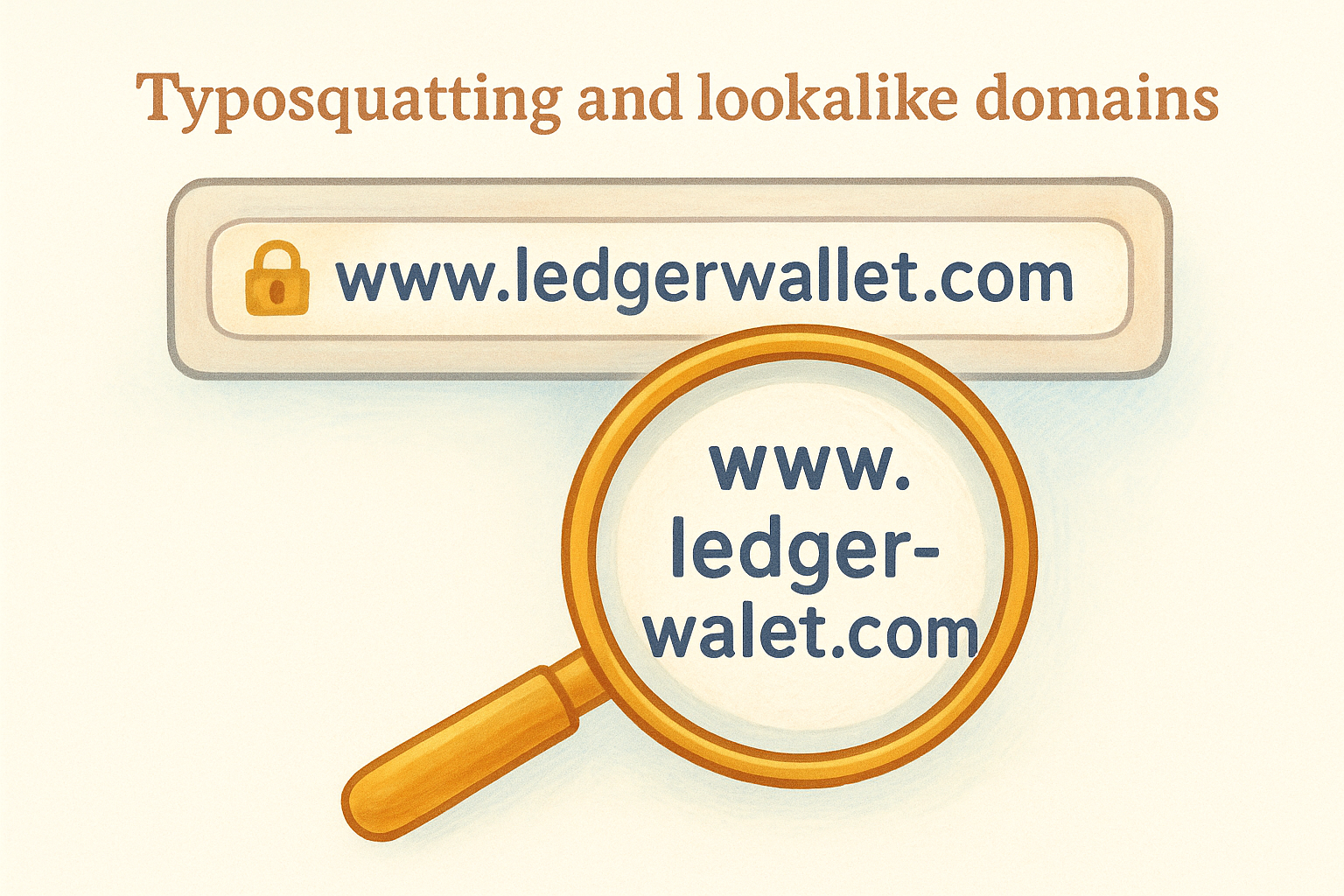
Subdomain spoofing takes a different angle. A URL like "coinbase.com.account-verify.net" looks trustworthy at a glance because your eye catches "coinbase.com" first. The actual domain controlling that page is "account-verify.net," and it belongs entirely to the attacker.
Why domain spoofing is dangerous
Understanding what is domain spoofing is only half the picture. The real concern is the damage these attacks cause once they succeed. Spoofing attacks work because they bypass your defenses before you even realize something is wrong. By the time you notice the problem, the attacker has already collected what they needed.
Financial loss and direct theft
Cryptocurrency transactions are irreversible. This single fact makes domain spoofing uniquely destructive in the crypto space. If an attacker tricks you into entering your seed phrase or private key on a fake wallet site, they can drain your funds within seconds. There is no fraud department to call, no chargeback option, and no recovery process. The assets are gone permanently.
In 2021, a spoofed version of a major hardware wallet site harvested seed phrases from thousands of users, resulting in millions of dollars in losses that were never recovered.
Credential harvesting and account takeover
Beyond direct wallet theft, domain spoofing regularly targets login credentials for exchanges, DeFi platforms, and custodial services. Once an attacker has your username and password, they move quickly to drain balances, change account settings, and lock you out entirely. Many victims discover the breach only after the attacker has already withdrawn funds or transferred assets.
Attackers also use harvested credentials across multiple platforms because many people reuse passwords. A single successful spoof on one fake exchange site can cascade into losses across several accounts. Treating every login form as a potential threat is not paranoia; it is a reasonable response to how these attacks actually operate.
How domain spoofing attacks work
Understanding what is domain spoofing at a technical level helps you spot an attack before it succeeds. Most spoofing attempts follow a predictable sequence of steps, moving from setup to delivery in a matter of hours. Attackers invest very little upfront because domain registration is cheap and cloning a website requires minimal skill.
Setting up the fake infrastructure
Attackers begin by registering a lookalike domain through any standard registrar, often spending just a few dollars. They then copy the visual design of a legitimate site, replicating logos, fonts, color schemes, and page layouts so the fake version looks identical to the real one. Adding a valid SSL certificate to the fake site makes the padlock icon appear in your browser, which fools many users into assuming the site is safe.
A padlock confirms your connection is encrypted, not that the site receiving your data is trustworthy.
Encryption and legitimacy are two separate things, and attackers count on you confusing them.
Delivering the attack to your inbox or browser
Once the fake infrastructure is ready, attackers distribute the spoofed domain through phishing emails, social media messages, or paid ads that appear above legitimate search results. The message almost always creates urgency, warning you of a security issue or pending account lock. Entering any credentials or seed phrase on that page sends your information directly to the attacker's server with no visible error or warning on your end.
Your browser displays a normal-looking page throughout the entire process, which is exactly why these attacks catch so many people off guard.
How to prevent and respond to domain spoofing
Knowing what is domain spoofing gives you a foundation, but applying that knowledge to your behavior is what keeps your assets safe. Prevention comes down to building consistent habits and using tools that fill the gaps your eyes can't catch on their own.
Verify every domain before you act
The most effective step you can take is manually verifying the domain in your browser's address bar before entering any information. Type the address yourself rather than clicking links from emails or messages. For crypto services, bookmark the official URLs directly from the provider's verified documentation and use only those bookmarks going forward.
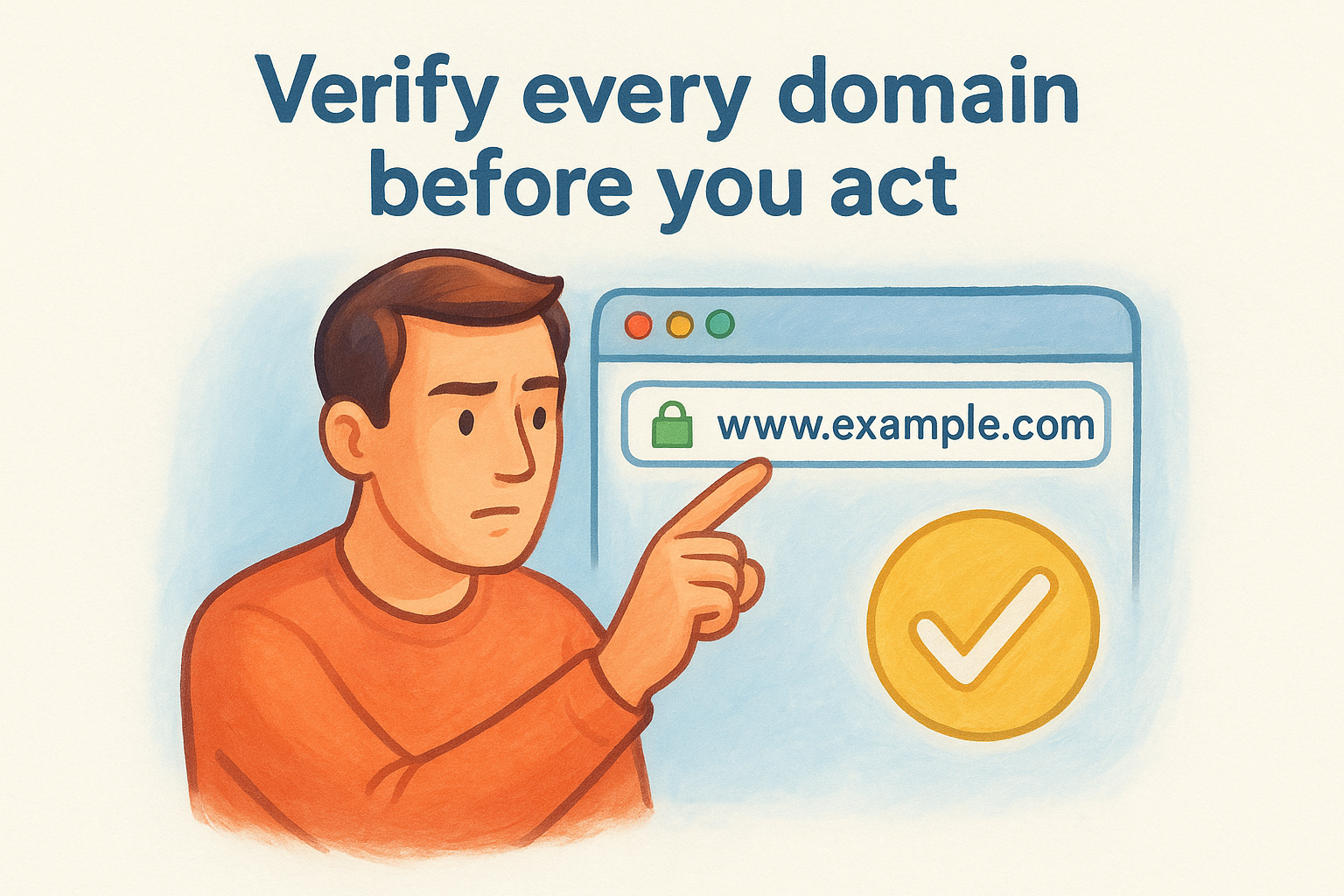
Never trust a URL that arrives through an unsolicited message, even if the sender address looks legitimate.
Use authentication protocols to block spoofed email
If you run a domain, implement [SPF, DKIM, and DMARC records](https://fintechdynasty.com/blogs/news/outlook-report-phishing-button) to prevent attackers from forging your email address. These protocols instruct receiving mail servers to reject messages that don't originate from authorized sources. Microsoft publishes clear guidance on configuring these for your domain.
For your inbox, check full message headers whenever an email creates urgency around your accounts. Most email clients expose headers through a details option, and the actual sending server almost always reveals a spoofed sender immediately.
Respond immediately when you suspect an attack
If you enter credentials on a suspicious page, change your passwords on the legitimate platform right away and enable two-factor authentication. Act fast because attackers move within minutes of collecting credentials.
Shared a seed phrase? Treat that wallet as fully compromised and move your funds to a new wallet immediately. Also report the spoofed domain to the registrar and the impersonated platform to help protect other users.
Final takeaways
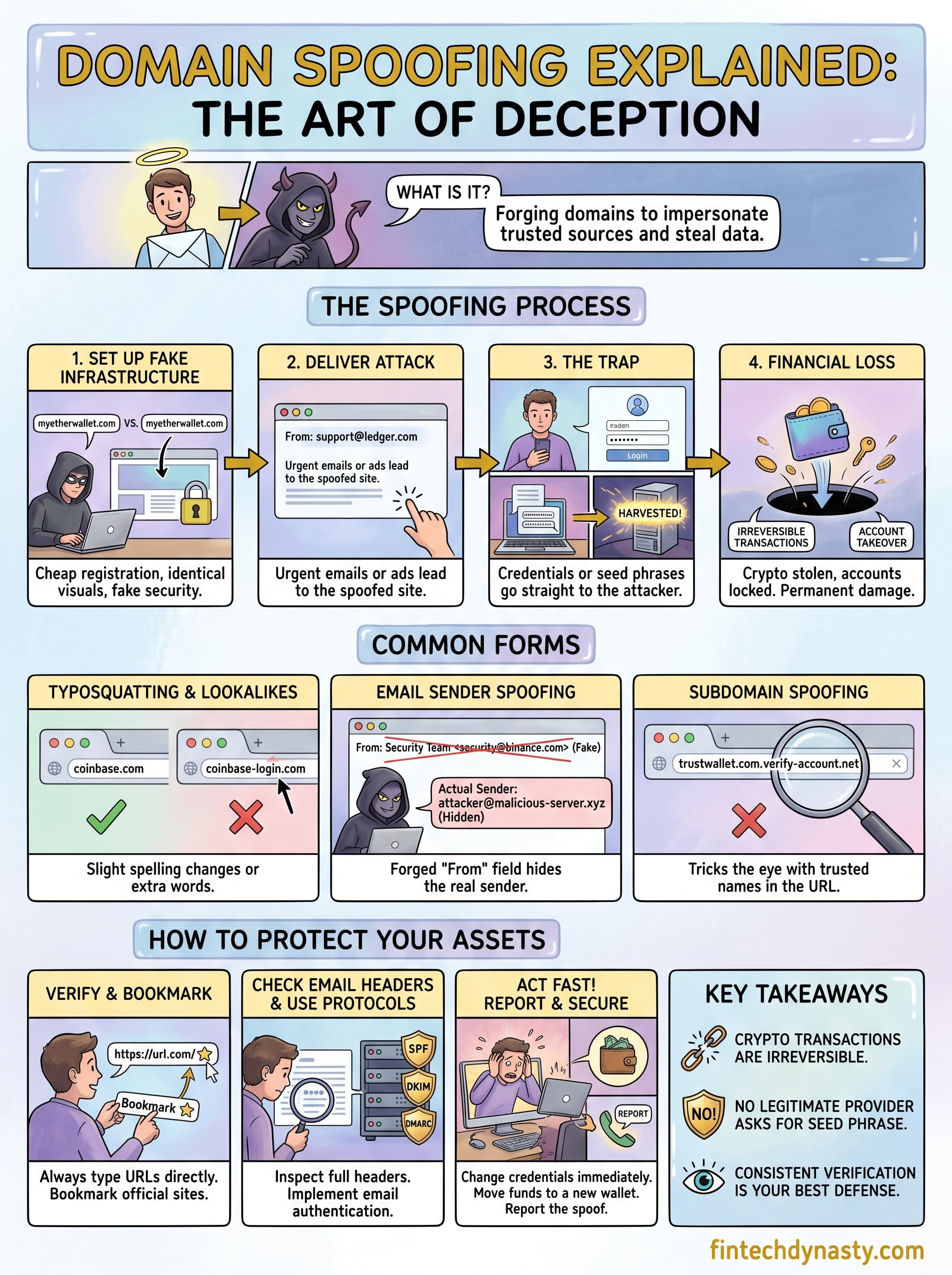
Understanding what is domain spoofing gives you a real advantage against one of the most common and costly threats in the crypto space. Attackers rely on split-second inattention, and every habit you build around verifying domains, checking email headers, and bookmarking official URLs directly reduces your exposure. These are not complicated steps. They require consistency, not technical expertise.
Your seed phrase and private keys are the final line of defense for your assets. No legitimate wallet provider, exchange, or support team will ever ask for them. If a website or email does, stop immediately and verify through official channels before taking any other action.
Protecting your crypto starts with understanding how these attacks are built and why they work. If you want to go deeper on wallet security, self-custody, and keeping your digital assets safe, start with our structured crypto security course and build that knowledge from the ground up.