

Private Key vs Recovery Phrase: What’s The Real Difference?
Most people who own cryptocurrency have heard both terms thrown around, but when it comes to private key vs recovery phrase, the actual difference trips up even experienced holders. They sound like they might be the same thing. They're not. And confusing the two can lead to costly mistakes when you're trying to secure or recover your funds.
Here's the short version: a private key controls access to a single blockchain address, while a recovery phrase (also called a seed phrase) can regenerate every private key in your entire wallet. They're related, but they serve very different functions in how your crypto is stored and protected. Understanding that relationship is one of the most important steps in taking real ownership of your assets.
At FinTech Dynasty, we build our content around exactly this kind of foundational security knowledge, the stuff that actually matters when you're moving off exchanges and into self-custody. This article breaks down how private keys and recovery phrases work, how they connect to each other, and what each one means for your wallet's security. By the end, you'll know precisely which one does what and why both deserve your attention.
Why this distinction matters for self-custody
When you move your crypto off an exchange and into a hardware or software wallet, you take on full responsibility for two separate layers of security. Most guides treat private keys and recovery phrases as interchangeable, which creates a serious problem. Mixing them up changes how you respond to threats, how you back up your wallet, and what you risk if either one gets exposed.
The exposure risk is not the same for both
Losing a private key is serious, but the damage stays contained. Someone who gets hold of a single private key can drain one address and only one. That's bad, but it's not necessarily catastrophic depending on how you've structured your holdings. Losing your recovery phrase, on the other hand, gives an attacker access to every address your wallet has ever generated or will ever generate. The scope of that exposure is completely different, and it demands a completely different level of protection.
Treat your recovery phrase as the master key to your entire financial vault, not just one room in it.
Why self-custody requires understanding both
Self-custody means you are the only person responsible for protecting your assets. There is no customer support line, no recovery process managed by a third party, and no insurance policy that applies. When people confuse the private key vs recovery phrase relationship, they often back up the wrong thing, store it in the wrong place, or assume one covers the other. That assumption is where most irreversible losses begin.
Understanding each layer lets you make smarter decisions at every step. You'll know why a hardware wallet asks for your recovery phrase during setup, why you should never type it into any website, and why losing your device doesn't automatically mean losing your crypto. Each piece of information serves a specific function, and protecting it correctly depends on knowing exactly what that function is.
The role of structure in a secure setup
A well-designed wallet follows a clear hierarchy. Your recovery phrase sits at the top, capable of rebuilding everything beneath it. Private keys sit one level down, tied to individual addresses. Most hardware wallets manage this structure automatically, but you still need to understand it. Without that understanding, you cannot make informed decisions about backup strategies, device replacements, or threat responses when something goes wrong.
What a private key is and what it does
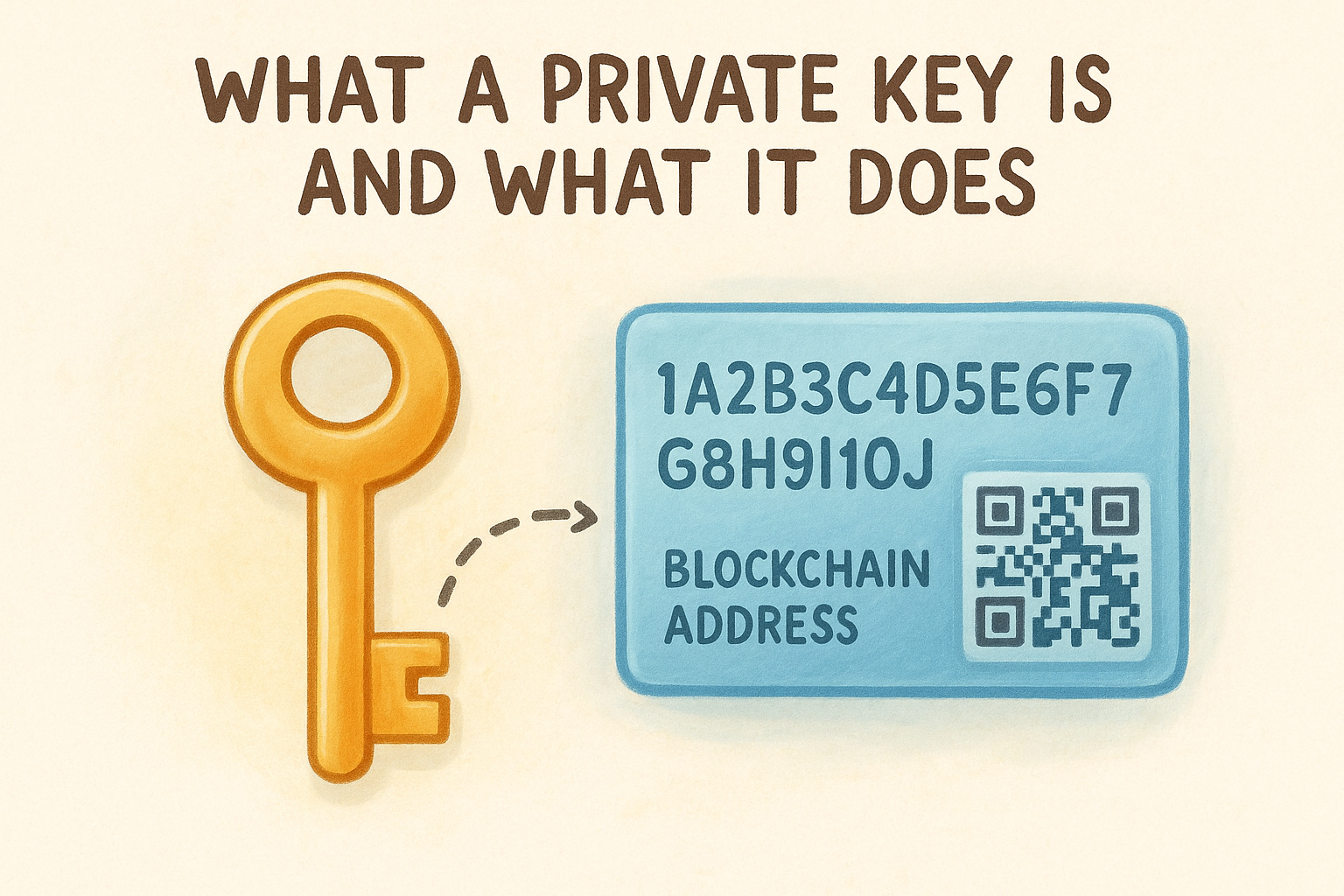
A private key is a long string of randomly generated characters, typically 256 bits of data, that proves ownership of a specific blockchain address. When you send cryptocurrency, your wallet uses the private key to sign the transaction mathematically. That signature tells the network you authorized the transfer without ever revealing the key itself. Think of it as the combination to a specific lock on a specific safe.
One key, one address
Each private key corresponds to exactly one blockchain address. If your wallet holds Bitcoin, Ethereum, and a handful of tokens across multiple addresses, each of those addresses has its own private key sitting behind it. That's where the private key vs recovery phrase distinction starts to matter in a practical sense: a private key is narrow in scope, controlling only what sits at that single address.
Exposing a private key gives an attacker full and permanent control over that specific address, with no way to reverse any transactions they make.
What a private key cannot do
A private key cannot regenerate other keys in your wallet, and it cannot rebuild your wallet if you lose your device. Its function is strictly limited to signing and authorizing transactions for the one address it belongs to. To be precise about its boundaries, a private key:
- Controls one address only
- Signs transactions but never travels across the network
- Cannot recover or regenerate any other key in your wallet
Understanding the structure above the private key level matters enormously, and that structure begins with the recovery phrase.
What a recovery phrase is and what it does
A recovery phrase (also called a seed phrase or mnemonic phrase) is a sequence of 12 to 24 common English words generated when you first set up a cryptocurrency wallet. These words are not random gibberish. They follow a standardized format called BIP-39, which lets compatible wallets decode them into the root data needed to rebuild your entire wallet structure from scratch.
The scope of what it covers
Unlike a private key, a recovery phrase sits above every address and key your wallet contains. When you understand the private key vs recovery phrase relationship, this is the most important distinction to internalize: one recovery phrase can reproduce hundreds or even thousands of private keys, depending on how many addresses your wallet has generated over time.
Your recovery phrase is not a backup of one address. It is the root of your entire wallet, covering every address you have or ever will use within that wallet.
What happens when you use it
You use your recovery phrase in one specific situation: restoring your wallet to a new device after your original is lost, damaged, or stolen. When you enter your phrase into a compatible wallet, the device reconstructs every private key and address in the same order they were originally generated. Your funds do not live inside the phrase itself. They remain on the blockchain, and the phrase simply gives you the keys to reach them again.
Protecting your recovery phrase deserves far more attention than protecting any single private key, because the exposure risk it carries applies to everything in your wallet at once.
How a recovery phrase generates private keys
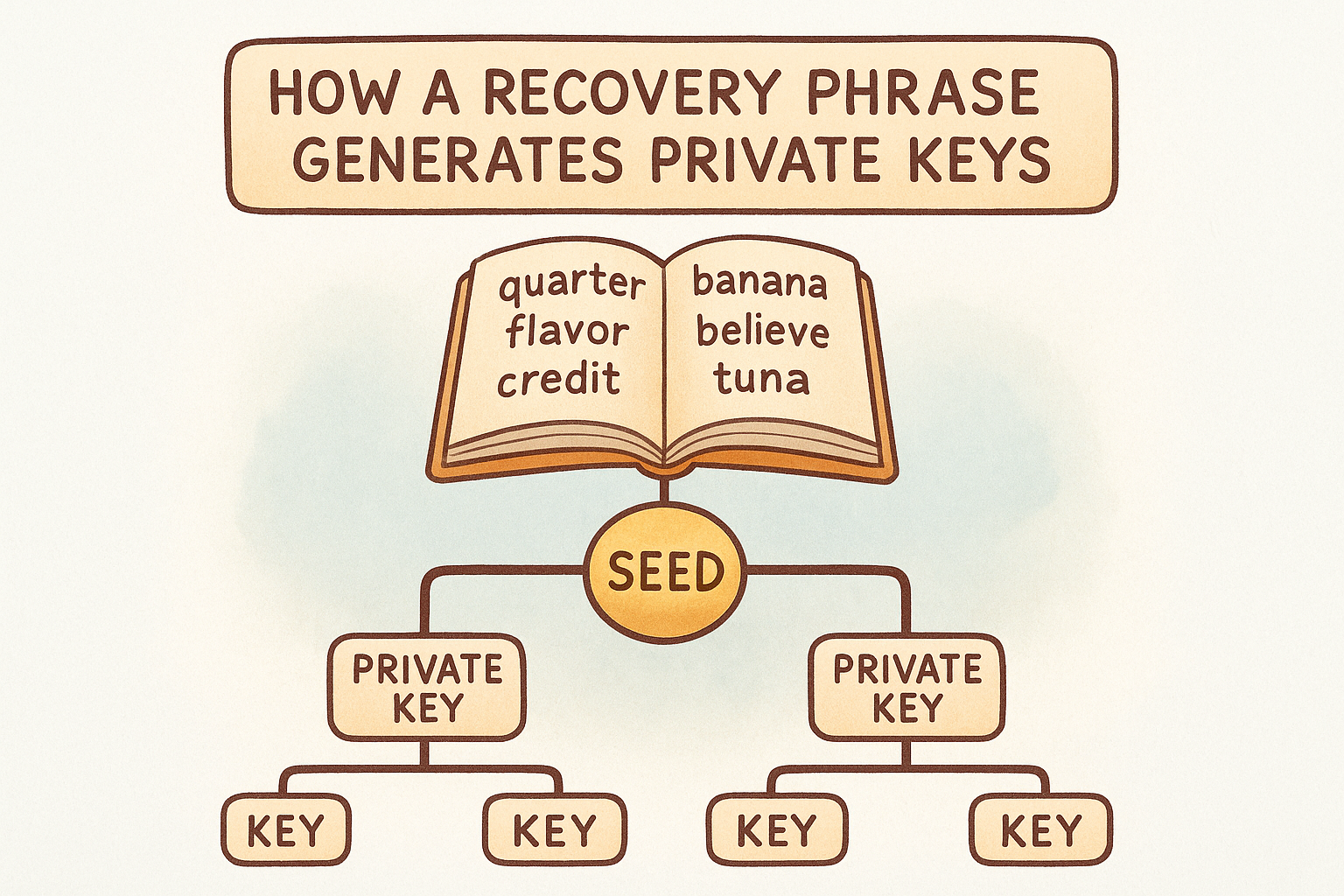
The connection between your recovery phrase and your private keys follows a precise mathematical process defined by two technical standards: BIP-39 and BIP-32. BIP-39 converts your 12 to 24 words into a large number called a seed, and BIP-32 uses that seed to build a structured tree of private keys. This is the core of the private key vs recovery phrase relationship: one root produces many branches.
The seed and the derivation path
Your wallet converts your recovery phrase into a 512-bit seed number through a hashing function. From that seed, the wallet follows a specific derivation path, a numbered sequence that determines which private key gets generated at each position. This means key number one, key number two, and every key after that all trace back to the same single seed. If you enter the same recovery phrase into a compatible wallet, it follows the identical derivation path and reconstructs every private key in the same order.
The deterministic nature of this process is what makes recovery possible: the math always produces the same result from the same input.
Why the hierarchy matters for your security
Because all private keys in your wallet descend from one root seed, the security of your entire setup depends on keeping that seed protected. A single exposed recovery phrase compromises every address simultaneously, while an exposed individual private key only affects one. Understanding this hierarchy helps you prioritize: your phrase needs the strongest protection, and your private keys matter only when you work with them directly.
How to store keys and phrases safely
Now that you understand the private key vs recovery phrase relationship, the next step is applying that knowledge to your actual storage habits. The level of protection each one deserves should match the level of exposure each one creates. Your recovery phrase needs the most rigorous protection, while individual private keys require careful handling only when you're actively working with them directly.
Protecting your recovery phrase
Your recovery phrase should never exist in digital form. That means no photos, no cloud documents, no password managers, and no typed copies stored on any device connected to the internet. Write it down on paper immediately after setup, verify every word is correct, and store it in a physically secure location such as a fireproof safe or a locked drawer only you can access.
A recovery phrase captured in a screenshot or cloud note is effectively exposed to every service, device, and account connected to that storage.
Consider making two physical copies stored in separate secure locations. If one is destroyed in a fire or flood, the second copy protects your ability to restore your wallet entirely.
Handling private keys
Private keys rarely require direct handling if you use a hardware wallet, since the device manages signing internally and the key never leaves the chip. When you do need to work with a raw private key directly, follow these rules:
- Work offline only, on a device that has never connected to the internet
- Never paste or type a private key into any web-based tool or browser extension
- Delete any temporary files created during the process immediately after use
A simple way to tighten your setup
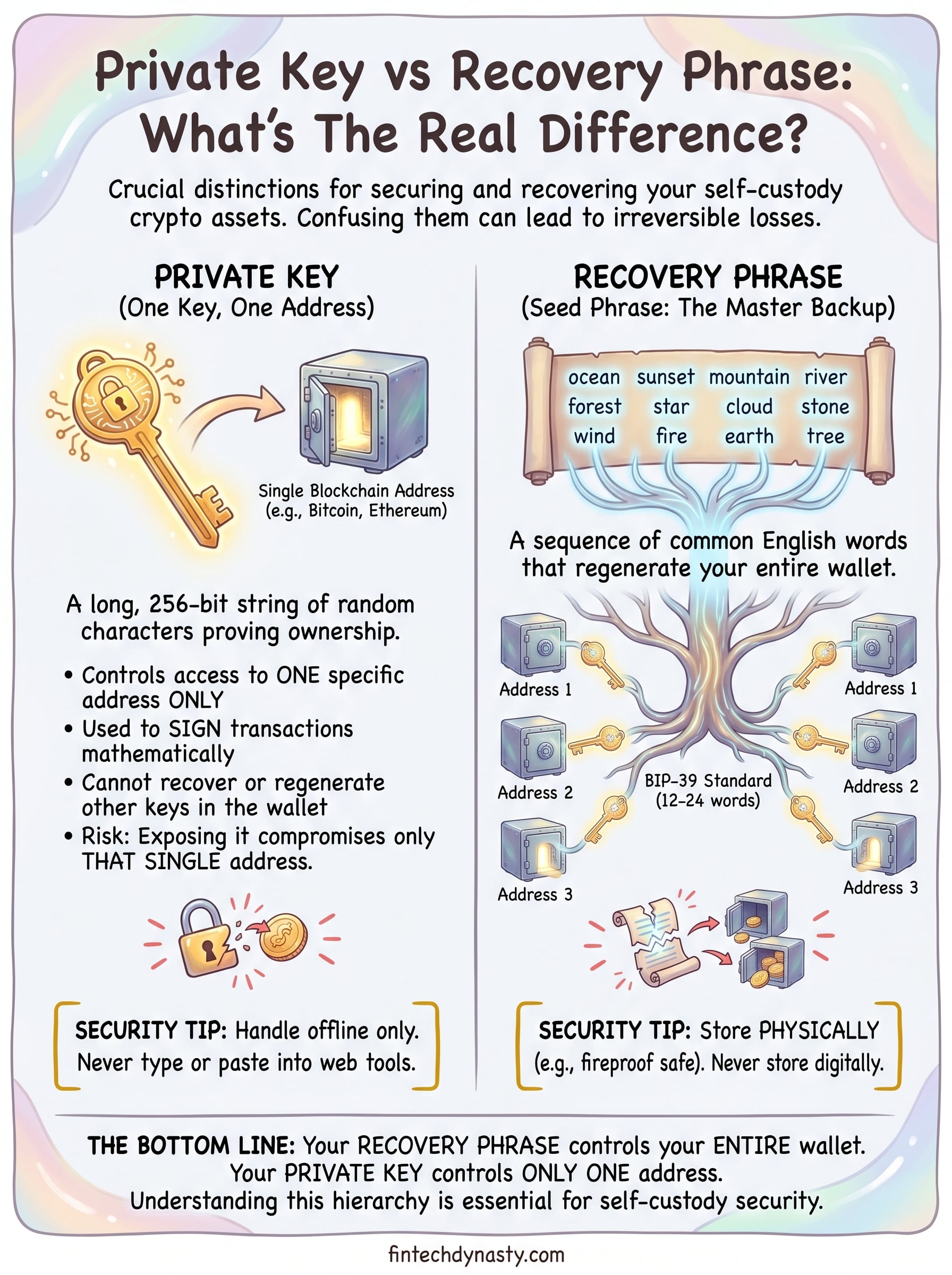
Understanding the private key vs recovery phrase relationship gives you a real advantage most crypto holders never have. You now know that your recovery phrase controls everything in your wallet, while each private key controls only one address. That single distinction changes how you back up your wallet, how you respond to threats, and how seriously you treat each piece of information. Apply what you've learned here: write your phrase down on paper, store it in two separate secure locations, and never expose either layer to an internet-connected device. These steps alone put you ahead of the vast majority of self-custody holders.
Building a secure setup takes structured knowledge, not just scattered tips. If you want to go deeper on wallets, seed phrases, and everything else that goes into protecting your crypto, the FinTech Dynasty crypto education course walks you through it all in a clear, practical format built for real understanding.