

Private Key Vs Seed Phrase: Differences, Uses, And Safety
If you've ever set up a crypto wallet, you've encountered both a private key and a seed phrase, and probably wondered whether they're the same thing. The short answer: they're not. Understanding private key vs seed phrase is one of the most important distinctions in crypto self-custody, and confusing the two can lead to costly mistakes when securing or recovering your funds.
A private key controls access to a single blockchain address. A seed phrase can regenerate every private key in an entire wallet. They serve different purposes, carry different risks, and demand different security practices. Yet most guides lump them together or gloss over the details that actually matter when you're protecting real money.
At FinTech Dynasty, we focus on the practical, technical side of crypto security, no price speculation, no hype. This guide breaks down exactly how private keys and seed phrases work, where they differ, how they relate to each other, and what you need to do to keep both safe. By the end, you'll have a clear mental model for how your wallet actually manages access to your assets, and the confidence to store both credentials correctly.
Private key vs seed phrase in plain English
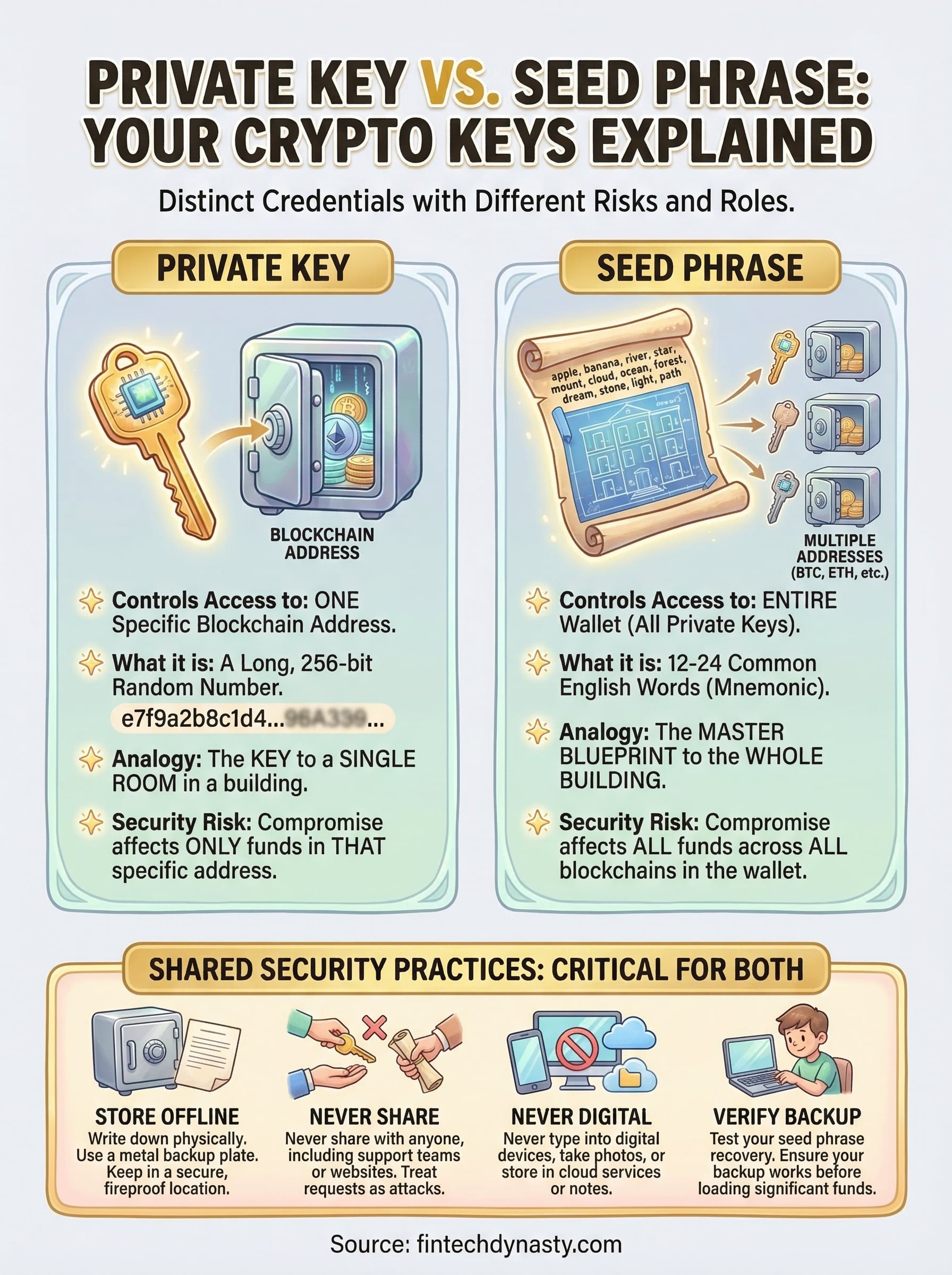
When you compare private key vs seed phrase, you're looking at two different layers of the same security system. Think of your wallet like a building. Each room in that building is a blockchain address, and a private key is the physical key to one specific room. The seed phrase is the master blueprint that can recreate every key to every room in the building. They are related, but they operate at completely different levels of control.
What a private key actually is
A private key is a 256-bit number generated randomly when a new blockchain address is created. It typically appears as a long string of letters and numbers, and it proves to the blockchain network that you have the right to move funds stored at the corresponding address. Every Bitcoin or Ethereum address has exactly one private key. If someone else obtains your private key, they control that address completely, with no way for you to override them or reverse any transactions they make.
Whoever holds your private key owns the funds at that address, full stop. The blockchain has no customer support line.
What a seed phrase actually is
A seed phrase, also called a mnemonic phrase or recovery phrase, is a set of 12 to 24 common English words your wallet generates when you first set it up. These words encode a master secret that your wallet uses to mathematically derive every private key it manages. One seed phrase can generate thousands of individual private keys, each controlling its own address across multiple blockchains.
Here is what distinguishes seed phrase formats at a glance:
| Word count | Common use case |
|---|---|
| 12 words | Most mobile and software wallets |
| 18 words | Less common, some older wallet standards |
| 24 words | Most hardware wallets, higher entropy |
How the two connect
Your seed phrase sits at the top of the hierarchy. From it, your wallet derives private keys, and from those private keys, it generates your public addresses. You rarely need to handle individual private keys directly in modern wallets because the seed phrase already contains everything needed to reconstruct all of them.
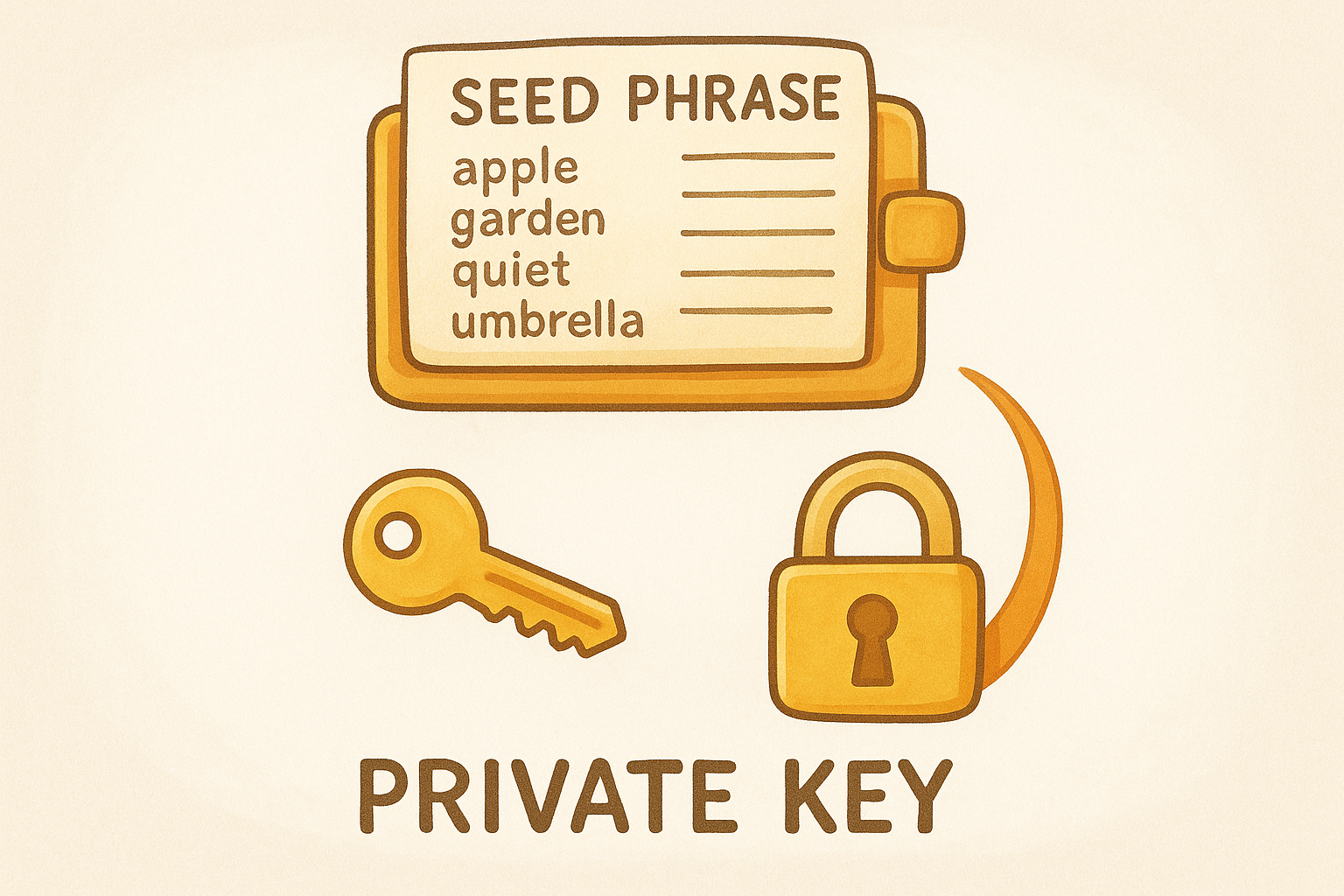
If you lose your device but still have your seed phrase, you can restore every address and every balance on a new wallet. But if you lose the seed phrase and the device together, your funds are effectively gone with no recovery path available.
Why the difference matters for self-custody
When you take self-custody seriously, the private key vs seed phrase distinction stops being academic and becomes a practical security decision. Each credential carries a different blast radius if compromised: one can cost you a single address, the other can cost you everything.
Exposure risk is not equal
Exposing a private key compromises one blockchain address and all funds stored there. That is serious, but the damage is contained. Exposing your seed phrase is categorically worse because it gives anyone who has it the ability to derive every private key your wallet has ever generated, across every blockchain your wallet supports. A single screenshot of your seed phrase in the wrong place can empty your entire portfolio.
Never store your seed phrase digitally, whether in a note app, email, cloud storage, or photo library.
Recovery works in only one direction
Your wallet can restore everything from your seed phrase alone, but it cannot restore your seed phrase from a private key. This asymmetry is intentional. The seed phrase sits at the root of your wallet's key hierarchy, so backing up your seed phrase correctly replaces the need to back up individual private keys. If you set up a new hardware wallet tomorrow with the same seed phrase, every address and balance reappears exactly as before.
Treating a private key backup as an acceptable substitute for a seed phrase backup is a common mistake. You would only recover the funds tied to that one address, leaving every other address in your wallet inaccessible if your device is lost or damaged.
How private keys work on a blockchain
A private key is not just a password; it is a cryptographic credential that the blockchain network uses to verify ownership. When you send funds from any address, your wallet uses the [private key to create a digital signature](https://fintechdynasty.com/blogs/news/myetherwallet-export-private-key) that proves you authorized the transaction without ever revealing the key itself. The network can verify that signature using only your public address, so your private key never has to leave your device.
How a private key gets generated
Your wallet generates a private key by pulling a random 256-bit number from a cryptographically secure source. That number is so large that the odds of two wallets ever generating the same one are effectively zero. From that private key, your wallet derives a public key using elliptic curve cryptography, and then hashes that public key down to produce the address you share with others to receive funds.
The derivation follows a strict one-way chain:
- Private key (secret, never shared)
- Public key (derived from private key)
- Public address (derived from public key, shared openly)
What happens when you sign a transaction
Every time you send crypto, your wallet runs the private key through a signing algorithm to produce a unique signature for that specific transaction. The blockchain nodes then validate the signature against your public address to confirm you own the funds. This is the core mechanic that makes private key vs seed phrase security so important: if the signing key is wrong or missing, the transaction cannot proceed, and no third party can intervene on your behalf.
Your private key never travels to the blockchain network; only the signature it produces does.
How seed phrases work in modern wallets
Most modern wallets follow a technical standard called BIP39, which defines how a seed phrase is generated and how it maps to your private keys. When you first set up a wallet, the software pulls a large random number from a secure entropy source and converts it into a list of 12 or 24 common English words drawn from a fixed list of 2,048 options. Those words are not random poetry; they encode a precise binary value that your wallet uses as the root of your entire key structure.
How the derivation path turns words into keys
Your wallet runs the seed phrase through a key derivation function to produce a master seed, then applies a hierarchy of derivation paths to generate individual private keys for each address. This process follows another standard called BIP32, which defines how child keys branch off from a parent key in a predictable, reproducible way. The same seed phrase always produces the same addresses in the same order, which is exactly what makes wallet recovery reliable.
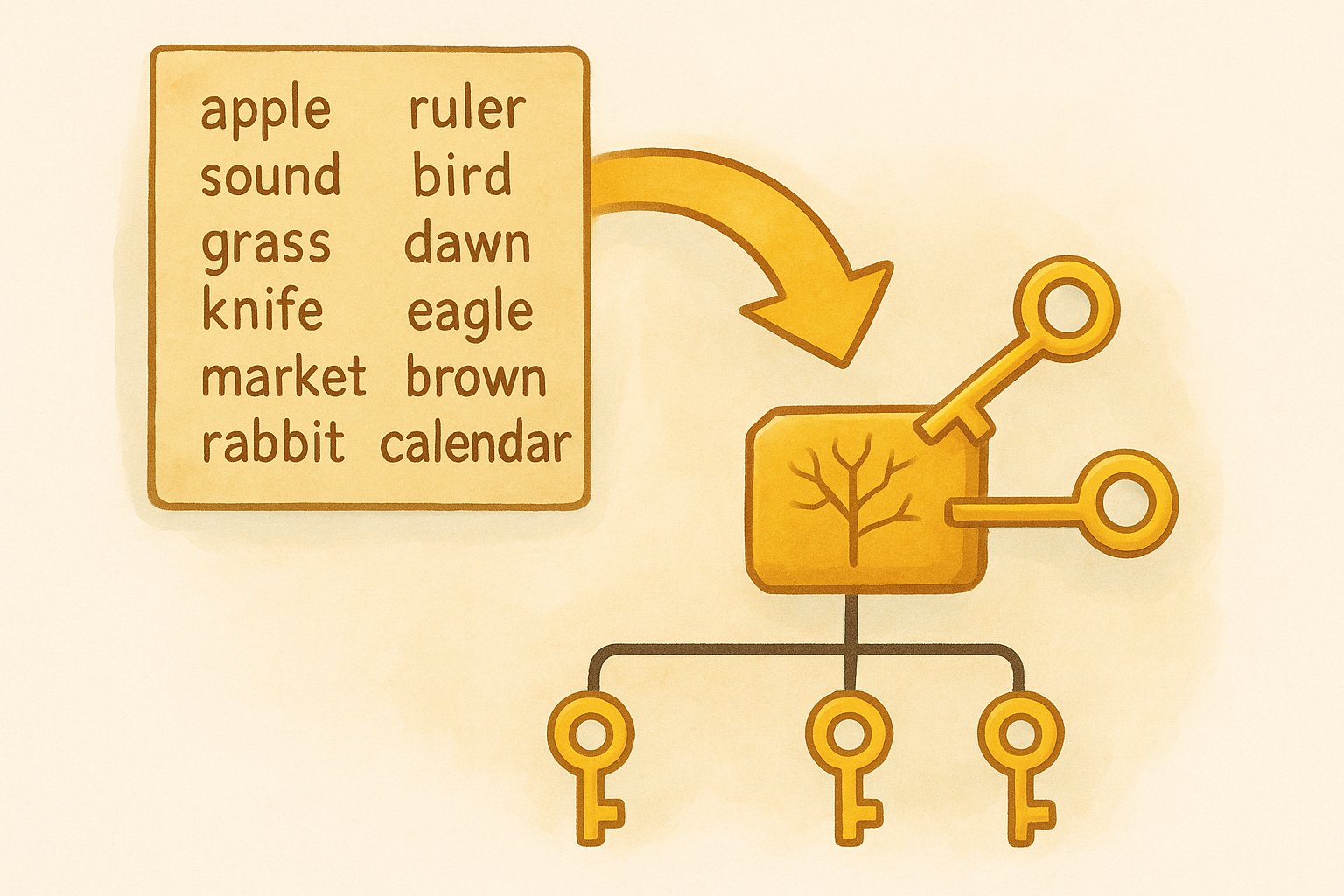
The deterministic nature of seed phrase derivation is what allows you to restore a full wallet on any compatible device using just those words.
Why one phrase covers multiple blockchains
Modern wallets extend the derivation path to assign separate branches for separate blockchains, so your Bitcoin addresses, Ethereum addresses, and other assets all trace back to one root. This is the key insight in private key vs seed phrase security: you are not backing up individual keys when you write down your seed phrase. You are backing up the single source that generates all of them.
How to store, share, and recover safely
Understanding the private key vs seed phrase distinction directly shapes how you handle storage and recovery. Your seed phrase carries the highest risk because it controls your entire wallet. Your private keys carry narrower but still serious risk. Treating both with intentional, offline security practices is what separates a recoverable setup from a permanent loss.
Storing your seed phrase offline
Write your seed phrase on paper or a durable metal backup plate the moment your wallet generates it. Never type it into any digital device, including phones, computers, or voice assistants. Store the physical backup in a secure, private location such as a fireproof safe or a safety deposit box. For wallets holding significant value, consider keeping a second copy in a separate physical location.
Never photograph your seed phrase or store it in any cloud service, even one you consider private.
What you should never share
The rule on sharing is simple: never share your seed phrase or your private keys with anyone, under any circumstances. Legitimate wallet support teams, exchanges, and hardware wallet manufacturers will never ask for either credential. If someone requests this information, treat it as an attack regardless of how official it looks.
For individual private keys, the same logic applies. Export a raw private key only when you are actively migrating funds to a new wallet, and perform that operation on an offline or air-gapped device whenever possible. Once the migration is complete, move the funds out of the old address so the exposed key controls nothing of value.
Key takeaways and what to do next
The private key vs seed phrase distinction comes down to scope. A private key controls one address, while a seed phrase controls your entire wallet. Exposing a private key puts one address at risk. Exposing your seed phrase puts every address and every asset you hold at risk. Both credentials deserve serious protection, but they operate at different levels and require different handling.
Your most important action right now is to verify that your seed phrase is written down, accurate, and stored offline in at least one secure physical location. If you have not tested a wallet recovery using your seed phrase, you do not yet know whether your backup actually works. Fix that before your setup holds any significant value.
For deeper guidance on hardware wallets, cold storage, and practical security setups, visit FinTech Dynasty and explore the full range of wallet comparisons and self-custody resources available there.