

What Is An Open Source Crypto Wallet? Pros & Top Picks
When you hand your crypto to a wallet, you're trusting that the software does exactly what it claims, nothing more, nothing less. But how do you verify that trust if you can't see the code running behind the scenes? That's the core question behind what is an open source crypto wallet, and the answer has real implications for anyone serious about protecting their digital assets long-term.
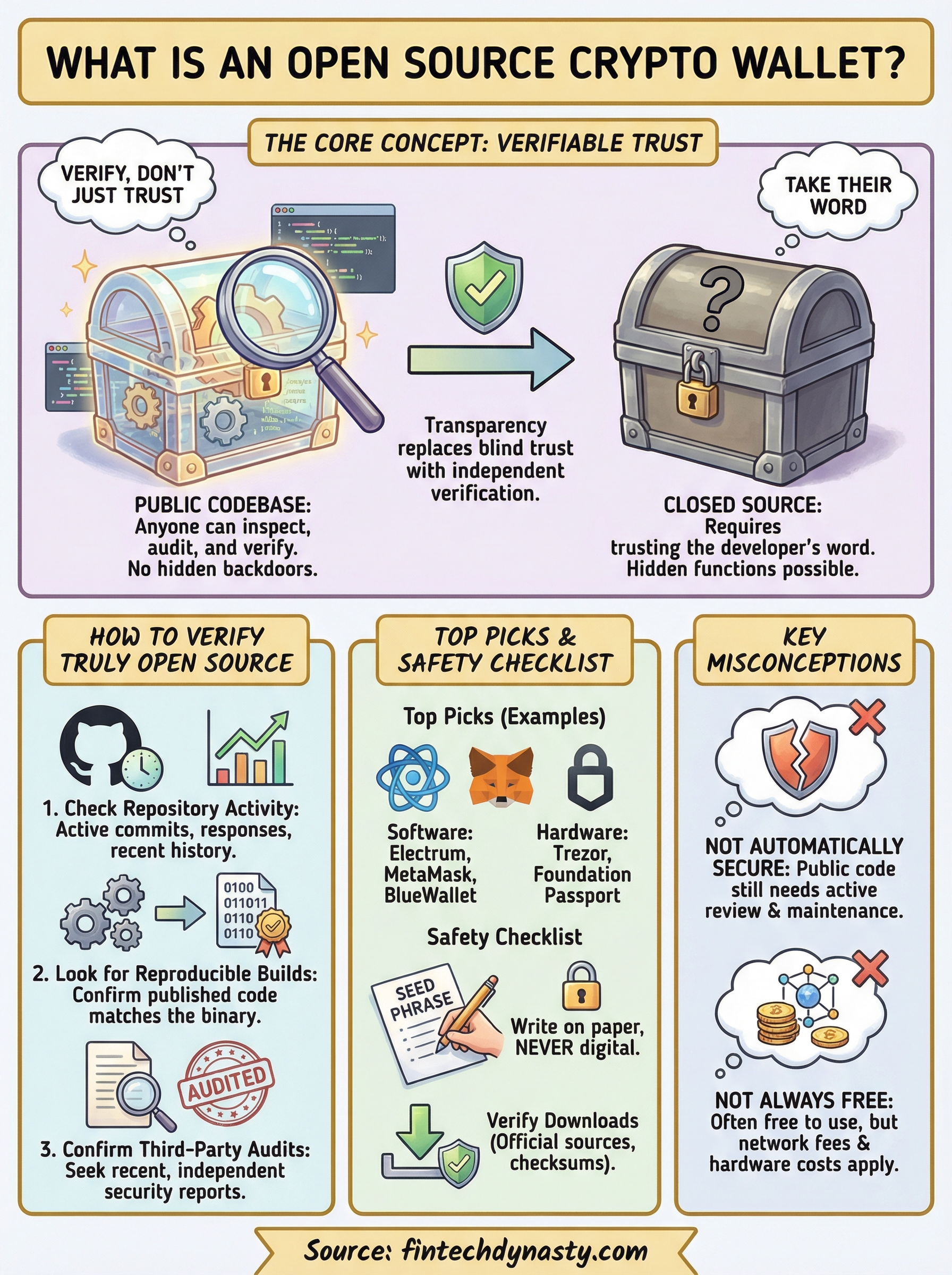
An open-source wallet makes its entire codebase publicly available for anyone to inspect, audit, and verify. This means security researchers, developers, and even you can confirm there are no hidden backdoors, tracking mechanisms, or vulnerabilities baked into the software. Closed-source wallets ask you to take the company at its word. Open-source wallets let you, or the broader community, check the receipts yourself.
At FinTech Dynasty, we focus on helping you understand the technical side of crypto security so you can make informed self-custody decisions, free from hype and speculation. This article breaks down how open-source wallets work, why transparency is a meaningful security feature, the tradeoffs you should consider, and our top picks for both software and hardware options worth evaluating. Whether you're moving off an exchange for the first time or upgrading your current setup, this guide gives you what you need to choose confidently.
What makes a crypto wallet open source
An open-source crypto wallet is software where the entire codebase is publicly available for anyone to read, copy, modify, and redistribute. The term "open source" refers specifically to a licensing model that removes the secrecy barrier between the developers and the people using the product. When you ask what is an open source crypto wallet, you're really asking: can I, or anyone else, independently verify that this wallet does exactly what it claims to do? With an open-source wallet, the answer is yes.
The role of the codebase
The codebase is the complete set of instructions that tells a wallet how to function. It governs how your private keys are generated, how transactions are signed, and how the wallet communicates with a blockchain network. In a closed-source wallet, this code sits behind a wall, visible only to the development team. In an open-source wallet, that same code lives in a public repository where any developer, security researcher, or technically curious user can read every line.
This transparency is not just a philosophical position. Every function that touches your private key is something you can verify directly rather than trust based on a company's marketing copy. If a wallet developer claims it never transmits your seed phrase to external servers, open-source code lets you confirm that independently rather than accepting it on faith.
When the code is public, trust becomes verifiable rather than assumed.
Public repositories and community audits
Most open-source wallets host their code on platforms like GitHub, where version history, changes, and contributor activity are all logged and publicly visible. This creates an environment where developers worldwide can review, flag, and report problems. When a vulnerability is discovered, it often gets patched faster because the community can submit fixes directly rather than waiting for an internal team to notice the issue.
Community audits strengthen security in a way that internal review rarely achieves on its own. A company's internal team has limited bandwidth and may carry blind spots shaped by their own assumptions about how users interact with the product. An open community reviewing the same code brings a wider range of expertise, and none of those reviewers have an internal incentive to overlook problems.
The difference between open source licensing and open source practice
Not every wallet that claims to be open source operates with full transparency in practice. Open source licensing means the code must be publicly available under terms that allow review, modification, and redistribution. Common licenses you will see include MIT, GPL, and Apache 2.0. However, a wallet can technically hold an open-source license while still publishing code that is outdated, incomplete, or mismatched with the actual binary you download and install.
This gap between licensing and practice is a real risk worth understanding before you commit to a wallet. You want to confirm that the published code is current, that the build process is reproducible, and that independent security firms have actually audited the codebase at some point. A wallet with a documented, verifiable audit trail provides a meaningfully stronger security foundation than one that posts code publicly but shows no evidence of active maintenance or external review. Checking for recent commits, open issues, and published audit reports tells you far more than the license label alone.
Why open source matters for wallet security
When you understand what is an open source crypto wallet, the security argument becomes straightforward: public code allows independent verification, and verification is the foundation of trust in any security-critical system. With a closed-source wallet, you have no way to confirm what the software actually does with your private key. You accept the developer's claims as fact, which places your entire financial security on a company's reputation rather than on independently verifiable evidence.
Independent verification replaces blind trust
No security claim carries weight unless someone outside the organization can test it. Open-source wallets allow any security researcher, developer, or auditing firm to examine every function that handles your private keys, seed phrase generation, and transaction signing. When multiple independent parties review the same code and reach consistent conclusions, that agreement creates a much stronger security assurance than any marketing statement.
This verification process also protects you from a specific risk: intentional backdoors or hidden data collection embedded by a developer with bad intentions. A malicious closed-source wallet can transmit your seed phrase to a remote server while presenting a perfectly normal interface. With open-source code, that kind of deception is far harder to sustain because the code must match the behavior that anyone can observe and test.
Open code cannot hide what closed code can bury.
Faster vulnerability detection and patching
Security flaws exist in every piece of software. The real question is how quickly they get found and fixed. Open-source projects benefit from a global pool of reviewers who bring different expertise and different attack perspectives than any single internal team. When someone finds a critical flaw, they can submit a patch directly or report it through the project's public issue tracker, compressing the time between discovery and resolution.
Closed-source wallets rely entirely on their internal development team to both discover and fix vulnerabilities, which limits the speed and breadth of that review. If a company is small, under-resourced, or simply slow to respond, a known vulnerability can remain unaddressed for months. With open-source wallets, community pressure and transparent issue tracking make it much harder to delay critical security updates without facing direct public accountability.
Open source vs closed source wallets
Choosing between an open-source and a closed-source wallet isn't just a preference. It's a fundamental security decision that determines how much you actually know about what happens to your private keys. Understanding what is an open source crypto wallet means understanding this contrast directly, because the differences affect your real exposure to financial risk in concrete, measurable ways.
What closed source wallets conceal from you
A closed-source wallet keeps its code private, which means you rely entirely on the developer's word about how it handles your data. You cannot verify whether the wallet logs your seed phrase, shares transaction data with third parties, or contains security flaws the company hasn't publicly acknowledged. The company may publish a privacy policy, but without access to the code, no external party can confirm the policy matches actual software behavior.
A privacy policy without verifiable code is a promise you cannot audit.
Closed-source wallets are not automatically malicious. Some well-funded development teams maintain strong internal security practices and commission independent auditing firms to review their software. But that audit data often stays private, which means you still cannot review the findings yourself. The more honest companies release summary reports, but even those summaries cannot give you the same confidence as reviewing the actual code and test methodology yourself. You inherit whatever trust level the auditing firm carries, rather than forming your own independent assessment of the evidence.
Where open source wallets have limitations
Open-source wallets carry real advantages, but they do not eliminate all risk. Publishing code publicly does not guarantee anyone has reviewed it carefully. A wallet project can sit in a public repository for years with no meaningful external audit, no active maintenance, and a small contributor base that lacks the depth to catch subtle cryptographic flaws. If a well-known project hasn't received a third-party security audit in over two years, that gap matters regardless of how clean the code appears at first glance. The label alone tells you less than the project's actual audit and maintenance history.
You should also understand that open-source code introduces a specific distribution risk: forked or modified versions. Once code is public, anyone can copy it, alter it, and redistribute it under a misleading name. A bad actor can take a trusted wallet's codebase, insert malicious functions, and release it as a near-identical product. This makes it critical to download only from verified, official project sources and confirm checksums where available, rather than treating all open-source wallets as equivalent by default.
How to verify a wallet is truly open source
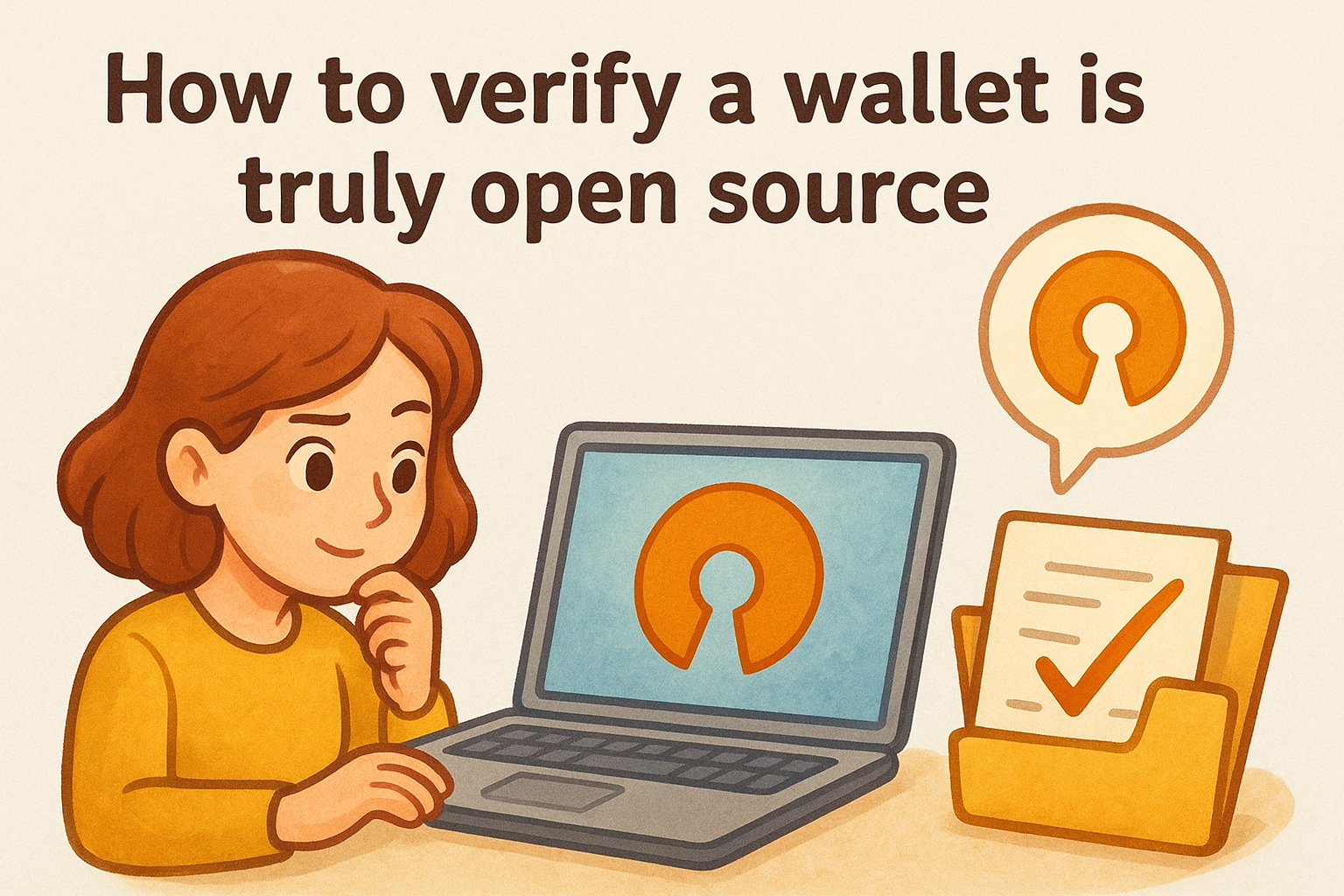
Knowing what is an open source crypto wallet is useful, but knowing how to confirm a wallet actually meets that standard is what protects you in practice. Companies can use the term loosely, and a wallet that posts code publicly without maintaining it gives you far less security than a well-audited project with an active contributor base. Verifying open-source status takes a few deliberate steps, but none of them require you to be a developer.
Check the repository directly
Start by locating the wallet's official GitHub repository and reviewing its activity. Look at when the last commit was made, how many active contributors there are, and whether open issues are being responded to. A repository with no activity in the past six months is a warning sign regardless of how polished the wallet interface looks. Check that the version shown in the repository matches the current version you would download, because if the code lags behind the released product, the published source does not reflect what you're actually running.
Confirm the license type as well. Look for a recognized open-source license such as MIT, GPL, or Apache 2.0 in the repository's root directory. Proprietary licenses or missing license files mean the code is not truly open source, even if the company claims otherwise.
A repository is only useful if the code inside it matches what you actually install.
Look for reproducible builds
A reproducible build means you can take the published source code, compile it yourself, and produce a binary that matches the official release exactly. This matters because a project can publish clean code while distributing a binary compiled from a different, modified version. Instructions for building from source should be included in the repository documentation. If a wallet provides no reproducible build process, you cannot fully verify the connection between the code you can read and the software you actually run on your device.
Confirm third-party audit history
Search for published security audit reports from independent firms. Legitimate projects commission audits and make the results publicly available, not just in summary form. Look for the auditing firm's name, the date of the audit, and whether the identified issues were addressed in subsequent releases. An audit from three or more years ago with no follow-up review provides limited assurance for a wallet you plan to use today, so prioritize projects that show a consistent pattern of external review over time.
Top open source crypto wallets to consider
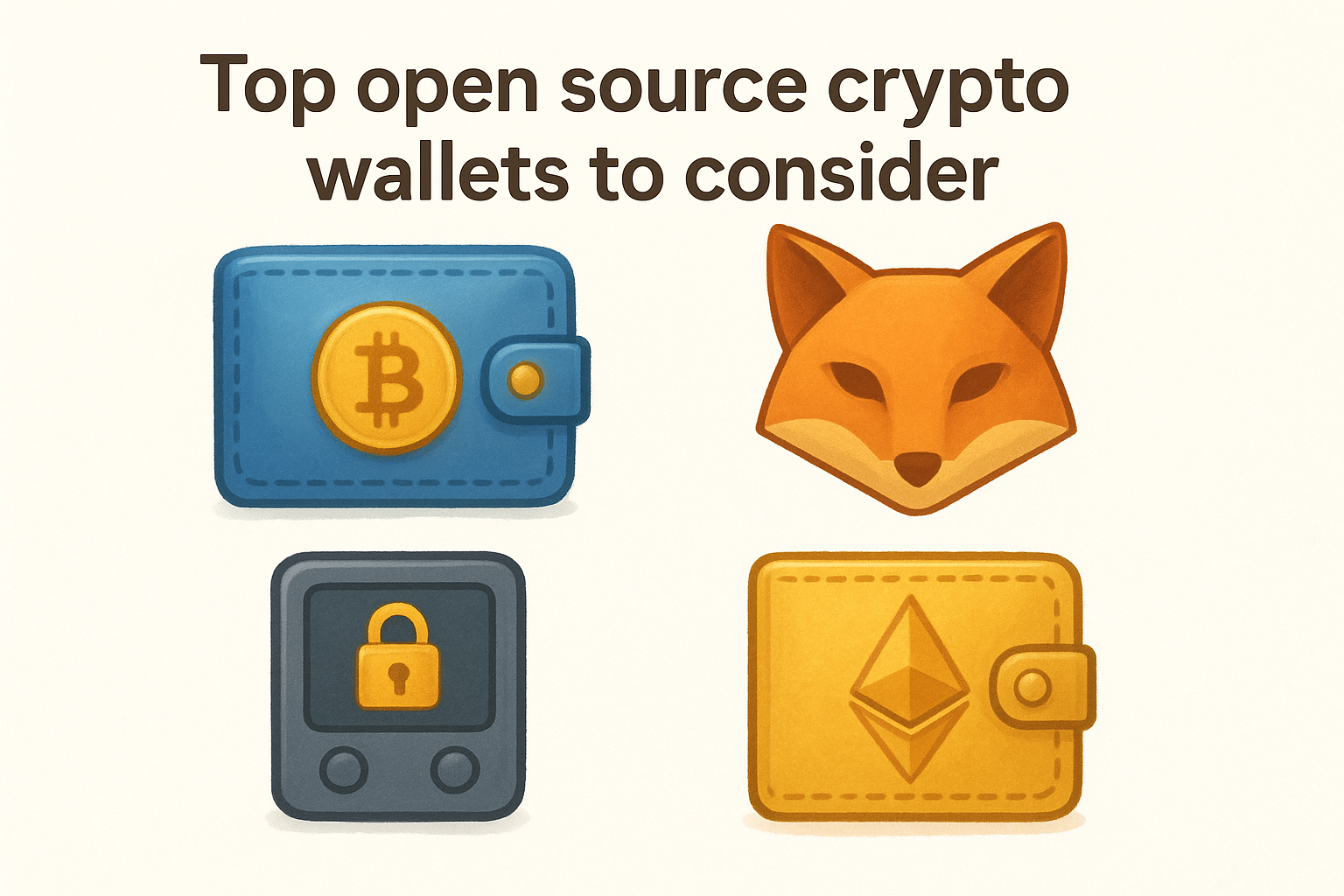
Now that you understand what is an open source crypto wallet and how to verify one, selecting a specific wallet becomes a more informed decision. The options below represent wallets with publicly available code, active repositories, and documented audit histories, but you should still verify their current status independently before committing to any of them, since maintenance activity and audit frequency change over time.
Open source software wallets worth evaluating
Electrum remains one of the most widely used Bitcoin software wallets, with a long public audit history and an active development community on GitHub. Its codebase is published under the MIT license, and it supports advanced features like multi-signature transactions and hardware wallet integration, making it a solid choice if you want fine-grained control over transaction fees and coin management.
MetaMask is the dominant open-source option for Ethereum and EVM-compatible networks. Its repository is publicly maintained and regularly updated, and it supports both browser extension and mobile use. You should note that MetaMask's business model involves optional analytics, which you can disable in settings, so reviewing its privacy configuration before first use is worth the few minutes it takes.
BlueWallet targets Bitcoin and Lightning Network users with a clean interface and a fully public codebase. It supports both custodial and non-custodial configurations, so confirm you are operating in non-custodial mode to retain full control of your private keys before relying on it for serious storage.
Knowing a wallet's name is not enough; checking its repository activity before you download is the step most users skip.
Open source hardware wallets worth evaluating
Trezor publishes both its firmware and hardware schematics as open source, which places it among the most transparent hardware wallet options available. Both the Model One and Model T have been reviewed by independent security researchers, and the build reproducibility process is documented in the official repository, allowing technically capable users to verify the firmware they install against the published source.
Foundation Passport takes open-source hardware wallet design further by making the hardware schematics, firmware, and manufacturing details fully public. It operates as an air-gapped device, meaning it never connects directly to an internet-connected computer during transaction signing, which removes a significant category of attack surface compared to USB-connected alternatives. If full-stack transparency matters to you, this is one of the strongest options currently available.
Safety checklist for using any wallet
Understanding what is an open source crypto wallet gets you part of the way to safer self-custody, but the wallet type alone does not protect you from the most common mistakes people make during setup and daily use. Your seed phrase, your download source, and your backup process are three areas where a single error can cost you permanent access to your funds. Running through a consistent checklist before and after setting up any new wallet closes the gaps that technical transparency alone cannot fill, and it takes less time than most people expect.
Protecting your seed phrase
Your seed phrase is the master key to every address in your wallet. Anyone who obtains those 12 or 24 words gains full and irreversible access to your funds, regardless of how secure the wallet software itself is. Write the phrase down on paper immediately during setup, confirm every word is legible, and store that paper in a location that is both physically secure and separate from the device running your wallet. Test your recovery process with a small amount before transferring significant funds, so you can confirm your backup is accurate before the stakes are high.
Your seed phrase should never exist as a photo, a note in your phone, or a file on any internet-connected device.
Use this list every time you initialize a new wallet:
- Write the seed phrase by hand on paper, never type it into any digital field
- Verify each word matches the on-screen prompt exactly before completing setup
- Store the written copy in a fireproof location, physically separated from your device
- Never photograph, screenshot, or copy-paste the seed phrase
- Perform a small test recovery before sending significant funds to the wallet
Downloading and verifying your wallet
Always download wallet software directly from the official project website or verified repository, never from third-party download sites, unsolicited app store links, or URLs shared in forum comments. Attackers regularly publish copycat wallets that look identical to legitimate ones but contain code that captures your seed phrase the moment you enter it during setup.
After downloading, verify the file checksum against the value published by the official project. Most open-source wallet projects publish SHA256 checksums alongside their release files, which you can compare using built-in tools on Windows, macOS, or Linux. If the values do not match, delete the file immediately and report the discrepancy through the project's official communication channel before attempting another download.
Common questions about open source wallets
People researching what is an open source crypto wallet tend to arrive with a handful of recurring questions that deserve direct answers. The following covers the ones that come up most often, so you can move forward with confidence rather than uncertainty.
Are open source wallets free to use?
Most open-source wallets cost nothing to download and install, which is a direct result of their open licensing model. However, free to use does not mean free of all costs. You still pay standard blockchain network fees each time you broadcast a transaction, which vary based on network congestion and are unrelated to the wallet software itself. Hardware wallets with open-source firmware, like Trezor or Foundation Passport, require you to purchase the physical device, but the software running on them remains publicly auditable.
Does open source mean a wallet is automatically secure?
No, and this is the most important misconception to correct. Public code does not equal reviewed code. A wallet project can sit in an open repository for years with minimal contributor activity, no external audits, and unresolved security issues. What open source provides is the opportunity for verification, not a guarantee that verification has happened. You should always check for recent independent audit reports and active maintenance history before treating any wallet as secure, open source or not.
The transparency open source provides is only as valuable as the review activity it has actually received.
Can a beginner use an open source wallet safely?
Yes, but your level of technical knowledge should match the wallet you choose. Software wallets like MetaMask and BlueWallet offer straightforward interfaces that beginners can navigate without reading a single line of code. You benefit from the open-source security model without needing to compile the software yourself. Where experience matters most is in seed phrase management and download verification, which are practical habits rather than technical skills, and both are covered earlier in this guide.
Do hardware wallets also come in open source versions?
Several do. Trezor publishes its firmware and hardware schematics openly, and Foundation Passport takes that further by making the full hardware design public. Not all hardware wallets follow this model. Some use proprietary firmware on top of open-source elements, so it is worth checking the specific repository for each component rather than accepting a blanket claim of openness at face value.
Next steps for safer self-custody
Understanding what is an open source crypto wallet gives you a real foundation for making smarter security decisions, but knowledge only protects you when you act on it. Your immediate next step is to review any wallet you currently use against the verification criteria covered in this guide: check the repository activity, confirm the license type, and look for a current third-party audit report. If your wallet fails those checks, start researching alternatives using the top picks listed above as a starting point.
Moving your assets off an exchange and into a properly verified, open-source wallet you fully control is one of the highest-impact security improvements you can make as a crypto holder. If you want structured guidance through the full process, the FinTech Dynasty crypto education course walks you through securing your crypto from basics to advanced self-custody in a clear and practical way.