

Address Verification Meaning: How It Works And Why Matters
Every time you buy a hardware wallet online, sign up for a crypto exchange, or verify your identity on a financial platform, there's a good chance your physical address gets checked behind the scenes. The address verification meaning comes down to a simple concept: confirming that a given postal address is real, accurate, and deliverable by cross-referencing it against authoritative databases like those maintained by USPS, Royal Mail, or similar postal authorities.
The process matters more than most people realize. A failed address verification can delay your hardware wallet shipment, block your exchange account activation, or flag your transaction for manual review. For anyone in the crypto space who values security and self-custody, the kind of people we serve here at FinTech Dynasty, understanding how this system works gives you a clearer picture of the verification layers between you and your assets. It also helps explain why platforms ask for the information they do, and what happens with it after you hit submit.
This article breaks down exactly how address verification works, the technology behind it, where it's commonly applied in fintech and e-commerce, and why it should matter to anyone managing digital assets or purchasing security-focused products like cold storage devices.
What address verification is and is not
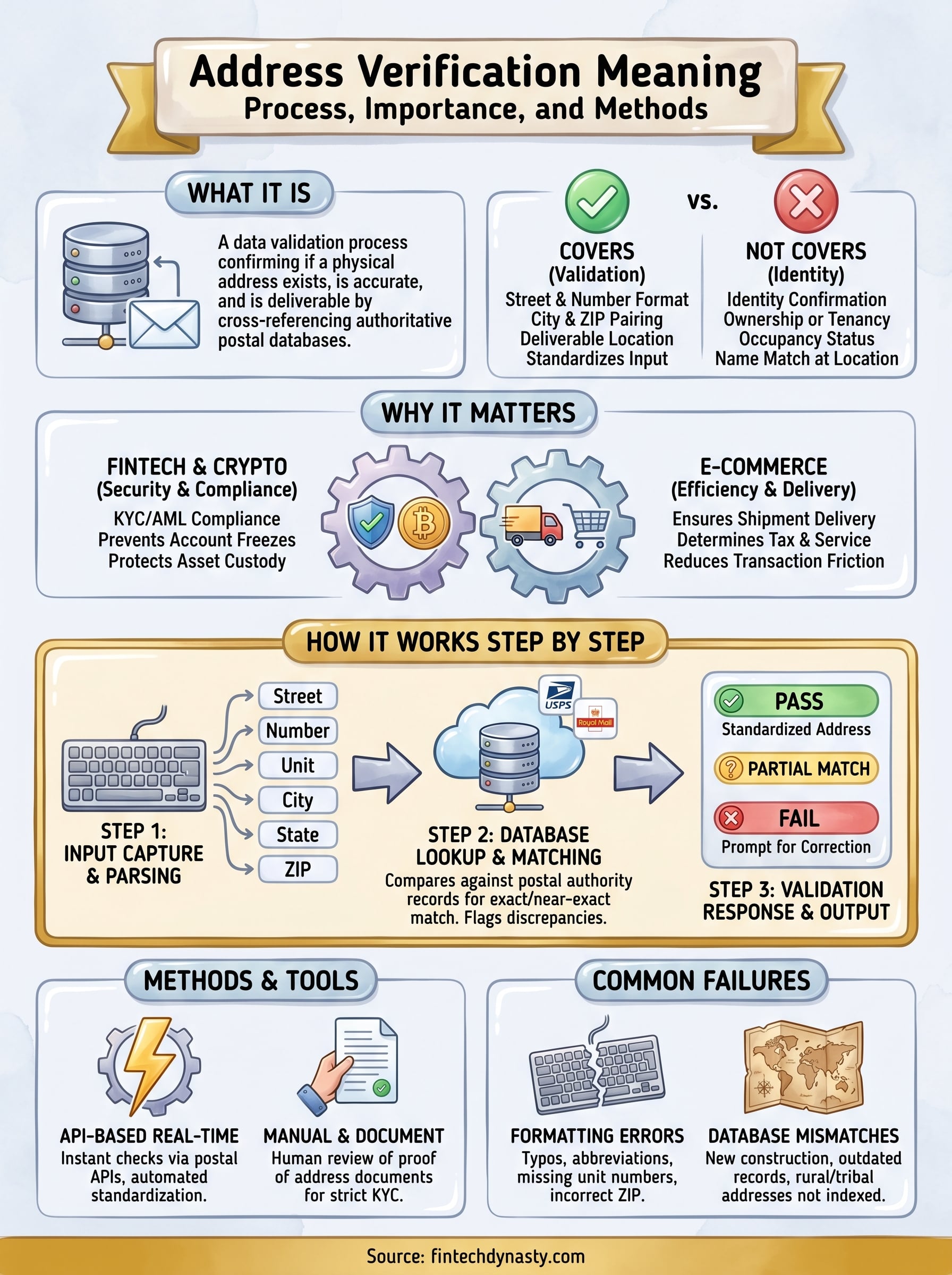
Address verification is a data validation process that checks whether a physical address exists and can receive mail or deliveries. The system compares what you submit against authoritative postal databases, like those maintained by the USPS, to confirm the address is correctly formatted and deliverable. People often confuse the address verification meaning with identity verification or fraud detection, which are related but distinct processes.
What address verification actually covers
When you enter your address on a platform, the verification system checks several things in sequence: the street name and number format, the city and ZIP code pairing, and whether the full string maps to a known deliverable location. It can also standardize your input, converting abbreviations to accepted formats or correcting minor typos automatically. The goal is to confirm the address points to a real, reachable place.
An address can pass verification and still belong to someone else. Verification confirms existence, not ownership.
The system may also return additional data points, including delivery point validation codes and whether the address is classified as residential or commercial. This enriched output helps platforms route your package correctly or determine which services they can offer at your location.
What address verification does not cover
Address verification does not confirm your identity or prove you live at the address you provided. It only validates that the address itself is real and correctly formatted. Platforms that need to link an address to a specific person run a separate identity verification step, which typically involves document checks or cross-referencing through credit bureau records.
Common things address verification does not do:
- Confirm you own or rent the address
- Check whether the address is currently occupied
- Verify that your name matches any records at that location
Knowing this distinction matters when an account gets flagged. Your address can pass verification completely while your identity check still fails, and the reverse is equally possible.
Why address verification matters
Address verification sits at the center of several processes you interact with regularly, even if you never see it running. For crypto users, failed verification can freeze account access or delay the shipment of a cold storage device you need to protect your assets. Getting it right the first time saves you time and avoids unnecessary friction with platforms that depend on clean, accurate address data to function properly.
Inaccurate address data costs businesses billions each year in undeliverable mail, returned packages, and failed compliance checks, and those costs often translate into slower service and more friction for customers.
The role it plays in fintech and e-commerce
The address verification meaning extends well beyond package delivery. In fintech and regulated financial platforms, accurate address data is a legal requirement tied to Know Your Customer (KYC) and anti-money laundering (AML) compliance. Platforms must confirm you exist at a real, verifiable location before they can process transactions or unlock account features.
For e-commerce, particularly when you're ordering hardware wallets or security accessories, a verified address reduces the risk of delivery failure and protects both you and the merchant. Platforms also use your address data to determine tax jurisdiction, shipping eligibility, and regional service availability. Every field you fill in serves a specific function, and address verification is what keeps that data reliable and actionable across the entire transaction.
How address verification works step by step
The address verification meaning is easier to grasp when you follow what actually happens to your data after you submit it. The process runs in seconds, but it moves through several distinct stages before the system returns a result.
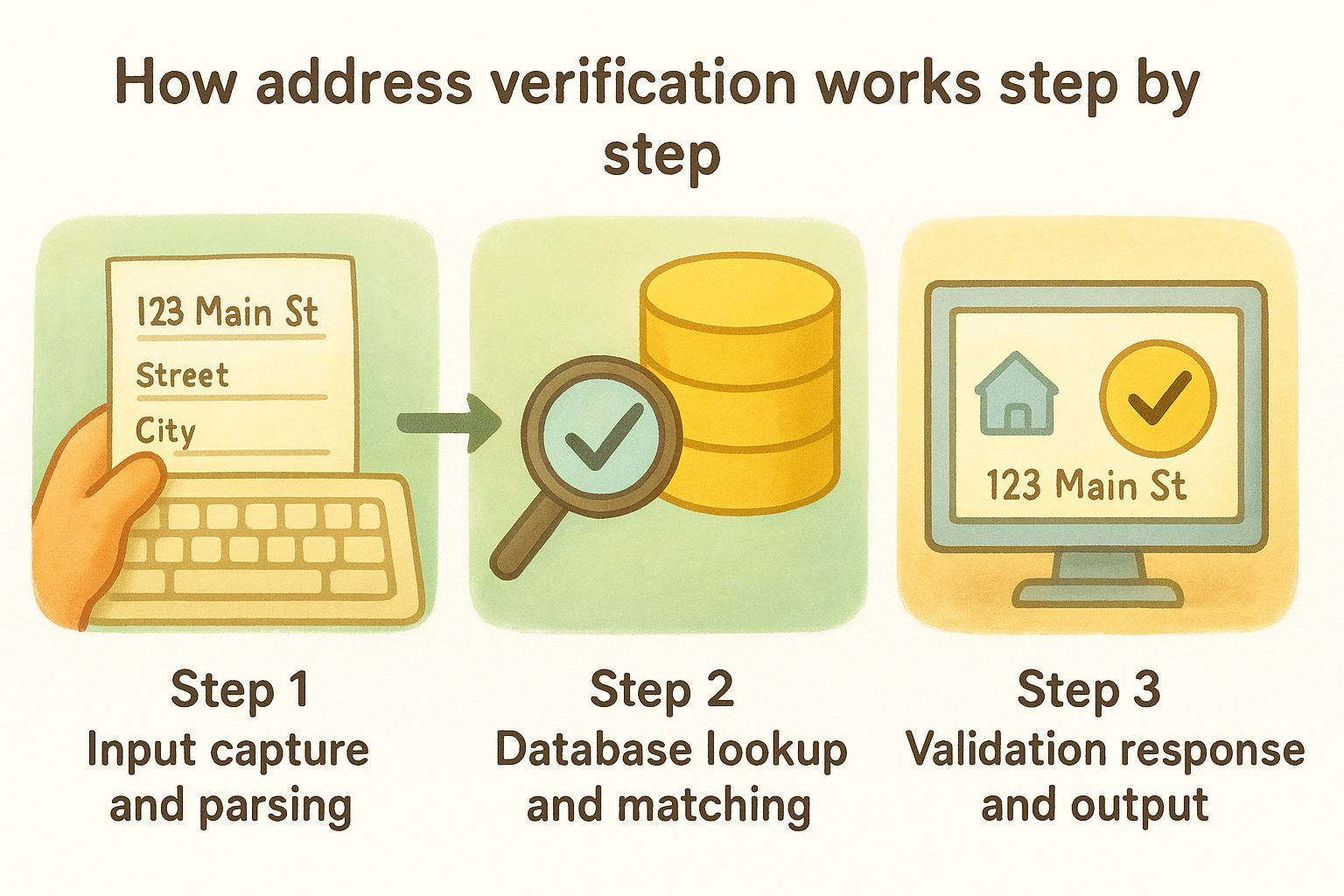
Step 1: Input capture and parsing
When you type your address into a form, the system immediately breaks the input into components: street number, street name, unit or apartment designator, city, state, and ZIP code. This parsing step separates your raw text into structured data fields the verification engine can actually read and compare.
Step 2: Database lookup and matching
The parsed data gets sent to a postal authority database, such as the USPS Coding Accuracy Support System (CASS), which holds records of every recognized delivery point in the country. The system looks for an exact or near-exact match against that database and flags discrepancies it finds along the way.
If your input contains a common abbreviation or minor typo, many systems will auto-correct it and return a standardized version before checking for a match.
Step 3: Validation response and output
The system returns a pass, fail, or partial match result to the platform. A passing result often includes a standardized address string the platform stores for future use, while a failure triggers a prompt asking you to re-enter or correct your information.
Address verification methods and tools
The address verification meaning plays out differently depending on which method a platform uses to check your data. Some systems run automated checks in real time, while others rely on manual document review to confirm your details. Understanding the available methods helps you anticipate what a platform needs from you and why certain verification steps take longer than others.
API-based real-time validation
Most modern platforms connect to postal authority APIs that verify your address the moment you finish typing. These integrations pull directly from databases like the USPS Web Tools API, which gives platforms instant access to every recognized delivery point in the United States. The result comes back in milliseconds, and standardized address data gets stored automatically if the check passes.
Real-time API validation catches formatting errors before they reach a human reviewer, which means fewer delays on your end.
Manual and document-based verification
Some regulated platforms, particularly those with strict KYC compliance requirements, ask you to submit a proof of address document alongside your automated check. Accepted documents typically include a recent utility bill, a bank statement, or a government-issued letter showing your name and address. A compliance reviewer then compares what you submitted against your declared address to confirm the two match before your account moves forward.
Common reasons an address fails verification
Understanding the address verification meaning includes knowing what causes the process to break down. Most failures come from predictable, correctable issues on the user side rather than system errors, which means you can often fix a failed check without contacting support.
Formatting and data entry errors
The most common cause of a failed check is incorrect formatting. Postal databases match against very specific patterns, so a misspelled street name, a missing apartment number, or a transposed ZIP code can prevent a match entirely. These small errors get caught immediately when the system parses your input and finds no corresponding record.
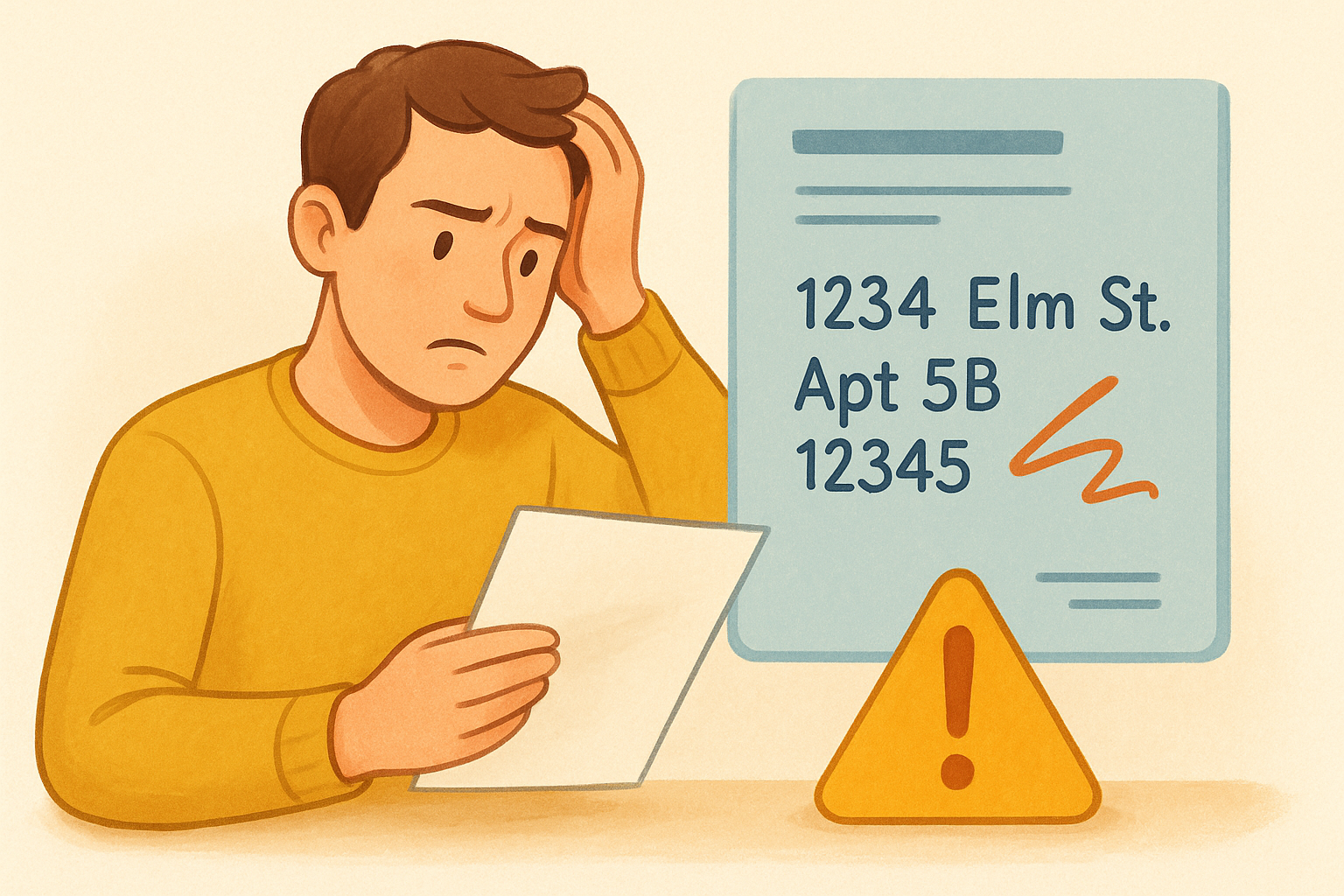
Double-checking your entry before you submit takes less than ten seconds and prevents most formatting-related failures upfront.
Common formatting issues that trigger failures include:
- Abbreviated street types that don't match the database entry (for example, "St" versus "Street")
- Missing unit or suite numbers on multi-unit buildings
- Incorrect ZIP code and city pairings
Database mismatches and outdated records
Some addresses fail verification because the postal database hasn't caught up with reality. New construction, recently renamed streets, and rural or tribal addresses sometimes lack entries in major systems like USPS CASS. Your address can be completely legitimate and deliverable while still returning a failed result if it hasn't been indexed yet. In those cases, a platform's manual document review process is your best path forward.
What to do next
Now that you understand the address verification meaning, you can approach any platform's onboarding process with real confidence. When you submit your address to a crypto exchange, a hardware wallet shop, or any financial service, you know exactly what the system checks, why it checks it, and what causes it to fail. That knowledge alone saves you time and prevents avoidable account delays before they turn into bigger problems.
Your next step is building the broader knowledge base that supports your crypto security decisions. Knowing how address verification fits into the larger landscape of KYC compliance and self-custody puts you in a stronger position to protect your assets long term. If you want to go deeper on wallet management, private key security, and taking real control of your digital wealth, start with our structured crypto education course and work through the topics that matter most to your situation.