

International Address Verification API: Benefits And Use
Every time a business ships a product across borders, whether it's a hardware wallet headed to a customer in Germany or a security accessory bound for Japan, the accuracy of the delivery address determines whether that package arrives or gets lost in limbo. Bad address data costs companies billions annually through failed deliveries, returned shipments, and frustrated customers. An international address verification API solves this by programmatically validating, standardizing, and confirming the deliverability of postal addresses worldwide, across different formats, languages, and postal systems.
At FinTech Dynasty, we focus on helping people secure their digital assets through independent research and practical guidance. Part of that mission means understanding the fintech infrastructure that supports global commerce, especially when physical products like cold storage devices need to reach buyers accurately and efficiently. Address verification sits at that intersection of digital systems and real-world logistics.
This article breaks down how international address verification APIs work, what makes them valuable for businesses operating globally, and where they fit into modern fintech and e-commerce workflows. Whether you're evaluating one for your own platform or simply want to understand the technology, you'll walk away with a clear picture of the benefits, limitations, and practical applications.
Why international address verification matters
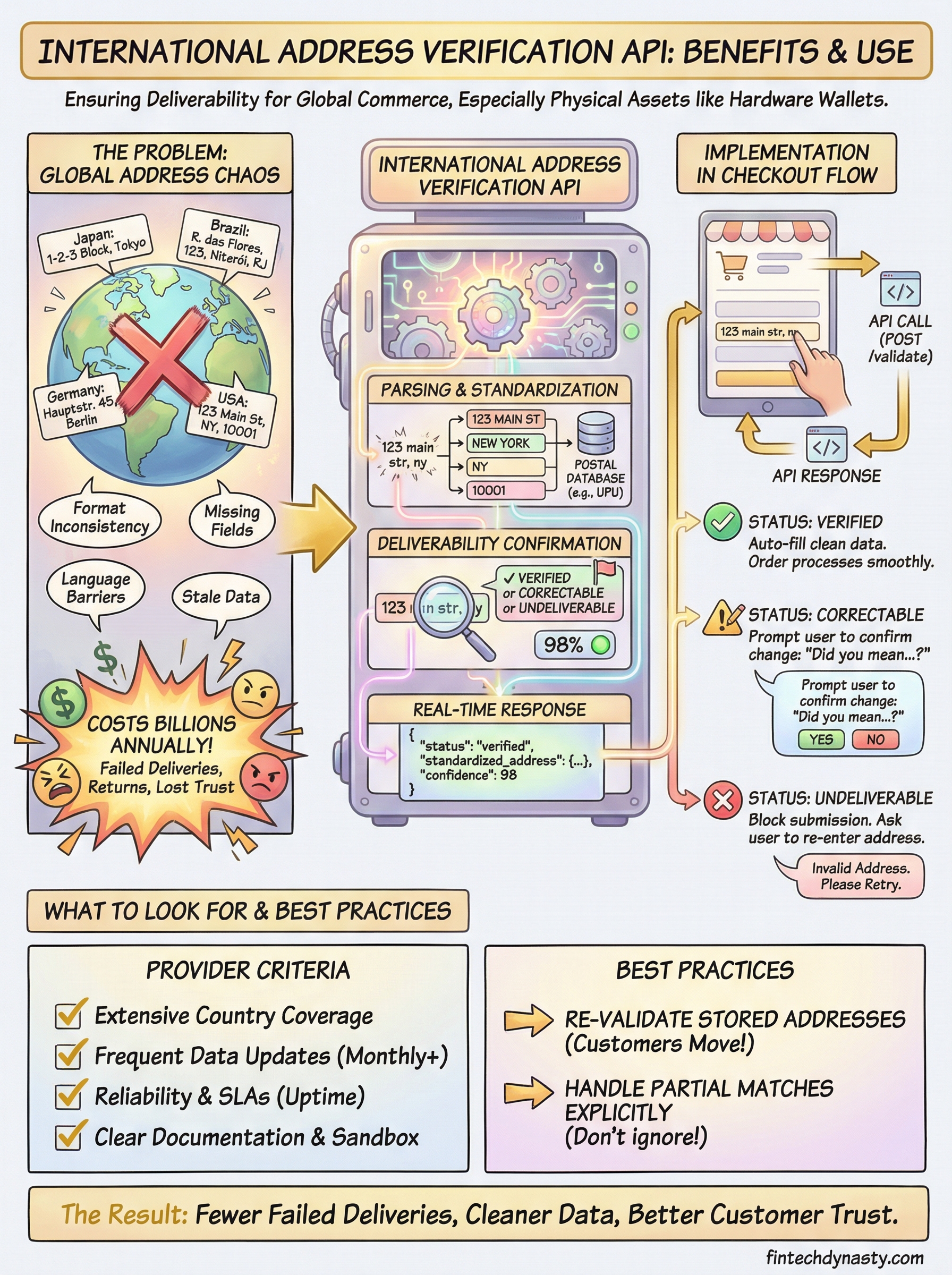
Global postal systems do not follow a single standard. A street address in Japan lists the block and lot number before the street name, while an address in Brazil requires a specific neighborhood field that most Western forms ignore entirely. When your platform collects addresses from users in dozens of countries, even a small mismatch between what the user types and what the postal carrier expects can cause a shipment to fail, a package to be returned, or a customer to never receive what they paid for. The problem compounds fast at scale.
The real cost of bad address data
Returned packages, re-shipments, and customer service overhead add up quickly. Industry logistics reports consistently show that bad address data accounts for a disproportionate share of failed deliveries, and the downstream costs extend well beyond postage. Your team spends time manually correcting records. Your warehouse handles return processing. Your customer waits, loses confidence, and sometimes requests a refund before the package even makes it back to you.
Inaccurate address records do not just delay deliveries; they erode customer trust in ways that take much longer to rebuild than the time saved by skipping validation.
For businesses selling physical products internationally, like hardware wallets or cold storage accessories, a failed delivery can also expose sensitive order information in addition to wasting money and time. The stakes climb higher when the product itself serves a security purpose.
Why format inconsistency is the core problem
Most address validation failures come down to format inconsistency across postal systems. The United States uses a numeric ZIP code. The United Kingdom uses an alphanumeric postcode with a specific structure. Canada uses a six-character code with a space in the middle. Germany breaks addresses across multiple lines in a particular order. No single input field handles all of these correctly without dedicated logic behind it.
Your checkout form likely treats every address the same way, which means it passes invalid data straight into your database. By the time a shipment fails, the record is already wrong, and correcting it retroactively costs more than preventing the error at the source. This is exactly where an international address verification API becomes essential. Rather than building country-specific validation logic into your product manually, an API handles the parsing, standardization, and deliverability confirmation automatically. You send an address string; the API returns a verified, standardized version along with a status code, keeping your data clean from the moment of entry.
How an international address verification API works
When your system sends a raw address string to an international address verification API, the API runs it through a structured pipeline. Each step in that pipeline transforms messy, inconsistent input into a clean, standardized record your database and shipping carrier can actually use. The process happens in milliseconds, typically through a single HTTP request and response.
Parsing and standardization
The API first breaks the address into its component parts: street number, street name, city, region, postal code, and country. This is harder than it sounds because different countries place these components in different orders, and users often omit or transpose fields. Once the components are identified, the API maps them against official postal databases maintained by national postal authorities, such as those published by the Universal Postal Union. If the input says "Str." instead of "Strasse," the API resolves the abbreviation and returns the correct, standardized form.
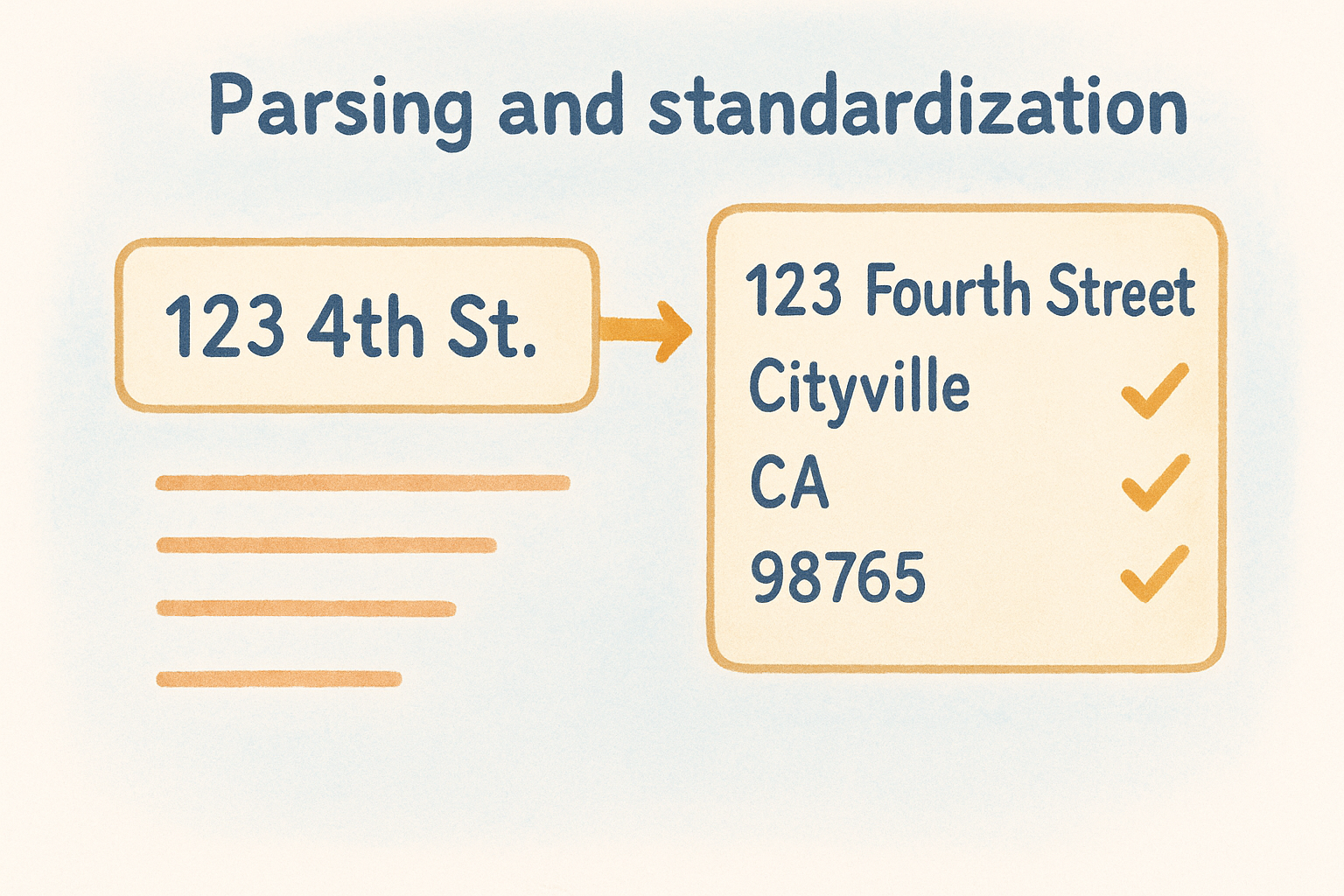
Standardization is not just cosmetic cleanup; it is the step that makes your address data compatible with carrier systems that would otherwise reject or misroute the shipment.
Deliverability confirmation
After standardization, the API checks whether the address actually exists and can receive mail. Some providers also return a confidence score or a deliverability status flag, such as "verified," "correctable," or "undeliverable." Your application can use that flag to prompt the user to correct their input before the order processes, rather than discovering the problem days later when the shipment fails. This real-time feedback loop keeps bad data out of your records from the start.
How to implement it in real products
Most platforms add an international address verification API at the point of user input, typically during checkout or account registration. Calling the API at this stage catches errors while the user is still present and able to correct them, which is far more effective than running a batch cleanup after orders process. Your integration path depends on your stack, but the core pattern stays consistent: send a raw address, receive a structured validated response, then act on the status your application receives.
Adding validation at the checkout layer
Your checkout form is the highest-value integration point for address verification. When a user finishes entering their address, your frontend triggers an API call and either auto-fills the corrected fields or prompts the user to confirm a suggested change before the order submits. This works across web and mobile applications and keeps your records clean from the moment of purchase.
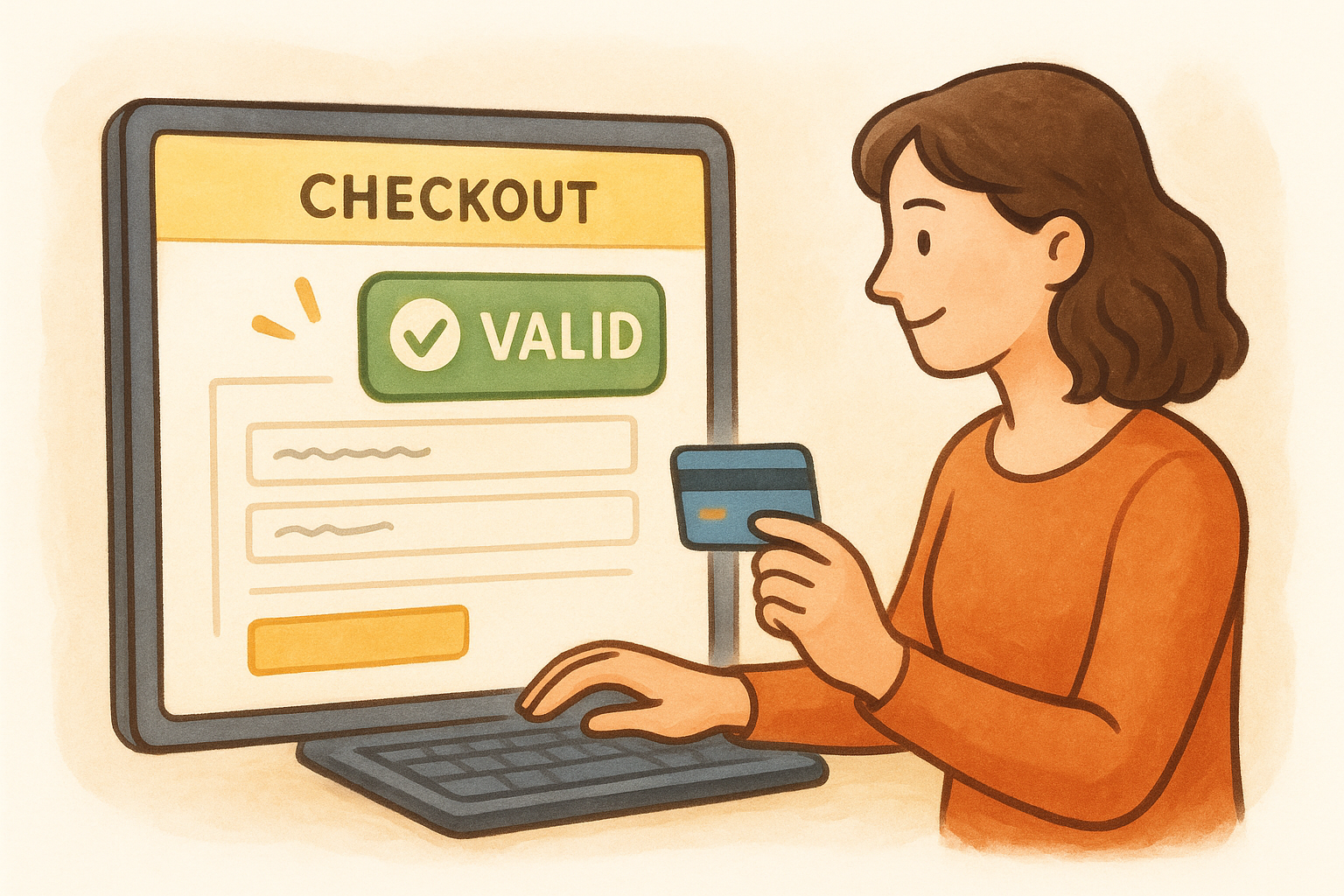
Catching an address error at checkout costs a fraction of what a failed international shipment and manual correction process will cost you later.
Most providers offer REST endpoints with JSON request and response structures, which means your backend team can complete a basic integration quickly using standard HTTP libraries.
Handling the API response in your application
After the API responds, your application needs to map each status code to a specific user-facing action. Building that logic explicitly, rather than treating all responses the same, keeps your fulfillment pipeline reliable. Here is how most implementations handle the three primary status types:
- Verified: Address matches a deliverable record. Pass it through automatically.
- Correctable: The API adjusted the address. Show the user the corrected version for confirmation.
- Undeliverable: No valid match found. Block submission and prompt the user to re-enter.
What to look for in an API provider
Not every international address verification API delivers the same quality of results. Your choice of provider directly affects how accurate your address data is, how well your integration holds up under production load, and how quickly your team can maintain it over time. Before you commit to a provider, evaluate a focused set of criteria that determines whether the API actually solves your problem or simply adds another dependency to manage.
Coverage and data freshness
The most important factor is how many countries the API supports and how frequently the underlying postal data updates. Postal codes change, new streets are added, and city boundaries shift regularly. Check whether the provider clearly documents its data sources and update cadence before you sign up. When reviewing any provider, confirm these specifics:
- Country coverage count and whether it includes your core markets
- Data refresh frequency, with monthly updates as a reasonable baseline
- Source attribution to national postal authorities such as those catalogued by the Universal Postal Union
Stale postal data will verify addresses as deliverable when they are actually invalid, which silently lets bad records into your system without triggering any error.
Reliability and documentation
Your application depends on the API responding consistently under peak load. Look for providers that publish uptime SLAs and offer sandbox environments so your team can test edge cases before going live. A provider that degrades during high-traffic checkout windows creates real problems for your customers at the worst possible moment.
Clear reference documentation, accurate code samples, and transparent error code definitions reduce integration time and make debugging faster when something breaks in production. Strong documentation is not optional; it is what separates a provider you can maintain from one that becomes a long-term liability.
Common pitfalls and best practices
Even a well-integrated international address verification API can underperform if your implementation overlooks a few recurring mistakes. Most of the issues teams encounter are not technical failures in the API itself but gaps in how the application handles API responses or when validation occurs in your workflow.
Skipping validation for returning customers
Many platforms only validate addresses during initial registration and then skip checks on subsequent orders, assuming the stored address is still correct. This is a mistake. Postal routes change, customers move, and addresses that were valid six months ago may no longer be deliverable. Run verification against stored addresses periodically, or at least prompt users to confirm their address when they revisit checkout after an extended absence.
Treating a stored address as permanently valid is one of the most common sources of silent delivery failures in e-commerce fulfillment systems.
Ignoring partial match responses
When your API returns a "correctable" status, your application needs to surface that correction to the user rather than silently accepting or silently rejecting the input. Teams that treat partial matches the same as verified records let inaccurate data through, while teams that block them outright frustrate users with valid addresses that simply need minor standardization. The right approach is to show the suggested correction clearly, let the user confirm or override it, and log the outcome for quality review.
Building a review process into your workflow also helps you catch patterns in where your users make errors, which can inform improvements to your address input form design and reduce the volume of corrections your team needs to handle manually over time.
Next steps
Adding an international address verification API to your platform is a straightforward investment that pays off quickly through fewer failed deliveries, cleaner data, and a better checkout experience for your customers. The core steps are clear: pick a provider with strong country coverage and fresh postal data, integrate the API at your checkout layer, and build explicit logic for each response status so your application handles verified, correctable, and undeliverable addresses differently.
Start by testing your current address data against a sandbox environment to see how much of your existing inventory would fail verification. That gap reveals exactly how much bad data you are already working with and gives you a concrete baseline to measure your improvements against. From there, a production integration and a periodic re-verification schedule will keep your records accurate over time.
If you want to build a stronger foundation in how digital infrastructure and fintech tools connect, explore the FinTech Dynasty crypto education course to deepen your understanding.