

What Is A Software Bill Of Materials (SBOM)? Explained
Every hardware wallet, every crypto app, and every piece of security software you trust with your digital assets is built from dozens, sometimes hundreds, of individual software components. If even one of those components carries a hidden vulnerability, your funds could be at risk. A software bill of materials (SBOM) is the document that makes those hidden layers visible, and understanding it matters more than most crypto holders realize.
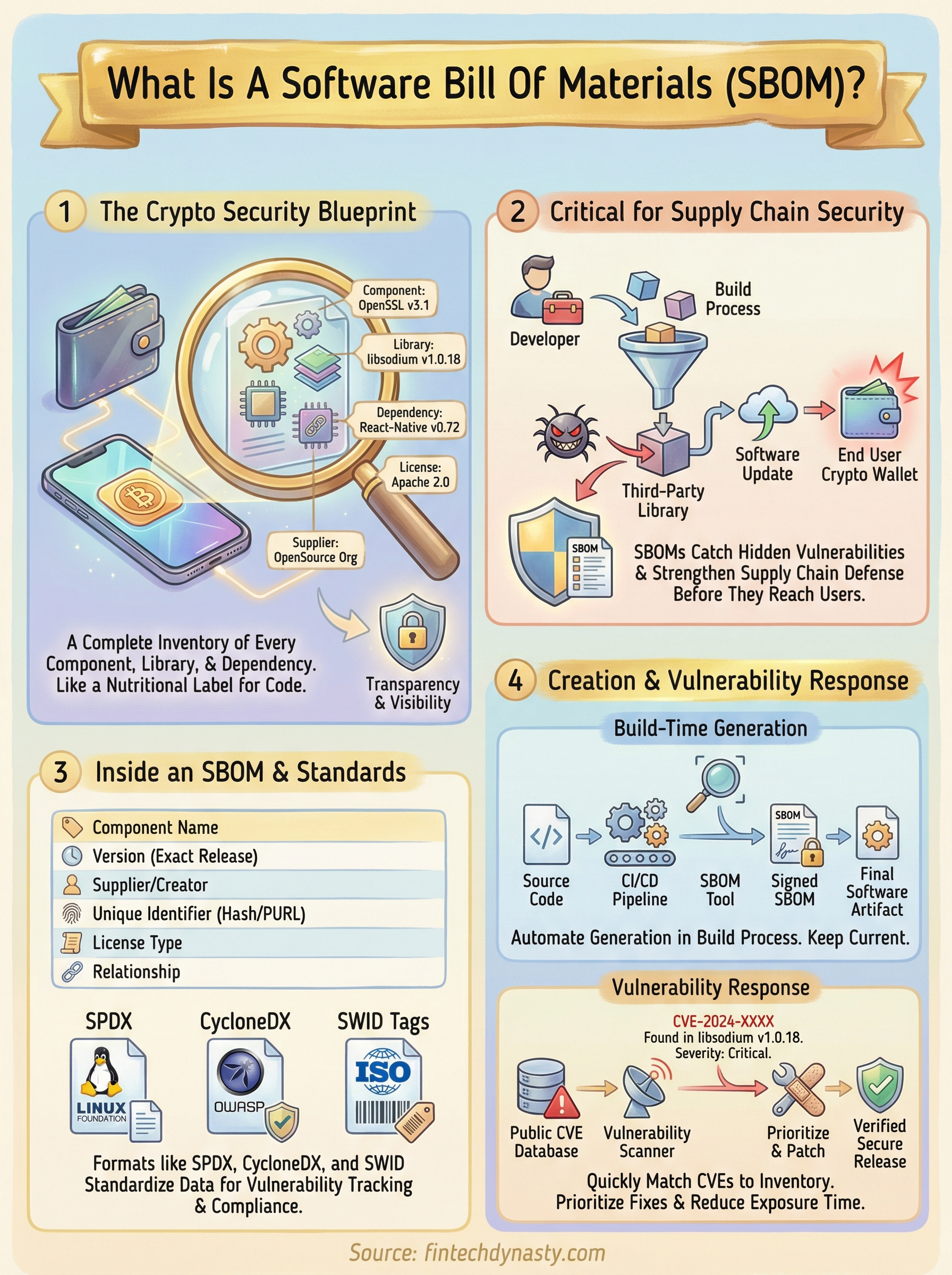
An SBOM is essentially a complete inventory of every component, library, and dependency inside a piece of software. Think of it like a nutritional label, but for code. It lists what's inside, where it came from, and what version is running. Organizations use SBOMs to track vulnerabilities, verify licensing compliance, and strengthen software supply chain security before threats reach end users.
At FinTech Dynasty, we focus on helping you make informed decisions about the tools that protect your crypto. That means going beyond surface-level wallet comparisons and digging into the technical foundations that actually determine how secure a product is. SBOMs sit at the core of that conversation. When a wallet manufacturer publishes an SBOM, it signals transparency. When they don't, it raises questions worth asking.
This article breaks down what an SBOM contains, how it works in practice, and why it has become a critical piece of modern software security. Whether you're evaluating a new hardware wallet or simply want to understand how software vulnerabilities get tracked and managed, you'll walk away with a clear, practical understanding of the concept.
Why SBOMs matter for software supply chain security
When you install a hardware wallet app or rely on any crypto security tool, you're trusting a product built from components you've never seen. Modern software almost never starts from scratch. Developers pull in open-source libraries, third-party modules, and frameworks written by people completely separate from the company whose product you use. That invisible dependency layer is your attack surface, and most users never think to question it.
The software supply chain problem
Software supply chain attacks have grown significantly in recent years. The 2020 SolarWinds incident showed how a single compromised dependency in a widely distributed software package could expose thousands of organizations at once. Attackers didn't target end users directly. They infiltrated a build process upstream, inserted malicious code into a trusted update, and let the distribution chain do the damage. The victims had no visibility into which components were running inside their own systems.
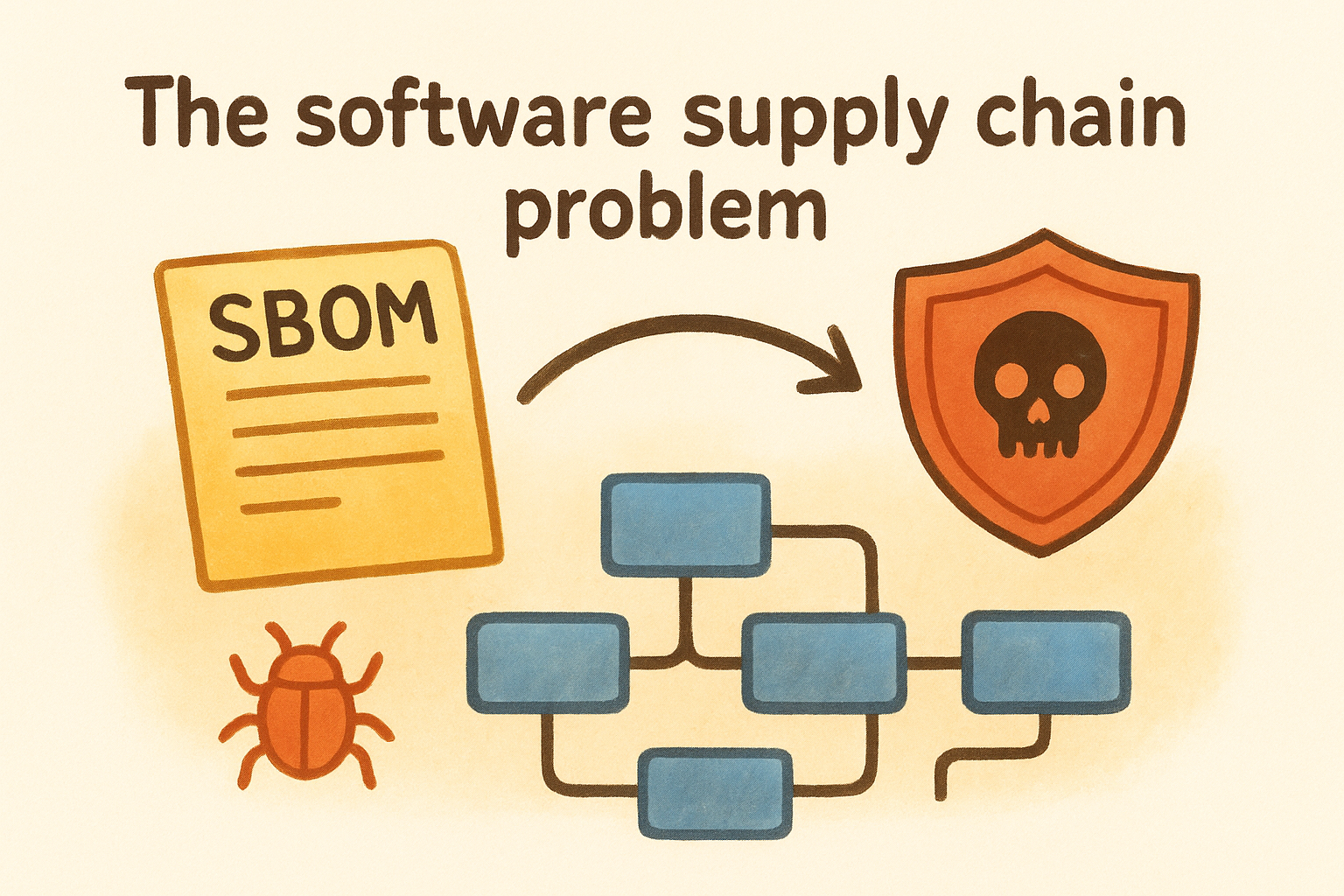
When you understand what is a software bill of materials (SBOM), you start to see why transparency at the component level is the first real line of defense against this kind of attack.
This problem applies directly to crypto security. Hardware wallet firmware and companion apps depend on cryptographic libraries that get updated, deprecated, and sometimes silently abandoned by their maintainers. Without an SBOM, neither the manufacturer nor you can quickly identify which version of a given library is embedded in the product you're relying on today.
How SBOMs improve visibility and speed up response
When a new vulnerability is disclosed, response time determines how much damage occurs. Organizations with accurate SBOMs can search their component inventory in minutes and pinpoint exactly which products contain the affected code. Organizations without SBOMs spend days or weeks manually auditing codebases, and attackers can exploit every hour of that window.
For you as a crypto holder, this translates directly into real risk. If a critical flaw surfaces in a cryptographic library embedded in your wallet firmware and the manufacturer has no documented component inventory, their ability to assess scope and push a patch slows significantly. An SBOM shortens that gap between discovery and a working fix landing in your hands.
Regulatory pressure is making SBOMs a baseline expectation
Governments have started treating SBOMs as a non-negotiable part of responsible software security. In 2021, the U.S. Executive Order on Improving the Nation's Cybersecurity directed federal agencies to require SBOMs from software vendors as part of procurement. The National Institute of Standards and Technology (NIST) followed with detailed guidance on minimum SBOM data fields and clear expectations for how organizations should produce and consume them.
This regulatory push creates real accountability. When a hardware wallet company sells into enterprise or government-adjacent markets, they must produce an SBOM or lose the contract. That pressure filters down to consumer products too, since maintaining separate security practices for different market segments is expensive. The result is that SBOMs are moving from an optional transparency gesture to a standard baseline across the industry.
You don't need to be a security engineer to benefit from this shift. When a manufacturer publishes an SBOM, you gain the ability to independently verify what's inside the product protecting your crypto holdings. When they can't produce one, that absence tells you something important about their approach to security transparency and how seriously they treat long-term accountability to their users.
What an SBOM includes and what it can miss
Understanding what actually goes into an SBOM helps you evaluate whether the document a vendor provides is genuinely useful or just a box-checking exercise. A complete SBOM covers every software component, library, and dependency that a product uses, giving you a structured map of the code running inside that product. The depth and accuracy of that map determine how much real security value the document provides.
What a well-formed SBOM documents
A properly constructed SBOM captures several critical data fields for each component it lists. These fields are the reason the document functions as more than a simple name list.
| Field | What it tells you |
|---|---|
| Component name | The library or module being used |
| Version | The exact release installed |
| Supplier | The organization or developer who created it |
| Unique identifier | A hash or PURL that removes naming ambiguity |
| License type | The legal terms governing use |
| Relationship | How the component connects to others in the product |
Each of these fields feeds directly into vulnerability tracking. When a security advisory references a specific component and version range, an SBOM with accurate version data lets a manufacturer cross-reference their inventory immediately and confirm whether their product is exposed.
The version field alone determines whether a disclosed vulnerability applies to your device, which is why an SBOM without precise version data provides almost no practical security value.
Where SBOMs fall short
Even a thorough SBOM has real limitations you should not overlook. The most significant gap involves transitive dependencies, which are the components that your direct components depend on. A wallet app may list its top-level libraries, but if those libraries pull in additional packages, those nested layers may not appear in the SBOM at all. Attackers frequently target exactly these indirect dependencies because they sit below the visibility most SBOM processes reach.
Runtime components also create blind spots. Some software loads additional code dynamically during operation rather than bundling everything at compile time. Standard SBOM generation tools typically scan the build stage, which means anything pulled in at runtime can go completely undocumented. For crypto security tools, where runtime behavior directly affects key handling and transaction signing, that gap matters.
Finally, SBOMs reflect a point-in-time snapshot. A document generated during a product release becomes outdated the moment any component gets updated, patched, or deprecated. Without a process to regenerate and publish updated SBOMs continuously, even an accurate document can mislead you about what version of a component is actually running in today's firmware update.
SBOM formats and key standards you will see
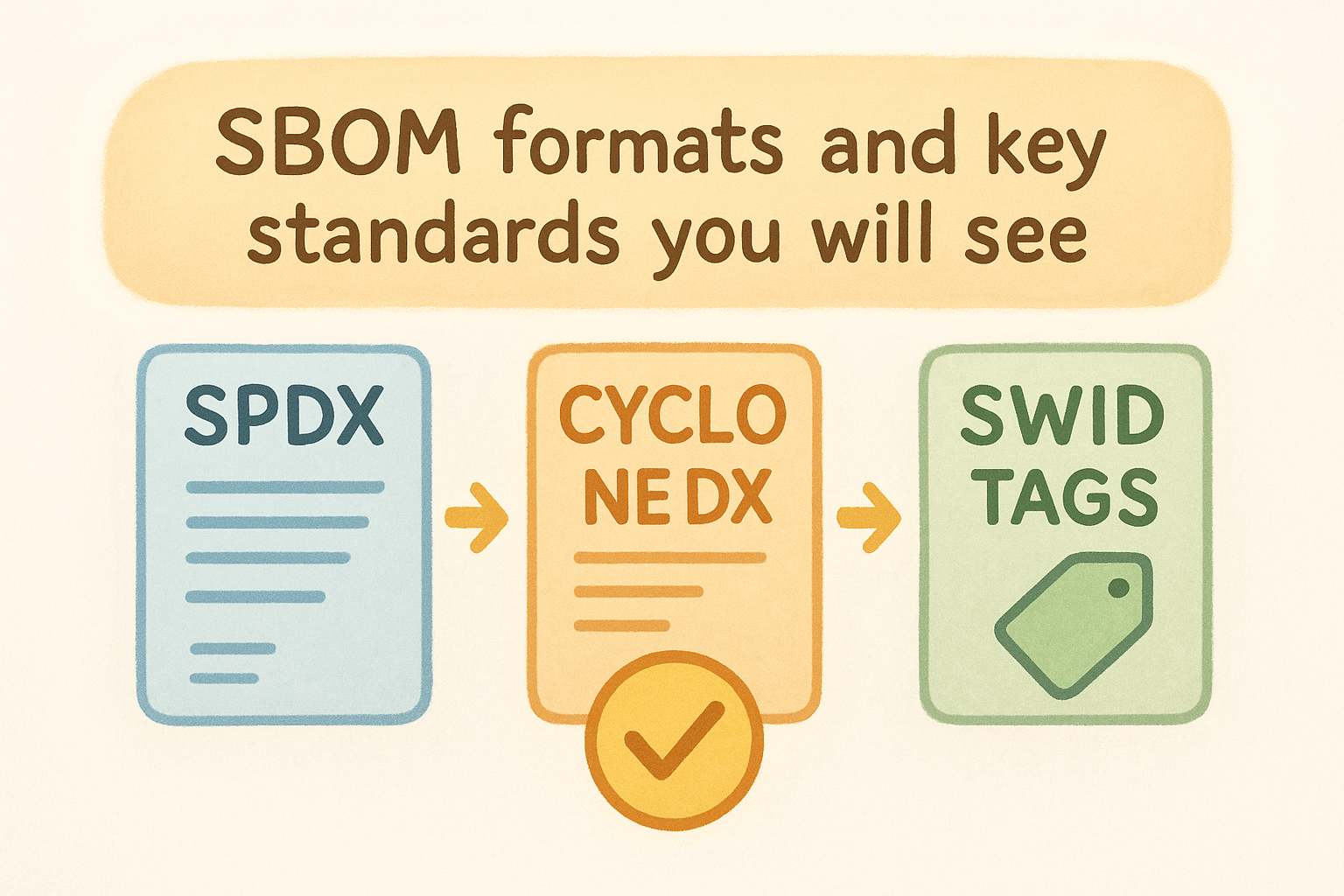
When you research what is a software bill of materials sbom in a technical context, you quickly encounter several competing formats. Each format structures component data differently, and understanding those differences helps you evaluate whether a vendor's SBOM is genuinely usable for vulnerability tracking or simply a formatted list with limited practical value. The three formats you will encounter most frequently are SPDX, CycloneDX, and SWID Tags, each backed by a distinct standards body with different priorities.
SPDX: The Linux Foundation standard
SPDX (Software Package Data Exchange) was originally developed to address software licensing compliance before expanding into full vulnerability and dependency tracking. The Linux Foundation maintains the SPDX specification, and the format carries ISO/IEC 5962:2021 recognition, giving it formal standing as an international standard. SPDX documents can be serialized in JSON, YAML, RDF, and tag-value text, so tooling can process them across different environments without manually converting data.
SPDX's broad format compatibility makes it particularly strong when organizations need to share SBOMs across teams, tools, or supply chain partners with different technical setups.
Because SPDX was built with licensing data as a core concern, it captures license expression fields in significant detail, which benefits both security and legal review teams working from the same document. Large enterprise vendors and open-source projects tend to favor it precisely for that dual-purpose utility.
CycloneDX: The security-focused alternative
CycloneDX was designed from the start around security use cases rather than licensing compliance. The OWASP Foundation maintains the specification, and its structure prioritizes vulnerability data, dependency graphs, and component integrity verification. CycloneDX supports JSON and XML serialization and integrates directly with a wide range of build tools and CI/CD pipelines, which makes it easier to generate SBOMs automatically during software builds rather than as a separate manual step.
Hardware wallet manufacturers that invest in automated SBOM generation tend to lean toward CycloneDX because it fits naturally into modern build workflows without requiring separate tooling or data conversion between stages.
SWID Tags: The ISO inventory standard
SWID (Software Identification) Tags follow ISO/IEC 19770-2 and focus on software installation records rather than dependency mapping. They function best as an inventory mechanism at the deployment layer, tracking what software is installed on a system rather than how it was built internally.
You will see SWID tags referenced most often in government procurement and enterprise asset management contexts. They carry less granular dependency data than SPDX or CycloneDX, so they work as a complement to those formats rather than a direct replacement when deep supply chain visibility is the goal.
How to create and maintain SBOMs in practice
Understanding what is a software bill of materials sbom in theory only gets you so far. Generating an accurate SBOM and keeping it current requires deliberate choices about tooling, workflow integration, and update cadence. Most of the heavy lifting can be automated if you build SBOM creation into your software pipeline from the start rather than treating it as a separate post-release documentation task.
Generating SBOMs during the build process
The most reliable way to produce an SBOM is to tie generation directly to your build pipeline so the document reflects exactly what components went into a specific release. Tools that analyze package manifests, lock files, and binary artifacts during compilation produce far more accurate results than tools that scan source code in isolation. When a build completes, the SBOM should be generated automatically, signed with a verifiable hash, and stored alongside the release artifacts so any future audit has a precise, tamper-evident record to reference.
For crypto security products in particular, build-time SBOM generation removes any ambiguity about whether the document matches what actually shipped to users. A firmware update that goes out without a corresponding SBOM update creates a gap that directly undermines your ability to use that document for vulnerability tracking later.
Treating SBOM generation as a build artifact rather than a documentation task is the single most effective way to keep it accurate.
Keeping SBOMs current after release
A single SBOM produced at launch becomes outdated the moment a component receives a patch or a dependency changes version. Continuous SBOM maintenance means regenerating the document every time a component is updated and publishing the new version in a location where your security team and, ideally, your users can access it. Without that update loop, even a well-structured SBOM misleads rather than informs.
Setting up a scheduled audit cycle helps catch drift between what the document says and what is actually running in production. Many organizations run these audits monthly at minimum, with additional triggers tied to any dependency update or new vulnerability disclosure that affects their stack. For hardware wallet manufacturers, this cadence matters because firmware release cycles often compress the window between vulnerability discovery and patch delivery.
You should also version your SBOMs explicitly, linking each document to the specific software release it describes. Versioned SBOMs let you trace exactly which components were present when a specific vulnerability was publicly disclosed, which becomes critical when you need to determine whether a past release exposed users to a known risk.
How to use SBOMs for vulnerability response
When a security researcher publicly discloses a vulnerability in a widely used open-source library, your first question should be: does this affect my software? If you understand what is a software bill of materials sbom, you already know the answer depends entirely on whether you can quickly cross-reference that vulnerability against a complete and current component inventory. That cross-reference is where SBOMs shift from a compliance document into an active security tool.
Matching CVEs to components in your inventory
A Common Vulnerabilities and Exposures (CVE) entry typically identifies the affected component, the vulnerable version range, and a severity score. When a CVE drops, your process should start with pulling your current SBOM and running a direct lookup against those three data points. If your SBOM accurately records component names and version numbers, that lookup takes minutes rather than days.

Accurate version data in your SBOM is what converts a public vulnerability disclosure into an immediate, scoped answer about your own exposure.
Many security teams feed their SBOMs into vulnerability scanning tools that automate this matching process continuously, flagging any component version that falls within a disclosed CVE's affected range. For crypto security products, where a flaw in a cryptographic library can directly compromise key generation or transaction signing, that automated alert loop is not optional. You want to know the moment a library embedded in your firmware or wallet app appears in a new advisory.
Prioritizing which vulnerabilities to address first
Not every vulnerability your SBOM surfaces carries equal urgency. Severity scoring systems like CVSS (Common Vulnerability Scoring System) give you a numerical baseline, but raw scores don't fully account for how a component is actually used inside your specific product. A high-severity flaw in a library your product calls only during an initialization step that never exposes network data carries different real-world risk than the same score applied to a component that handles live transaction data on every use.
Triage effectively by combining three factors: the CVSS score, the component's role in your product's security-critical functions, and whether a working patch or updated version already exists. Run through these questions systematically:
- Does the vulnerable component directly handle cryptographic operations or private key material?
- Is the component reachable by untrusted input from a network or external device?
- Has the vendor or open-source maintainer released a patched version?
Your SBOM gives you the starting point for each of these questions by making the exact component and version visible, so you spend your response time on actual remediation rather than auditing what is installed.
Common SBOM mistakes and best practices
Even organizations that commit to producing SBOMs regularly make errors that strip the document of real security value. Knowing where those errors typically occur helps you avoid them and build a process that actually supports faster vulnerability response rather than creating a false sense of security.
Mistakes that undermine SBOM accuracy
The most damaging mistake is treating the SBOM as a one-time release artifact rather than a living document. Teams generate an SBOM at launch, archive it, and never update it as dependencies change. By the time a new CVE drops, the document describes software that no longer matches what users have installed. A stale SBOM is worse than no SBOM because it actively misleads your triage process.
Incomplete transitive dependency coverage ranks as a close second. Many teams document only the top-level libraries they added directly to their codebase and skip everything those libraries pull in themselves. Attackers consistently exploit these nested layers precisely because most SBOM processes stop before reaching them. If your generation tool does not resolve and document the full dependency tree, your inventory has blind spots you cannot see.
An SBOM that covers only your direct dependencies is like a nutritional label that lists the main ingredients but omits everything in the sauce.
Omitting precise version numbers is another common failure. A component name without a version number tells a security team almost nothing when they need to determine whether a specific CVE applies. Version data is what makes the document actionable.
Practices that make SBOMs reliable
Understanding what is a software bill of materials sbom means little if your process does not produce documents that hold up under real vulnerability conditions. Automating SBOM generation inside your build pipeline removes human error and guarantees the document reflects exactly what compiled into a specific release. Treat it as a build artifact, not a documentation task.
Publish your SBOMs in a publicly accessible and versioned location linked directly to each firmware or software release. This gives your security team, independent researchers, and end users the ability to verify component contents without contacting you first. Transparency at that level signals accountability.
Run your SBOMs against a continuous vulnerability feed rather than checking manually on an ad hoc basis. Feed the document into a scanning process that monitors active CVE databases and alerts you the moment a listed component version appears in a new advisory. For crypto security products where a single compromised library can expose private key operations, that automated monitoring loop is non-negotiable.
Final takeaways
Knowing what is a software bill of materials sbom gives you a concrete way to evaluate the security practices behind every crypto tool you trust. An SBOM is not a marketing document. It is a verifiable, component-level record of what runs inside the software protecting your digital assets, and its presence or absence tells you something real about a manufacturer's commitment to transparency.
The practical value comes from how you use the document. Accurate version data and full dependency coverage are what make an SBOM useful for vulnerability tracking. Without both, the document gives you a false sense of security rather than actual visibility into your exposure.
Your crypto security starts with understanding the tools you depend on, not just trusting brand names. If you want to build that understanding from the ground up, start with our structured crypto security course and learn exactly how to evaluate the products that protect your holdings.