

6 Smart Contract Security Certification Picks For Auditors
Smart contracts handle billions of dollars in digital assets, and a single vulnerability can drain an entire protocol overnight. That reality has pushed demand for qualified auditors through the roof. If you're exploring a smart contract security certification, you're stepping into one of the most critical, and understaffed, roles in crypto. At FinTech Dynasty, we focus on every layer of digital asset protection, from hardware wallets and self-custody to the code-level security that keeps decentralized platforms from collapsing.
Choosing the right certification matters. Some programs teach you Solidity fundamentals and call it a day, while others put you through real audit simulations with live-fire exercises on vulnerable codebases. The difference between a surface-level credential and a respected one can shape your career trajectory and earning potential as an auditor.
This guide breaks down six certification programs worth your time and money. You'll find details on curriculum depth, hands-on training, recognition in the industry, and what each program actually prepares you to do. No filler credentials made it onto this list, only programs that produce auditors who can sit down with a smart contract and identify the flaws that cost people real money.
1. Solidity Smart Contract Auditor Certification by Hashlock
Hashlock is an Australian-based smart contract auditing firm, and their Solidity Smart Contract Auditor Certification stands out because it was built by people who run commercial audits for live protocols. The program prioritizes practical vulnerability identification over academic theory, which puts it ahead of many classroom-style credentials. If you want a smart contract security certification grounded in real audit workflows, this one deserves serious attention.
What you learn and skills validated
The curriculum targets core Solidity vulnerabilities including reentrancy, integer overflow, access control flaws, and front-running exploits. You work through code samples that mirror what you would encounter during actual protocol reviews. The program also validates your ability to produce structured audit reports, a skill that separates competent auditors from ones who can find bugs but cannot communicate them clearly to development teams.
Exam and delivery format
Assessment relies on hands-on audit exercises rather than multiple-choice questions, which reflects how the work actually gets done professionally. Delivery is fully online and self-paced, so your timezone or existing work schedule does not block you from completing it.
Practical exams built around real vulnerability patterns prepare you far better than theory-only tests ever will.
Prerequisites and best fit
You need solid Solidity programming knowledge before you enroll. This is not an introduction to writing contracts. It fits best if you already read and write Solidity regularly and want to formalize your auditing skills with a credential that signals real capability.
Pricing and renewal details
Pricing sits in a competitive range for professional-level certifications. Hashlock does not currently advertise a mandatory renewal cycle, but staying current with updated vulnerability classes through continued study is strongly recommended given how fast EVM-based ecosystems evolve.
Limits to know before you commit
The certification focuses exclusively on Solidity and EVM-based contracts, so it does not prepare you for auditing Rust-based programs on Solana or other non-EVM chains. Recognition outside Australia and EVM-focused audit firms is still building, which matters if you plan to pitch global clients.
2. Rust Security Auditor Certification by Hashlock
Hashlock built a Rust Security Auditor Certification specifically for auditors targeting Solana and other non-EVM ecosystems. As Solana protocol activity grows, the supply of Rust-trained auditors has not kept pace. This smart contract security certification fills a real gap that most other programs completely ignore.
What you learn and skills validated
The curriculum covers Rust-specific vulnerability patterns such as unsafe memory handling, ownership model exploits, and program account validation errors common in Solana programs. You exit the program able to produce structured audit reports for Rust-based codebases.
Exam and delivery format
Assessment is hands-on and practical rather than a multiple-choice quiz. Delivery is fully online and self-paced, so your schedule does not block your progress.
Rust audit skills are scarce, and this credential puts you in a market segment where demand clearly outpaces supply.
Prerequisites and best fit
You need functional Rust programming knowledge before you enroll. This program fits developers already writing or reviewing Solana programs who want to validate their security capabilities with a formal credential.
Pricing and renewal details
Pricing aligns with the Solidity version from the same firm. No mandatory renewal is currently listed, though Rust tooling evolves fast enough that continued self-directed study remains necessary.
Limits to know before you commit
Coverage is limited to Rust and Solana-adjacent ecosystems. If you audit across EVM and non-EVM chains, you need both Hashlock certifications to cover the full scope of your work.
3. Cyfrin Updraft Solidity Smart Contract Developer Certification SSCD+
Cyfrin Updraft is a free, open-access learning platform built by the team behind Cyfrin, one of the more recognized smart contract audit firms in the Ethereum ecosystem. Their SSCD+ certification takes a different angle than a pure auditing credential. It validates that you can both write and audit secure Solidity code, which makes it relevant whether you come from a developer or security background.
What you learn and skills validated
The curriculum covers Solidity fundamentals, DeFi protocol patterns, and common vulnerability classes that show up in real audits. You build working knowledge of tools like Foundry and static analysis frameworks, and the program tests your ability to identify and remediate security flaws inside contract code directly.
Exam and delivery format
The SSCD+ uses a project-based assessment model rather than a timed theory exam. You complete coursework through the Cyfrin Updraft platform at your own pace, making it a strong option if you need flexibility around existing commitments.
Free course access combined with a credentialed exit point makes this one of the more accessible smart contract security certification paths available.
Prerequisites and best fit
You need basic programming familiarity, though the platform guides beginners through foundational content before reaching advanced auditing material. This fits developers who want to transition into security roles without enrolling in a paid bootcamp.
Pricing and renewal details
The courses on Cyfrin Updraft are free to access, and the certification exam carries a modest fee. No formal renewal cycle is currently required.
Limits to know before you commit
The SSCD+ is a newer credential, so industry recognition is still growing compared to more established certifications. Coverage also stays focused on Solidity and EVM chains exclusively.
4. Certified Smart Contract Auditor by Blockchain Council
The Blockchain Council offers one of the more widely recognized names in blockchain education, and their Certified Smart Contract Auditor credential targets professionals who want a structured, vendor-neutral qualification. The program covers both auditing methodology and smart contract fundamentals under a single credential.
What you learn and skills validated
The curriculum walks you through vulnerability detection, code review techniques, and the audit lifecycle from initial scoping through report delivery. You also build familiarity with common attack vectors including reentrancy, logic errors, and permission misconfigurations that appear frequently in real protocol reviews.
Exam and delivery format
The exam is fully online and multiple-choice, which makes it more accessible but less hands-on than simulation-based alternatives. You complete the course and assessment at your own pace through the Blockchain Council platform.
Multiple-choice formats test knowledge recall, but they do not replicate the judgment calls required in a live audit.
Prerequisites and best fit
No formal prerequisites are listed, which makes this a reasonable starting point if you are new to smart contract security and want structured foundational coverage before tackling more advanced programs.
Pricing and renewal details
The certification runs at a mid-range price point and includes course access bundled with the exam fee. Renewal is required periodically, which keeps the credential current on paper.
Limits to know before you commit
The multiple-choice exam format means practical audit skills go largely untested. Experienced auditors and technical hiring teams often treat this credential as a foundational baseline rather than a signal of advanced capability.
5. CryptoCurrency Security Standard Auditor CCSSA by C4
The CCSSA certification takes a broader view of cryptocurrency security than most smart contract security certification programs. Rather than focusing purely on code vulnerabilities, it measures your ability to audit organizations and systems against the CryptoCurrency Security Standard, a framework used by exchanges, custodians, and crypto businesses to evaluate operational security posture.
What you learn and skills validated
The curriculum covers CCSS compliance requirements across ten security aspects, including key management, wallet controls, and organizational policies. You learn to assess both technical and procedural controls, which gives you a unique skill set that complements code-focused audit credentials.
Auditors who understand both on-chain vulnerabilities and organizational security controls offer significantly more value to enterprise clients.
Exam and delivery format
The exam is knowledge-based and delivered online, testing your understanding of the CCSS framework and how to apply it during a real organizational audit. No live code review component is included.
Prerequisites and best fit
No strict prerequisites are listed. This credential fits professionals working with exchanges, custodians, or crypto businesses that need formal security assessments rather than pure protocol code reviews.
Pricing and renewal details
Pricing sits at a reasonable level for professional certifications, with renewal required to keep the credential active as the CCSS framework updates over time.
Limits to know before you commit
The CCSSA does not teach Solidity, Rust, or smart contract vulnerability analysis, so it does not replace code-level audit credentials. It works best as a complementary qualification alongside a technical auditing program.
6. Security and Auditing in Ethereum course certificate on Coursera
Coursera's Security and Auditing in Ethereum course sits at the accessible end of the smart contract security certification spectrum. Offered through a widely recognized online learning platform, it gives you structured exposure to Ethereum security concepts without requiring a large upfront investment.
What you learn and skills validated
The course covers core Ethereum security topics including common vulnerability patterns, safe Solidity coding practices, and how attackers exploit flaws in deployed contracts. You finish with a course completion certificate from Coursera that documents what you studied.
Exam and delivery format
Assessment uses quizzes and graded assignments rather than live audit simulations or hands-on code review exercises. The course runs fully online at your own pace, which works well around existing work or study schedules.
Coursera's platform recognition carries weight with general hiring managers, but technical audit teams typically prioritize demonstrated hands-on skills over completion certificates.
Prerequisites and best fit
No advanced prerequisites are required to enroll. This course fits beginners who want structured foundational exposure to Ethereum security before committing to a more rigorous credential.
Pricing and renewal details
Coursera makes the course available through its subscription model or a one-time purchase, placing it among the most affordable entry points for security education. No formal renewal is required.
Limits to know before you commit
The certificate confirms course completion, not auditing competence. Specialized audit firms and protocol teams expect candidates to demonstrate practical vulnerability identification skills that a quiz-based format simply does not test.
Next Steps
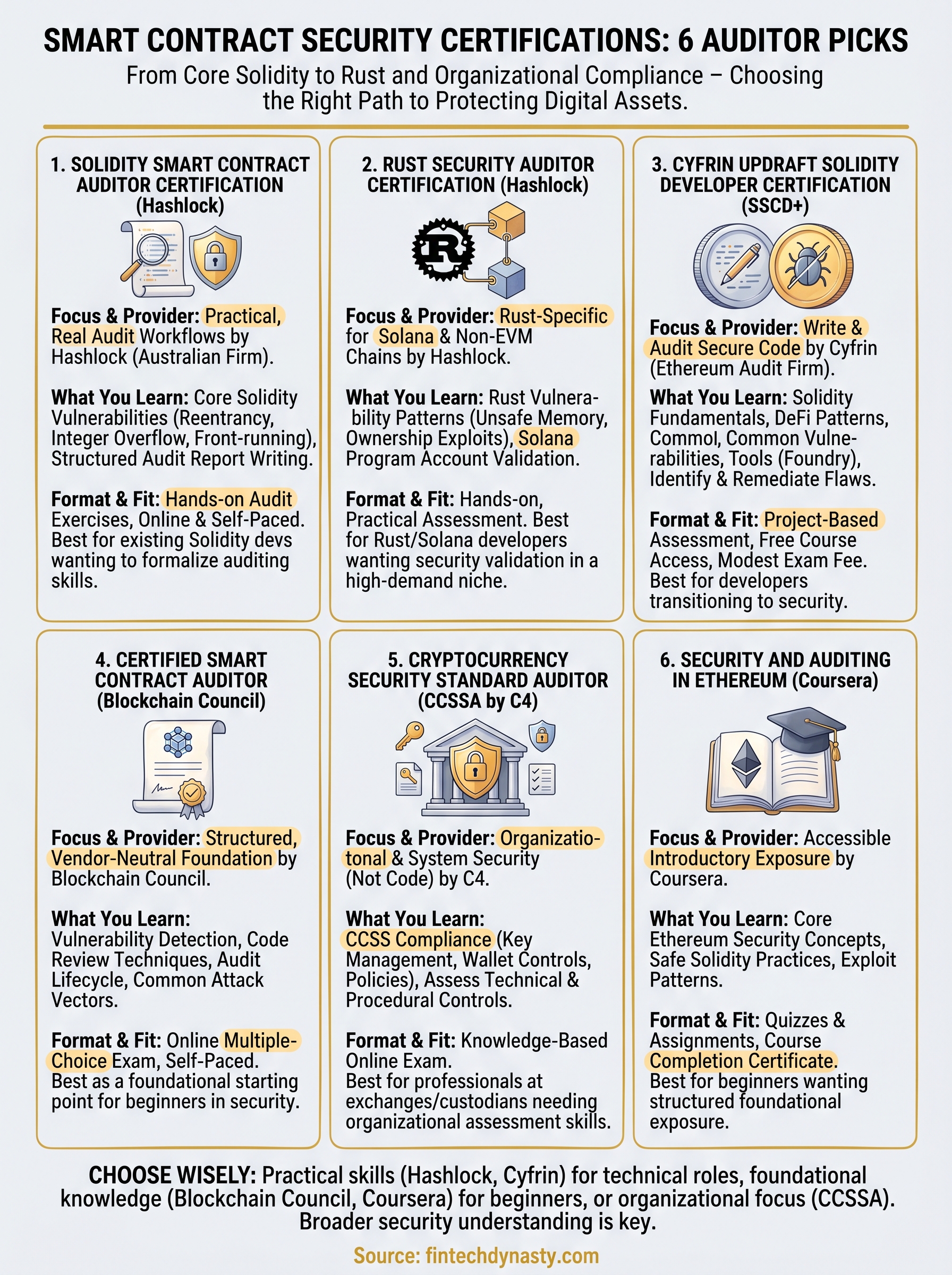
Picking the right smart contract security certification depends on where you are right now and where you want to work. If you write Solidity daily, Hashlock or Cyfrin Updraft gives you practical, hands-on validation that technical hiring teams respect. If you are earlier in your learning path, Blockchain Council or Coursera gives you structured foundational coverage before you tackle simulation-based exams. Rust developers targeting Solana should treat Hashlock's Rust credential as a priority, since qualified auditors in that space remain scarce.
Your broader security knowledge matters just as much as your audit credentials. Understanding self-custody, private key management, and wallet security builds the mental framework that helps you think like an attacker across both on-chain code and the users holding those assets. If you want to strengthen that foundation before or alongside your auditing studies, start with our structured crypto security course built specifically to help you learn safely and confidently.