

11 Best Smart Contract Auditing Firms to Hire in 2026
A single vulnerability in a smart contract can drain millions of dollars in minutes, and in crypto, there are no chargebacks. Whether you're launching a DeFi protocol, an NFT marketplace, or a token bridge, getting your code professionally reviewed isn't optional. It's the difference between a successful deployment and a catastrophic exploit. Finding the best smart contract auditing firms starts with knowing who actually delivers rigorous, reliable security assessments, and who's just selling a rubber stamp.
The problem is that the auditing space has grown crowded. Dozens of firms now offer smart contract reviews, but their methodologies, depth of analysis, and track records vary wildly. Some combine manual code review with formal verification, while others rely heavily on automated scanning tools. Choosing the wrong firm doesn't just waste your budget, it gives you false confidence that your contracts are safe when they may not be.
At FinTech Dynasty, our focus has always been on the security side of crypto, from hardware wallets and self-custody to the infrastructure that protects digital assets. Smart contract audits sit squarely in that mission. We researched and compared 11 auditing firms based on their expertise, audit quality, public track record, and real-world reputation among developers and protocols. Here's what we found.
1. OpenZeppelin
OpenZeppelin is one of the most recognized names in smart contract security. The team behind the widely used OpenZeppelin Contracts library has been auditing production-grade code since 2015, giving them a track record that very few other firms can match. Their published audit reports are publicly available and cover some of the highest-value protocols in the industry, including Compound, Aave, and Ethereum 2.0 components. If you are searching for the best smart contract auditing firms with a long public history, OpenZeppelin belongs at the top of your shortlist.
How OpenZeppelin approaches audits
OpenZeppelin uses a manual, line-by-line review process combined with a structured threat modeling phase before any code analysis begins. Their auditors map out attack surfaces and trust boundaries first, which means they approach your code the same way a sophisticated attacker would. This preparation makes their findings far more actionable than reports that simply list warnings generated by automated scanning tools.
Threat modeling before code review consistently surfaces logic errors that automated scanners miss entirely.
Best fit for
OpenZeppelin is best suited for high-value DeFi protocols and infrastructure-level projects where the cost of an exploit would be severe. If your project handles significant user funds, integrates with multiple external protocols, or deploys on mainnet with limited upgrade paths, their depth of expertise justifies the premium cost. Smaller projects with tight budgets may find better value elsewhere.
Strengths to look for in their reports
Their reports go deep on business logic vulnerabilities, not just common patterns like reentrancy or integer overflow. You should look specifically for the Impact and Likelihood matrix they use to prioritize findings, since that structure helps your development team triage fixes in the correct order rather than treating every flagged issue as equally urgent.
Typical pricing and timelines
OpenZeppelin audits carry a significant cost. Expect to budget $50,000 to $200,000 or more depending on codebase size and complexity. Timelines typically run four to eight weeks from audit start, and you will need to submit a detailed scoping document well in advance since their schedule books out several months ahead.
Questions to ask before you hire
Before signing with OpenZeppelin, ask these directly:
- Who specifically will review your code, and what is their background with your protocol type?
- What does the remediation process look like after the initial report is delivered?
- Will the final report be published publicly, and if not, what conditions govern that decision?
2. Trail of Bits
Trail of Bits is a New York-based security firm that operates across multiple domains, from government and defense contracts to blockchain security. That cross-domain experience matters because their auditors bring attack patterns and adversarial thinking from outside the crypto bubble, which regularly surfaces vulnerabilities that crypto-native teams overlook.
How Trail of Bits approaches audits
Trail of Bits combines manual review with proprietary tooling, including their open-source static analysis framework Slither. Their process runs threat modeling alongside code analysis, so findings are tied to realistic attack scenarios rather than theoretical edge cases.
Their public research contributions and open-source tooling signal the kind of deep technical investment you want to see from a firm before handing over your codebase.
Best fit for
This firm fits protocol teams and infrastructure builders who want a technically rigorous audit from researchers with experience beyond smart contracts. If your architecture involves cryptographic primitives, cross-chain bridges, or novel consensus mechanisms, Trail of Bits is one of the best smart contract auditing firms to consider.
Strengths to look for in their reports
Their reports typically separate tool-assisted findings from manual findings, which tells you immediately how much human judgment went into each issue. Pay close attention to any custom tooling results they include, since those often expose issues that standard automated scanners miss entirely.
Typical pricing and timelines
Budget $30,000 to $150,000 depending on scope and complexity. Timelines run roughly three to six weeks, though their schedule fills quickly and you should reach out at least two months before your target audit date.
Questions to ask before you hire
Ask Trail of Bits these questions before signing:
- Which auditors will work your engagement, and what is their specific background with your protocol type?
- Does the engagement include a post-report remediation review at no additional cost?
- What proprietary tools will they run against your code, and will you receive the raw output?
3. Cyfrin
Cyfrin entered the auditing space more recently than the firms above, but it has built a strong reputation among Solidity developers in a short time. Patrick Collins, one of the most recognized names in smart contract education, co-founded the firm, and that background shapes how the team communicates findings. Their public audit reports are detailed, readable, and paired with clear remediation guidance, which sets them apart from firms that deliver dense technical documents with minimal explanation.
How Cyfrin approaches audits
The firm relies on deep manual review as its primary methodology, with auditors working through code line by line before drawing any conclusions. Cyfrin also runs competitive audit contests through their CodeHawks platform, but their private engagements follow a structured process that includes scoping, review, and a final remediation check before the report closes.
A firm that invests in public educational content tends to produce clearer, more developer-friendly audit reports, and Cyfrin consistently demonstrates that.
Best fit for
Among the best smart contract auditing firms in this list, Cyfrin works especially well for early-stage DeFi projects and protocol teams that want a technically thorough audit without enterprise-level pricing. If your team is newer to smart contract security, their communication style and report clarity make it easier to act on findings quickly.
Strengths to look for in their reports
Their reports break findings into clear severity tiers with specific code references and recommended fixes. Look for the root cause analysis sections, since those explain not just what is wrong but why the vulnerability exists in the first place.
Typical pricing and timelines
Cyfrin engagements typically run $15,000 to $60,000 depending on codebase size. Timelines average two to four weeks for most projects.
Questions to ask before you hire
Ask Cyfrin these questions upfront:
- Who leads your review, and how many auditors will work the engagement?
- Does the final report include a re-audit of remediated findings before publication?
- What does your current waitlist look like, and can you commit to a specific start date?
4. Spearbit
Spearbit operates differently from most firms on this list. Rather than a fixed internal team, it runs as a network of independent senior security researchers who are matched to engagements based on their domain expertise. That model gives you access to auditors with deep specialization in your specific protocol type, whether that's lending markets, NFT infrastructure, or cross-chain messaging.
How Spearbit approaches audits
Spearbit assigns two or more senior researchers to each engagement, selected specifically for their familiarity with your codebase's architecture. The process centers on manual review, with findings consolidated and reviewed internally before the final report reaches your team.
Matching auditors by domain expertise rather than availability consistently produces higher-quality findings than generalist team assignments.
Best fit for
Spearbit is one of the best smart contract auditing firms for protocols that require specialized knowledge in a narrow technical domain. Their auditor network suits high-value mainnet deployments where deep familiarity with a specific primitive matters more than firm brand recognition alone.
Strengths to look for in their reports
Their reports include detailed root cause analysis alongside severity ratings. Look for whether the assigned researchers have prior public work in your protocol category, since that context often surfaces findings that generalist auditors would miss.
Typical pricing and timelines
Engagements typically run $20,000 to $100,000 depending on scope and researcher availability. Timelines average two to five weeks, and scheduling depends on which researchers align with your technical requirements.
Questions to ask before you hire
Ask Spearbit these questions before moving forward:
- Which specific researchers will review your code, and what relevant engagements have they completed?
- How does Spearbit handle conflicts of interest if a researcher has prior ties to a competing protocol?
- Does the engagement include a follow-up review after your team remediates the findings?
5. Sigma Prime
Sigma Prime is an Australian security firm best known for building Lighthouse, the Ethereum consensus client used by a large portion of the global validator set. That infrastructure-level work gives their auditors direct experience with Ethereum's protocol mechanics, placing them among the best smart contract auditing firms with genuine client-layer expertise alongside application-layer review.
How Sigma Prime approaches audits
Their team runs manual code review as the primary method, tracing logic paths through both smart contracts and surrounding infrastructure. Auditors pay close attention to how contracts interact with the broader Ethereum protocol, not just internal code behavior.
Firms that build core blockchain infrastructure tend to understand attack surfaces at a layer deeper than firms that only review application code.
Best fit for
Sigma Prime fits Ethereum-native protocols that need security coverage from auditors who understand consensus mechanics and low-level EVM behavior. Their background is most directly relevant for:
- Staking infrastructure and validator-adjacent contracts
- Complex on-chain governance systems
- Protocol contracts with non-standard EVM assumptions
Strengths to look for in their reports
Their reports typically flag protocol interaction risks that application-focused auditors overlook. Pay attention to any findings tied to EVM edge cases or validator behavior, since those reflect the team's infrastructure-level knowledge rather than standard pattern matching.
Look specifically at how they frame impact severity, since their framing draws on real validator and client behavior rather than theoretical scenarios.
Typical pricing and timelines
Engagements generally run $20,000 to $80,000 depending on scope. Timelines average two to five weeks, with availability shaped by their ongoing protocol commitments.
Questions to ask before you hire
Ask Sigma Prime these questions before you commit:
- Which auditors will handle your review, and do they have direct experience with your contract type?
- Does the engagement cover infrastructure dependencies beyond the contract code itself?
- What does the remediation review process look like after the initial report is delivered?
6. ChainSecurity
ChainSecurity is a Swiss security firm with direct roots in academic research at ETH Zurich. That academic foundation shapes their entire approach to contract analysis, making them one of the best smart contract auditing firms for projects that require formal verification alongside traditional manual review.
How ChainSecurity approaches audits
ChainSecurity combines manual code review with formal verification techniques, drawing directly on research tools developed at ETH Zurich, including their VerX verification framework. Their auditors build mathematical proofs around contract behavior, which means findings go beyond pattern recognition and into provable correctness guarantees for critical code paths.
Formal verification from a research-backed team produces a different class of security assurance than manual review alone.
Best fit for
ChainSecurity fits protocol teams building complex financial infrastructure where formal correctness matters as much as bug detection. Projects involving custom cryptographic logic or complex state machines benefit most from their academic methodology and verification tooling.
Strengths to look for in their reports
Their reports clearly separate formally verified properties from manually reviewed findings, giving your team a precise map of what has been proven correct versus what was assessed through judgment. Look for the property specifications they document, since those define exactly what guarantees the audit covers and where uncertainty remains.
Typical pricing and timelines
Engagements typically run $30,000 to $120,000 depending on scope and the depth of formal verification required. Timelines average three to six weeks for most protocol-level reviews.
Questions to ask before you hire
Ask ChainSecurity these questions before signing:
- Which formal properties will the audit verify, and how are those selected?
- Does the report clearly separate formally proven results from manual findings?
- What remediation support do they offer after the initial report closes?
7. ConsenSys Diligence
ConsenSys Diligence is the security arm of ConsenSys, one of the oldest and most influential organizations in the Ethereum ecosystem. Their direct access to core Ethereum tooling and developer infrastructure gives auditors a vantage point that independent firms rarely match, making them one of the best smart contract auditing firms for Ethereum-native projects.
How ConsenSys Diligence approaches audits
Their primary methodology centers on manual code review, supported by MythX, their open-source tool that combines symbolic analysis, fuzzing, and static analysis. Auditors use both human judgment and automated tool output together, so findings reflect pattern detection alongside deep logical reasoning.
Internal access to Ethereum tooling gives their auditors a contextual advantage when reviewing protocol-level edge cases.
Best fit for
This firm fits EVM-compatible protocol teams that want auditors with institutional Ethereum knowledge. Their background is most directly relevant for projects deploying token standards, governance contracts, or complex DeFi primitives on Ethereum or compatible chains.
Strengths to look for in their reports
Their reports clearly document tool-assisted findings alongside manual discoveries, so you can distinguish machine-generated warnings from human-assessed vulnerabilities. Look specifically for their severity rationale, since each finding connects to a realistic attack scenario rather than a generic risk label.
Typical pricing and timelines
Engagements typically run $20,000 to $100,000 depending on scope. Timelines average two to five weeks for most projects.
Questions to ask before you hire
Before you commit to an agreement, ask ConsenSys Diligence these specific questions:
- Which auditors will work your engagement, and do they have prior experience with your contract type?
- Does the audit include a remediation review after your team addresses the initial findings?
- Will the final report be made publicly available?
8. CertiK
CertiK is one of the most widely recognized names in blockchain security, having audited thousands of projects across multiple chains. Founded by professors from Yale and Columbia, the firm blends academic research with production-grade security tooling, giving them a scale and multi-chain reach that few competitors match.
How CertiK approaches audits
CertiK runs a combination of formal verification and manual review, supported by their proprietary static analysis infrastructure. Their process typically starts with automated scanning, followed by manual auditor review of flagged and high-risk code sections.
Volume alone does not indicate quality, so evaluate CertiK's methodology for your specific project type rather than relying on brand recognition.
Best fit for
Among the best smart contract auditing firms, CertiK fits projects that need broad chain coverage and faster turnaround, particularly those deploying on BSC, Polygon, or other EVM-compatible chains where their multi-chain auditing experience runs deep.
Strengths to look for in their reports
Their reports include a CertiK Security Score, a numerical rating that summarizes overall contract health at a glance. Focus on the individual finding details rather than the score itself, since the specific vulnerabilities flagged tell you far more about actual risk than a single aggregate number does.
Typical pricing and timelines
Engagements typically run $5,000 to $50,000 depending on codebase size and complexity. Timelines average one to three weeks, making CertiK one of the faster options on this list.
Questions to ask before you hire
Ask CertiK these questions before you commit:
- Which auditors will review your code, and what is their specific background with your contract type?
- Does the engagement include a dedicated manual review phase, or does automated scanning carry most of the workload?
- What remediation support do they provide after the initial report closes?
9. Hacken
Hacken is a Ukrainian cybersecurity firm founded in 2017 that has built its reputation across blockchain security, penetration testing, and smart contract auditing. They operate their own bug bounty platform, HackenProof, which connects white-hat researchers to projects actively looking for vulnerabilities before launch.
How Hacken approaches audits
Hacken combines manual code review with automated static analysis, running both processes in parallel rather than sequentially. Their auditors document each finding with a clear severity rating and a concrete remediation recommendation, keeping reports actionable rather than purely diagnostic.
Their dual-track methodology, running automation alongside manual review simultaneously, reduces the chance that time pressure forces shortcuts in either direction.
Best fit for
Hacken is one of the best smart contract auditing firms for mid-sized projects and startups that need solid coverage at a more accessible price point than the top-tier firms charge. They work well across EVM-compatible chains and cover token contracts, staking systems, and NFT infrastructure with consistent depth.
Strengths to look for in their reports
Their reports organize findings by severity tier with linked code references, so your development team can navigate directly to the relevant lines. Pay attention to the remediation verification section, which confirms that flagged issues were actually fixed before the report closes.
Typical pricing and timelines
Engagements typically run $5,000 to $40,000 depending on scope. Timelines average one to three weeks for most projects.
Questions to ask before you hire
Ask Hacken these specific questions before committing to an engagement:
- Which auditors will handle your review, and what prior work have they done in your contract category?
- Does the engagement include a post-remediation verification at no additional cost?
- Will the final report be published publicly on their website?
10. Code4rena and CodeHawks
Code4rena and CodeHawks represent a fundamentally different model from every other entry on this list. Rather than assigning a fixed team to your code, these competitive audit platforms open your codebase to a pool of independent security researchers who compete for prize money by finding vulnerabilities. The result is broad coverage from many perspectives rather than a focused review from a small team.
How competitive audits differ from firm audits
Traditional firm audits give you a dedicated team working your code for a set number of weeks. Competitive audits give you dozens of independent researchers scanning your code simultaneously, each motivated by the chance to earn a reward for each valid finding they submit first.
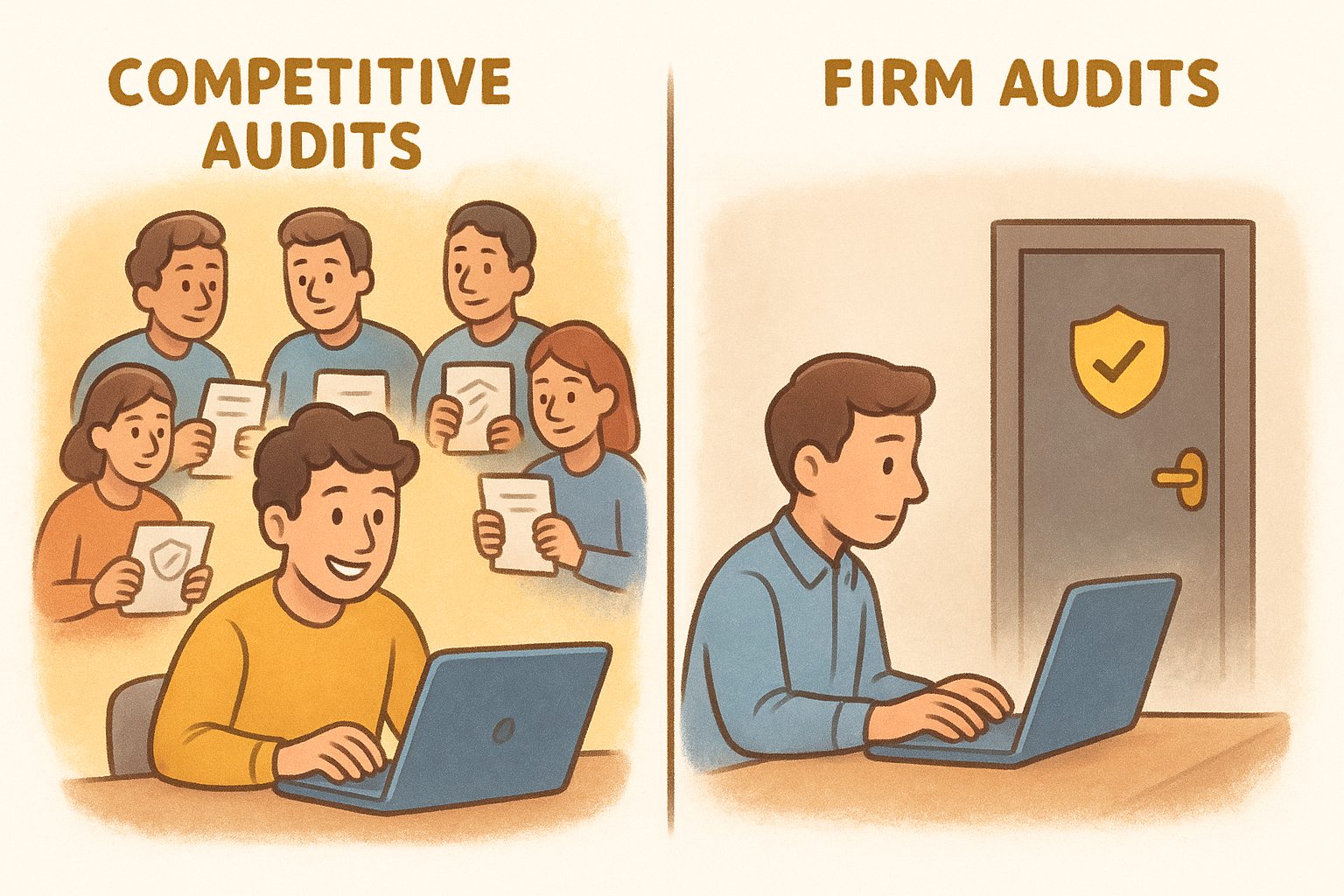
Volume of independent eyes consistently surfaces edge-case vulnerabilities that small dedicated teams overlook, especially in novel protocol designs.
Best fit for
Among the best smart contract auditing firms and platforms, Code4rena and CodeHawks work best for protocols with complex or novel codebases where broad coverage matters more than a structured consulting relationship. They also serve teams that have already completed a private audit and want an additional layer of adversarial review before mainnet deployment.
How to scope and run a contest the right way
You define the scope, prize pool, and contest duration before the competition opens. Narrowing scope to your highest-risk contracts and setting a competitive prize pool directly influences researcher participation and finding quality.
Typical pricing and timelines
Prize pools typically run $20,000 to $150,000, and contests run one to two weeks on average.
Questions to ask before you hire
- What minimum prize pool attracts experienced researchers for your contract type?
- Does the platform provide a judging service to verify and rank submitted findings?
Next steps
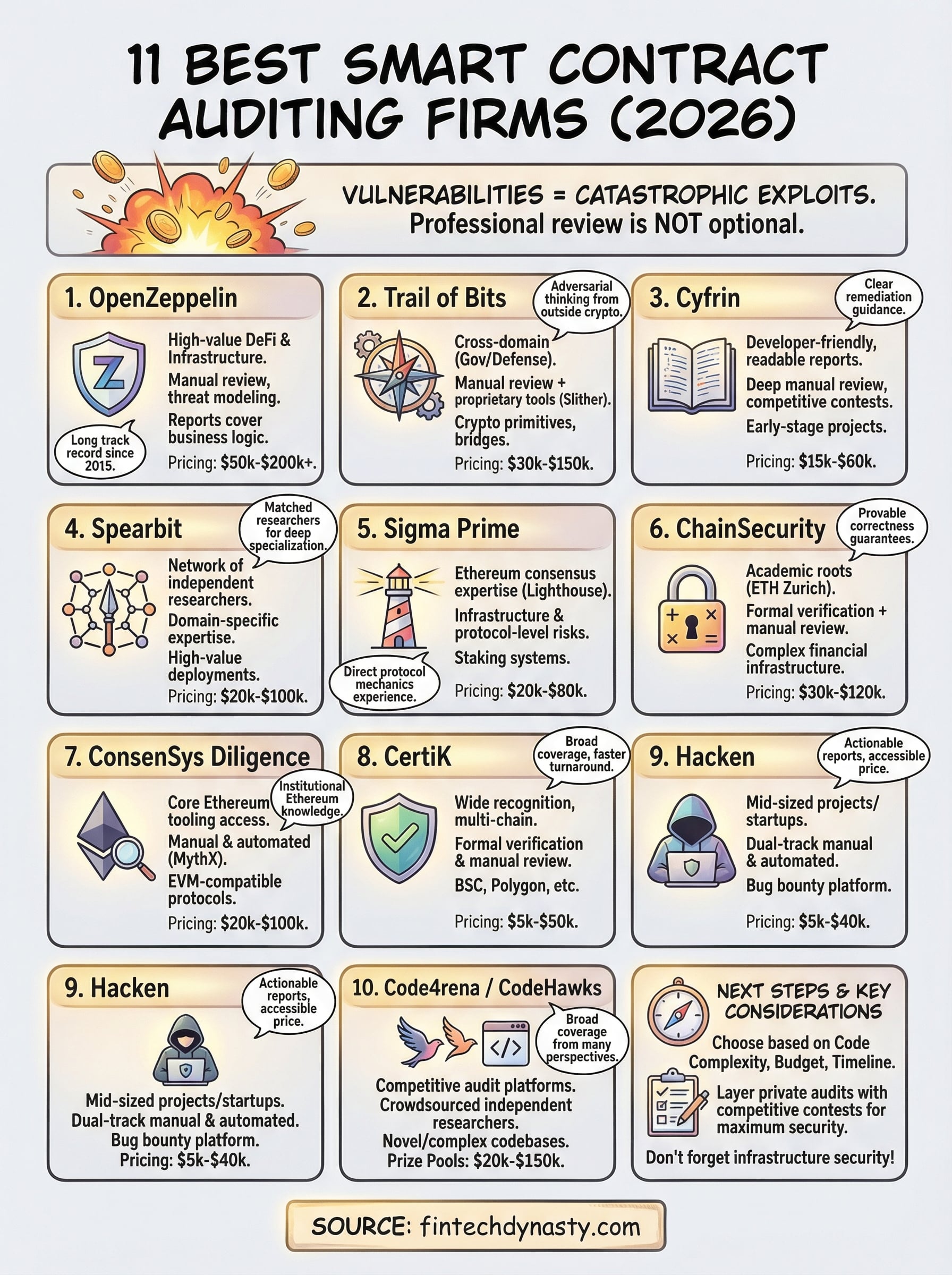
Choosing from the best smart contract auditing firms comes down to three factors: your codebase complexity, your budget, and your timeline before deployment. If you're building a high-value DeFi protocol, OpenZeppelin, Trail of Bits, or Spearbit deserve serious consideration. If you're working with a tighter budget and a simpler contract scope, Cyfrin or Hacken give you solid coverage without enterprise-level fees. For maximum adversarial coverage before mainnet, layering a private audit with a Code4rena or CodeHawks contest is one of the most thorough approaches available.
Security doesn't stop at the audit report. How you store keys, manage wallets, and protect access to your deployed contracts matters just as much as the code itself. If you want to build a stronger foundation in crypto security from the ground up, start with our crypto security and self-custody course and learn how to protect your digital assets at every layer.