

What Are Blockchain Confirmations? How Many Are Needed?
You send Bitcoin to your hardware wallet, but the transaction shows "unconfirmed" for what feels like forever. Is something wrong? Not necessarily. Understanding what are blockchain confirmations tells you exactly why that waiting period exists, and why it's actually protecting your funds. Every time you move crypto, a complex validation process runs in the background to ensure your transaction is legitimate and permanent.
At FinTech Dynasty, we focus on the practical knowledge that keeps your digital assets secure. Blockchain confirmations sit at the core of that security model. They determine when a transaction becomes irreversible and when you can trust that funds have truly arrived in your wallet. Without this understanding, you might make costly mistakes, like assuming a transaction is final before it actually is, or sending additional transfers prematurely.
This guide breaks down how blockchain confirmations work, what happens during each validation step, and how many confirmations you actually need before considering a transaction complete. Whether you're receiving funds on an exchange or transferring to cold storage, this knowledge directly impacts how you manage and protect your crypto.
What a blockchain confirmation is
A blockchain confirmation occurs when miners or validators add your transaction to a new block and permanently record it on the network. When you send cryptocurrency, that transaction first enters a waiting area called the mempool. Network participants then compete to include your transaction in the next block they create. Once your transaction makes it into a block that gets added to the blockchain, you receive your first confirmation.
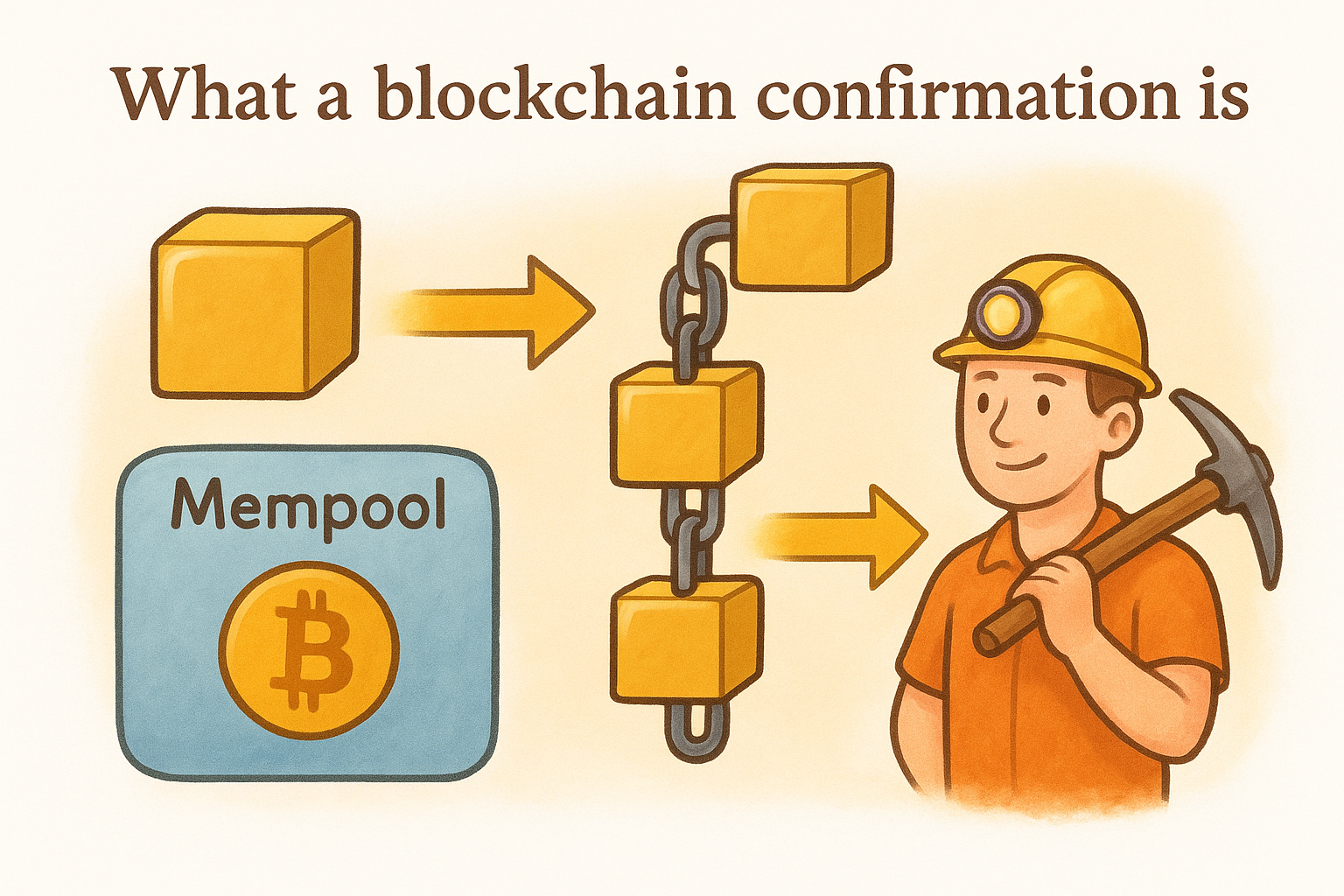
Each additional block added on top of the block containing your transaction counts as another confirmation, creating layers of security that make reversal nearly impossible.
Understanding what are blockchain confirmations means recognizing that one confirmation is just the start. The transaction exists on the blockchain, but it's not yet considered secure against attacks or reorganizations. Each new block that builds on top of yours adds another confirmation, making your transaction exponentially more difficult to undo. Most networks require multiple confirmations before considering a transaction final because blockchain forks can occasionally occur, potentially reversing recent blocks.
The technical process behind one confirmation
When miners create a new block, they select pending transactions from the mempool based on factors like transaction fees and priority rules. They bundle these transactions together, solve a complex cryptographic puzzle (in proof-of-work systems), and broadcast the new block to the entire network. Other nodes verify the block's validity and add it to their copy of the blockchain. Your transaction has now received its first confirmation, meaning it's part of the permanent ledger that thousands of independent computers maintain.
What multiple confirmations accomplish
Each subsequent block adds another layer of protection by building consensus across the network that your transaction is legitimate and irreversible. Reversing a transaction after multiple confirmations would require rewriting multiple blocks, which demands enormous computational power and coordination. The more confirmations accumulate, the more certain you can be that your funds have permanently moved to their destination address.
Why confirmations matter for transaction security
Confirmations protect you from double-spend attacks and ensure that transactions cannot be reversed after they reach the blockchain. Without this verification system, someone could theoretically send the same funds to multiple addresses simultaneously, creating counterfeit transactions that networks would struggle to identify. Understanding what are blockchain confirmations means recognizing that each confirmation represents another layer of security that makes fraudulent reversal exponentially more difficult.
The confirmation process transforms your transaction from a pending broadcast into an immutable record that the entire network has validated and agreed upon.
Protection against double-spend attacks
Double-spending occurs when an attacker attempts to spend the same cryptocurrency twice by broadcasting conflicting transactions to different parts of the network. With zero confirmations, your transaction sits vulnerable in the mempool where an attacker could potentially create a competing transaction with higher fees. Once your transaction receives multiple confirmations, reversing it would require rewriting the blockchain itself, which demands more computational power than most attackers can muster.
Network consensus and irreversibility
Each confirmation represents thousands of network nodes agreeing that your transaction is valid and permanent. After six confirmations on Bitcoin, for example, your transaction has become practically irreversible because an attacker would need to control more than 51% of the network's mining power and rewrite six blocks worth of data.
How confirmations work from mempool to finality
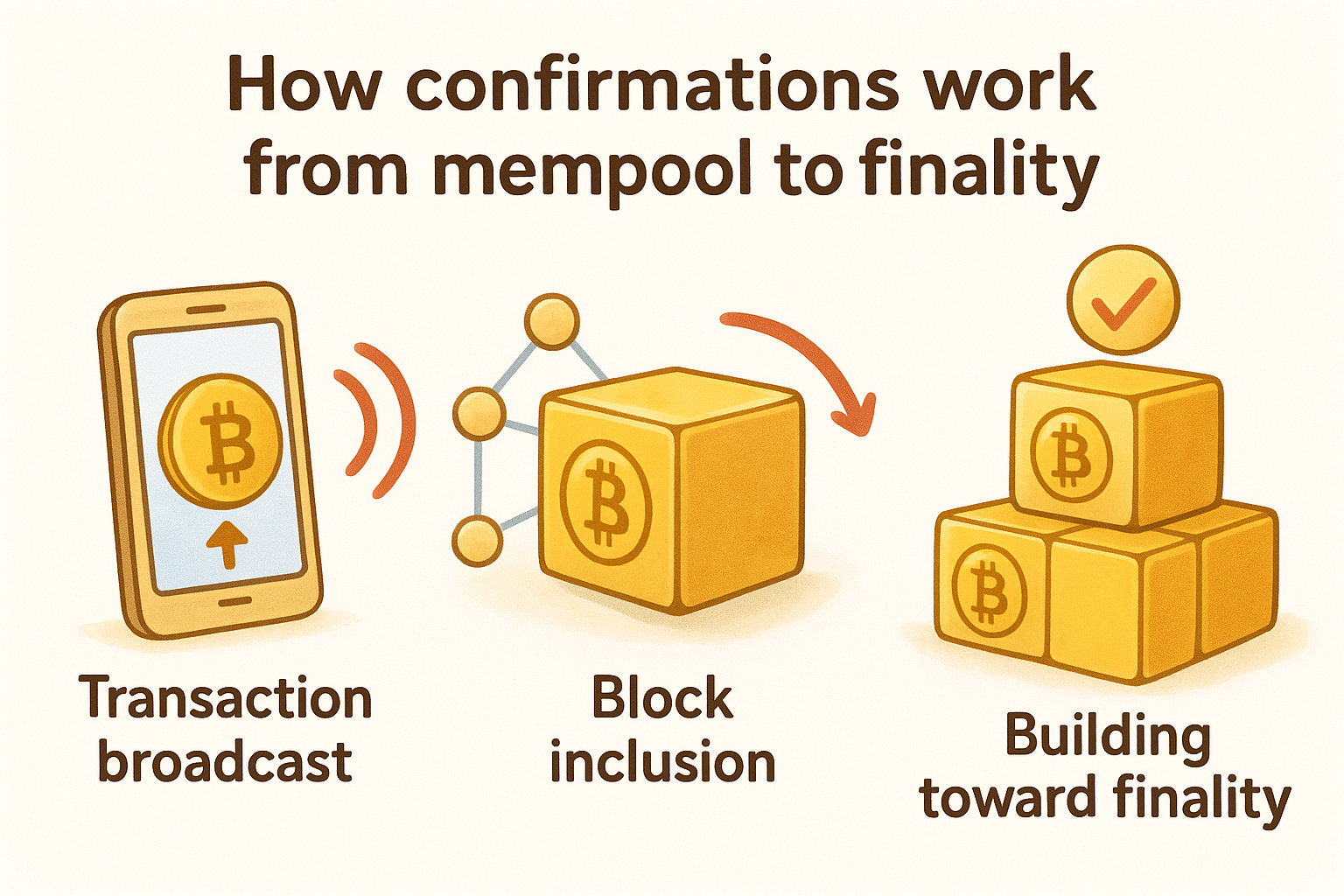
Understanding what are blockchain confirmations requires tracing your transaction through three distinct phases that transform an unverified broadcast into a permanent ledger entry. Your transaction doesn't instantly appear on the blockchain. Instead, it travels through a verification pipeline where network participants validate, prioritize, and permanently record your transfer. This process creates the security layers that prevent fraud and ensure your funds reach their destination without interference.
Transaction broadcast and mempool entry
When you initiate a cryptocurrency transfer, your wallet software broadcasts the transaction to multiple network nodes simultaneously. These nodes verify that you own the funds you're attempting to send and that your digital signature is valid. Approved transactions enter the mempool, a holding area where they wait for miners or validators to select them for inclusion in the next block. Higher transaction fees typically move your transfer toward the front of this queue.
Block inclusion and first confirmation
Miners bundle transactions from the mempool into a new block candidate and compete to solve the cryptographic puzzle required to add that block to the chain. Once a miner succeeds and broadcasts their solution, your transaction receives its first confirmation. The block now exists on the blockchain, but networks don't consider it final yet.
Building toward finality
Subsequent blocks stack on top of yours, adding additional confirmations that exponentially increase security against reversal attempts.
The deeper your transaction sits within the blockchain, the more computational power an attacker would need to rewrite history and reverse your transfer.
Most networks consider transactions practically irreversible after reaching a specific confirmation threshold, which varies by blockchain architecture and security model.
How many confirmations you need for common chains
Different blockchains require different confirmation counts before considering transactions final, based on their consensus mechanisms and security models. Knowing what are blockchain confirmations for your specific network helps you avoid premature spending or unnecessary waiting. Bitcoin typically requires six confirmations for large transactions, while exchanges often demand three to six confirmations before crediting your account. Faster networks achieve finality with fewer confirmations because their block times are shorter or their consensus models offer stronger guarantees.
Bitcoin confirmation requirements
Bitcoin's network needs six confirmations for most high-value transactions because blocks arrive approximately every ten minutes and the proof-of-work model requires substantial depth for security. Merchants accepting Bitcoin for physical goods often wait for one to three confirmations depending on transaction value, while exchanges typically mandate six confirmations before allowing you to trade or withdraw. Small transactions might require only one confirmation if the recipient accepts the minimal risk.
Each confirmation adds roughly ten minutes to your waiting period, meaning full Bitcoin finality takes about one hour under normal network conditions.
Faster alternatives and their considerations
Ethereum requires 12 to 30 confirmations depending on the recipient's security requirements, which translates to approximately three to six minutes given its faster block time. Litecoin achieves similar security with six confirmations in about fifteen minutes total, while networks like Solana reach practical finality within seconds due to their proof-of-stake architecture.
How to check confirmations and handle delays
Most blockchain explorers let you track confirmation status by entering your transaction ID (TXID), which your wallet provides when you initiate a transfer. These tools display real-time confirmation counts and show exactly where your transaction sits in the blockchain. Understanding what are blockchain confirmations means knowing how to monitor them when transfers take longer than expected, which happens during network congestion or when you set transaction fees too low.
Using block explorers to track status
You can paste your TXID into explorers like Blockchain.com for Bitcoin or Etherscan for Ethereum to see current confirmation depth and estimated completion time. These platforms show whether your transaction remains stuck in the mempool or has started accumulating confirmations. Look for the block number containing your transaction and count how many additional blocks have been added since then to verify confirmation progress.
What to do when confirmations stall
Transactions sitting unconfirmed for hours typically indicate insufficient transaction fees relative to network demand. Many wallets support replace-by-fee (RBF), allowing you to rebroadcast the same transaction with higher fees to speed up processing.
If your transaction remains stuck for extended periods, avoid sending additional transfers until the first one confirms, as this can create dependency chains that complicate resolution.
Contact the recipient's support team if their platform shows different confirmation counts than your wallet displays.

Key takeaways
Understanding what are blockchain confirmations gives you critical knowledge for managing cryptocurrency transactions safely. Confirmations represent the number of blocks added to the chain after yours, with each one making reversal exponentially more difficult. You need different confirmation counts depending on the blockchain you're using, with Bitcoin requiring six for full security, Ethereum needing 12 to 30, and newer networks achieving finality within seconds.
Never assume a transaction is complete after just one confirmation unless you're accepting minimal risk on small amounts. Most exchanges and merchants wait for multiple confirmations specifically to protect against double-spend attacks and blockchain reorganizations. You can track your transaction's confirmation status through block explorers using your TXID, and if confirmations stall, check whether you set adequate transaction fees.
Security starts with understanding how blockchain technology actually protects your funds. Visit FinTech Dynasty for more guides on cryptocurrency security, hardware wallet comparisons, and self-custody best practices that keep your digital assets under your control.