

Blockchain Explained for Parents: A Simple Guide
Quick Summary
A blockchain technology explanation for parents starts with one idea: a blockchain is a shared record book that many computers keep at once. Each new block links to the one before it, so changing an old record is very hard. No single company holds the only copy.
- A record is checked by many computers before it is added to the chain.
- Each block stores a fingerprint of the block before it, linking them in order.
- Proof of work uses energy-intensive puzzles; proof of stake uses far less energy.
- Blockchain is the record-keeping system; cryptocurrency is one thing that can run on it.
- Blockchains are tamper-resistant, not tamper-proof, and mistakes entered at the start are permanent.
Table of Contents
- What Blockchain Technology Is in Simple Terms
- How Blockchain Works: Blocks, Chains, and Shared Ledgers
- Blockchain Explained for Kids at Different Ages
- Blockchain Examples in Real Life Beyond Cryptocurrency
- Blockchain vs Cryptocurrency: What Parents Should Know
- A Hands-On Activity and Conversation Guide for Your Family
- Booking Your First Session on FinTech Dynasty
- Frequently Asked Questions
Blockchain Explained for Parents: A Simple Guide
Last Updated: October 28, 2026
What Blockchain Technology Is in Simple Terms
A blockchain technology explanation for parents starts with one idea: a blockchain is a shared record book that many computers keep at once.
Blockchain is a type of 2023 review of blockchain characteristics such as decentralization, time-stamped data and consensus. Think of it as a ledger, which is a list of records. The difference is that no single person or company holds the only copy.
Here is the simple version:
- A record is added to a list
- Many computers check that the record is valid
- Once approved, the record is very hard to change
- Everyone in the network can see the same copy
Blockchain is not the same as cryptocurrency. Bitcoin uses a blockchain, but blockchain can be used for many other kinds of records. We explain that difference later in this guide.
How Blockchain Works: Blocks, Chains, and Shared Ledgers
Blockchain works by grouping records into blocks and linking those blocks in order. Each block holds a set of transactions, and each new block points back to the one before it. That link is what creates the "chain."
Here is how the process usually goes:
- Record: A transaction is written down, such as "Ana sends 5 coins to Ben."
- Verify: Computers in the network check that the transaction is valid.
- Add: The approved transactions are grouped into a new block.
- Link: The new block is attached to the end of the chain.
- Share: Every computer in the network keeps an updated copy.
The part most explanations skip: how blocks actually link
A block is not just a list of transactions. It also contains a short code, often called a hash, that is generated from the block's contents. Change even one character inside the block, and the hash changes completely. Each new block stores the hash of the block before it, so the blocks form a chain where every link depends on the one before.
A simple way to picture it: imagine each page of a notebook ends with a fingerprint of that page. The next page starts by copying that fingerprint. If someone later alters page two, its fingerprint no longer matches the one copied onto page three, and the mismatch is visible to anyone checking.
Who does the checking?
Different blockchains use different methods to agree on which records are valid. Two common patterns are:
- Proof of work: Computers race to solve a hard math puzzle; the winner proposes the next block, and the others verify it. This is the model Bitcoin popularized, and it is energy-intensive by design.
- Proof of stake: Participants lock up coins as a stake and take turns proposing blocks; misbehavior can cost them their stake. This uses far less energy but concentrates influence among larger holders.
Most parents do not need the details, but knowing these two names helps when a child hears them in the news. A review of blockchain technology and applications describes these consensus features, including traceability and consensus, as core to how the systems operate.
Why changing an old record is hard
Because everyone holds a copy, changing one old record would mean changing it on most copies at once, and recomputing every hash that follows it. On a large network, that is impractical. This is why blockchains are described as tamper-resistant rather than tamper-proof: a small or poorly secured network can still be attacked, and mistakes entered at the start are just as permanent as correct entries.
The article lays out the core steps of how a blockchain adds and checks records, and how the two common approaches to agreeing on valid records differ.
| Step | What happens | Note |
|---|---|---|
| Record | A transaction is written down | Example: Ana sends 5 coins to Ben |
| Verify | Computers check the transaction is valid | Done by the network |
| Add | Approved transactions are grouped into a block | Blocks hold a set of transactions |
| Link | New block attaches to the end of the chain | Each block stores the one before's hash |
| Share | Every computer keeps an updated copy | Everyone holds the same record |
| Proof of work | Computers race to solve a math puzzle | Energy-intensive by design |
| Proof of stake | Participants lock up coins as a stake | Uses far less energy |
Blockchain Explained for Kids at Different Ages
Younger kids need a concrete picture. Older kids can handle questions about trust and fairness. Match your explanation to your child's age, and expect to revisit it as they grow. If you want more ways to learn blockchain yourself before explaining it, see practical learning paths for parents.
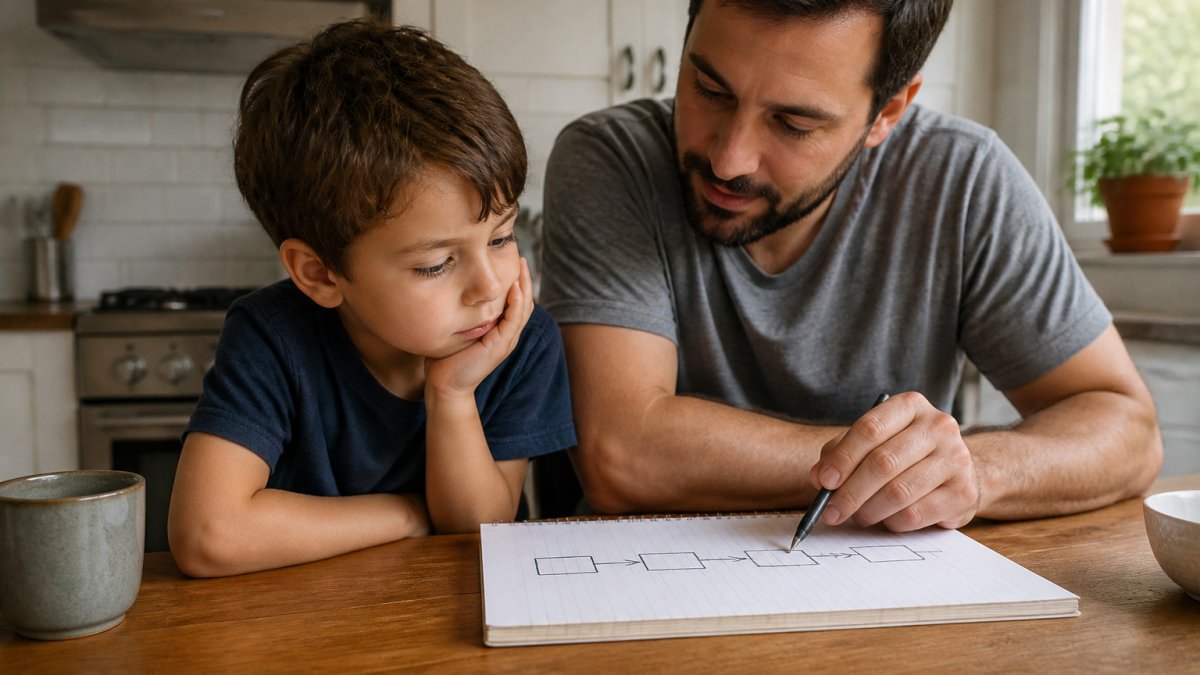
!A parent and young child sitting together at a kitchen table, looking at a simple paper notebook with a row of hand-drawn boxes linked by arrows
Ages 5 to 8: The Shared Class Notebook
Use this exact wording if you like: "Imagine every kid in your class has the same notebook. When one person writes a new line, everybody copies it. If someone tries to erase an old line in their own notebook, the other kids can see it doesn't match."
Try this with your child:
- Draw five boxes in a row on paper
- Write a simple "record" in each box, such as "Mia gave Sam a sticker"
- Draw arrows connecting the boxes
- Ask: "What happens if we change box two?"
Keep it to one idea: many copies make cheating easy to spot. Skip words like "ledger" and "decentralized" at this age.
Ages 9 to 13: Trust Without a Referee
Older kids can understand why a shared ledger matters. In a normal bank, a central company keeps the official record. In a blockchain, no single referee holds that role. The network checks the records together.
A line that works well: "A bank is like one referee keeping the score. A blockchain is like every player keeping the same scorecard and comparing it after every point."
Good questions to discuss:
- Who do you trust more: one person keeping score, or many people checking each other?
- What are the risks if everyone can see the record?
- What could go wrong if the network stops checking?
- If two scorecards disagree, how would the players decide which one is right?
This is also the age to introduce the word "consensus", it simply means the network agreeing on which records are valid.
Ages 14 and up: Trade-offs and Hype
Teenagers can handle the limits. Explain that blockchains are slow compared with ordinary databases, that some use large amounts of electricity, and that "on the blockchain" does not mean "true" or "safe." A record can be permanent and still be wrong, and scams are common.
Questions that land well with teens:
- If a record can never be deleted, what happens when someone posts something they regret?
- Why might a company choose a normal database instead of a blockchain?
- How would you tell a real use case from a marketing slogan?
Blockchain Examples in Real Life Beyond Cryptocurrency
Blockchain is used for more than coins. Many organizations test it for record keeping, supply chains and identity checks. These uses are still developing, so treat early claims with care. To understand digital ownership, learn what NFTs are and their limitations before getting involved.
Some examples include:
- Tracking where food or products come from in a supply chain
- Storing records that need a clear, shared history
- Running automatic agreements called smart contracts
If your child asks about digital art, an overview of how NFTs record ownership on a blockchain is a useful starting point.
Blockchain vs Cryptocurrency: What Parents Should Know
Blockchain is the record-keeping system. Cryptocurrency is one type of digital asset that can run on a blockchain. Bitcoin is the best-known example. To see how coins differ from traditional money, read a clear beginner introduction to digital assets.
A simple way to explain it to kids:
- Blockchain is like the notebook
- Cryptocurrency is like one of the things written in the notebook
Keep these points in mind:
- A blockchain can exist without a coin
- Coins carry price swings and scam risks
- Learning the technology first helps you judge the hype
A Hands-On Activity and Conversation Guide for Your Family
Try this 30-minute family activity:
- Gather supplies: Paper, pencils, and small objects like coins or buttons.
- Set the rules: Each family member gets a "notebook" on paper.
- Make records: Take turns writing small trades, such as "Dad gives Lily two buttons."
- Copy the record: Everyone writes the same entry in their own notebook.
- Try to cheat: Ask one person to change an old entry. Let the others spot the difference.
- Discuss: Ask what made the cheat easy or hard to catch.
Conversation starters:
- Why might a shared notebook be safer than one person's notebook?
- What are some things you would not want stored on a public record?
- How can we tell if an online offer is a scam?
Booking Your First Session on FinTech Dynasty
If you want a structured way to learn about cryptocurrency, blockchain systems and digital asset security, consider the FinTech Dynasty Course. It focuses on education and understanding, with no trading and no hype.

Frequently Asked Questions
How do you explain blockchain technology to a beginner?
Start with a shared notebook. Imagine a group of people each keeping an identical copy of the same record of who paid whom. Every new entry is grouped into a block, and each block is linked to the one before it, forming a chain. Because everyone holds a copy, no single person can quietly change an old entry without the others noticing. Once a beginner grasps that idea of shared, linked records, the rest of the vocabulary becomes much easier to follow.
Is blockchain the same thing as cryptocurrency?
No. Blockchain is the underlying record-keeping technology, while cryptocurrency is one application built on top of it. Bitcoin, for example, uses a blockchain to record its transactions. Many blockchains are used for purposes other than digital money, such as tracking supply chains or recording property ownership. Parents can tell children that the blockchain is the notebook and cryptocurrency is one thing people write in it.
How can parents explain blockchain to children?
Use a concrete analogy, such as a class notebook that every student copies, so no one can erase a classmate's entry unnoticed. Then try a short hands-on activity: have children write a few 'transactions' on paper, pass copies around, and discuss what happens if one copy is changed. Keep explanations matched to age, and pair the discussion with basic safety habits, such as never sharing passwords or recovery phrases.
